

Why Maintenance Matters More When Money Is Tight
When a family budget is under pressure, vehicle maintenance is one of the first line items that gets quietly deferred. A skipped oil change here, a worn wiper blade ignored there - individually each feels minor. Cumulatively, they create the conditions for expensive, unpredictable repair bills at the worst possible time.
The irony is that consistent, low-cost maintenance is one of the most reliable ways to reduce overall car spending. Engine damage from running low on oil, or a blown tyre from worn tread, costs several times more to fix than the service that would have prevented it. For a deeper look at the financial patterns behind this, see our article on why families often spend more on cars than they intended.
The goal isn't to spend more - it's to spend smarter, on the right things, at the right time.
$1,200+
Average annual vehicle maintenance and repair cost per U.S. household
According to the U.S. Bureau of Labor Statistics Consumer Expenditure Survey, vehicle maintenance and repair represents a significant ongoing household expense.
3-4x
Cost multiplier when minor issues become major failures
Industry estimates from ASE-certified mechanics consistently show that deferred maintenance turns small fixes into repairs costing several times more.
88%
Of vehicle breakdowns linked to owner-preventable maintenance lapses
A roadside assistance industry analysis found the large majority of roadside breakdowns involve issues that routine checks could have identified earlier.
Know Your Car's Service Schedule
Every vehicle comes with a manufacturer-specified service schedule, typically found in the owner's manual or a separate service booklet. These intervals - whether measured in miles, kilometres, or months - are not arbitrary. They reflect engineering data about when components typically degrade under normal operating conditions.
Many families operate without ever consulting this document, which means they're either over-servicing (wasting money) or under-servicing (accumulating risk). Our guide to your family car's maintenance schedule, explained breaks down exactly what each interval covers and why it matters.
Key intervals most families should track include:
- Engine oil and filter: Interval varies by vehicle and oil type - check your manual rather than relying on generic rules. Our article on car maintenance myths addresses why the old 3,000-mile rule is outdated for most modern vehicles.
- Tyre rotation and pressure checks: Typically every 5,000-7,500 miles; often available at low or no cost at tyre shops.
- Air filters (engine and cabin): Usually every 15,000-30,000 miles, though dusty driving conditions shorten that. Cabin filters are a common oversight - see routine maintenance items that are easy to overlook.
- Coolant, brake fluid, and transmission fluid: Less frequent but critical; neglecting these leads to component failure.
Prioritise Safety-Critical Tasks First
When budget forces a choice between maintenance items, a clear hierarchy applies: safety-critical components come first, always. These are the systems that protect your family on the road and that, if they fail, create immediate danger rather than just mechanical inconvenience.
- Brakes: Worn brake pads or low brake fluid are non-negotiable fixes. Brake pad replacement is far less expensive than rotor replacement caused by metal-on-metal contact.
- Tyres: Tread depth below the legal minimum (1/16 inch in most U.S. states) and severely under-inflated tyres significantly increase stopping distances and blowout risk, particularly in wet conditions.
- Lights: A failed headlight or brake light is both a safety hazard and a quick way to earn a traffic stop. Bulb replacement is inexpensive and often DIY-friendly.
- Steering and suspension: Unusual noises, vibrations, or pulling to one side warrant prompt professional assessment - these systems are closely linked to vehicle control.
When a shop presents a list of recommended services, ask them to mark each item as 'safety-critical now,' 'advisable soon,' or 'can wait.' This one question turns a stressful conversation into a manageable priority list.
Mechanics often present all recommended work at once, which can feel overwhelming and lead families to either decline everything or overspend on non-urgent items.
Set a phone reminder for a brief monthly tyre pressure check - correct inflation is one of the few maintenance actions that simultaneously improves safety, fuel economy, and tyre longevity.
Tyre pressure naturally drops about 1 PSI for every 10°F drop in temperature, meaning seasonal changes alone can push tyres meaningfully below the recommended level without any visible sign.
Understanding which problems are urgent versus manageable over a few weeks allows families to make informed decisions rather than panicked ones. When in doubt, ask a mechanic to clearly separate safety-critical from recommended items on any service quote.
What You Can Safely Do Yourself
A meaningful portion of routine vehicle care can be done at home by a careful owner with basic tools and the vehicle's owner's manual. These tasks don't require a hydraulic lift or specialist training, and handling them yourself eliminates labour charges entirely.
Tasks that most owners can manage safely include:
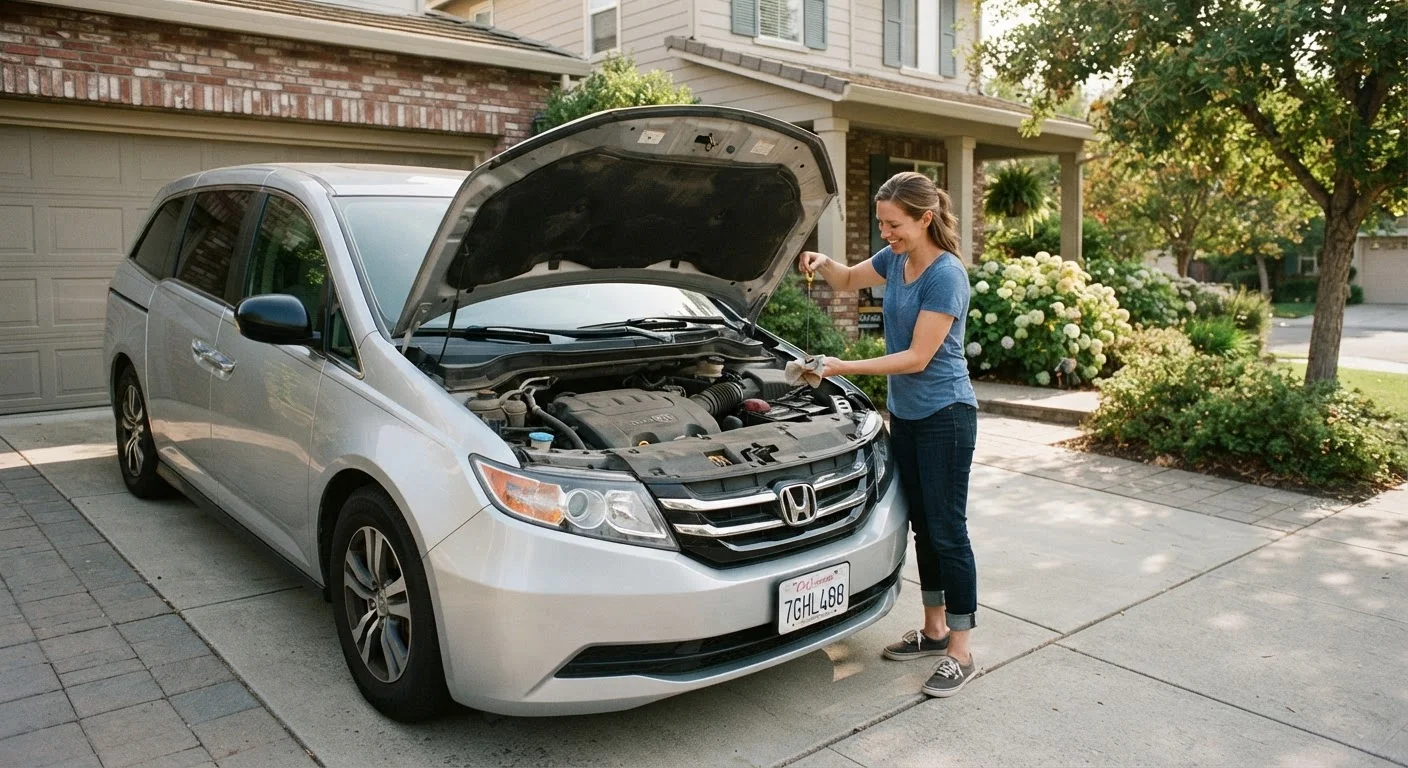
- Checking and topping up engine oil, coolant, brake fluid, power steering fluid, and washer fluid - our detailed walkthrough on fluid levels every family car owner should know how to check covers each one step by step.
- Replacing wiper blades (typically a tool-free clip-and-slide process).
- Swapping out cabin air filters - usually accessible behind the glovebox in a few minutes.
- Checking tyre pressure with an inexpensive gauge and inflating to the figure on the door jamb sticker.
- Replacing interior and exterior light bulbs on most vehicles (consult the manual first - some newer designs require professional access).
For a clear boundary on where DIY stops being sensible, see DIY car maintenance: where it makes sense and where to stop. Brakes, suspension work, and anything involving the fuel or electrical systems generally warrant a qualified mechanic.
Stretching Your Maintenance Budget Further
Even when professional servicing is necessary, there are practical ways to reduce what you spend without compromising quality or safety.
- Get multiple quotes: Labour rates vary considerably between dealerships, national chains, and independent garages. Independent mechanics with strong local reputations often charge significantly less for identical work.
- Ask for itemised quotes: Request a breakdown separating parts, labour, and any shop fees. This lets you identify where costs concentrate and compare accurately across providers.
- Prioritise the urgent, defer the elective: Ask your mechanic to flag which items are safety-critical now versus items that can reasonably wait until your next service without risk.
- Avoid unnecessary add-ons: Some service packages include items like fuel-system flushes or engine treatments that manufacturers don't specifically require. Our piece on common myths about saving money on cars unpacks which add-ons are often not worth the cost.
- Use manufacturer maintenance programs where available: Some vehicles include prepaid or complimentary maintenance for a defined period. Check your purchase documentation if your vehicle is relatively new.
For a broader picture of which maintenance tasks deliver the greatest financial return, routine maintenance that prevents expensive repair bills is worth reading before your next service appointment.
Building a Simple Car Maintenance Routine
Consistency is more valuable than perfection. A simple, repeatable system prevents the drift that leads to missed services and surprise repairs.
Monthly: Do a quick walkaround - check tyre pressure visually and with a gauge, inspect all exterior lights, and glance under the car for any new fluid spots on the driveway. Top up washer fluid as needed.
Every 3 months or 3,000 miles: Check engine oil level and condition (dark, gritty oil is a sign the change interval is approaching). Check coolant level and brake fluid level.
At each service: Record the date, mileage, work done, and cost in a simple notebook or phone note. This log is genuinely useful - it helps you track spending, verify warranty compliance, and demonstrate care to a future buyer. For more on why this record matters, see understanding your car's service history and why it matters.
Seasonally: Review tyre condition, battery health, and fluid levels before major weather changes. Our guide on seasonal car care covers which tasks matter most before summer heat and winter cold.
Families who invest ten minutes a month in basic checks tend to avoid the unpleasant surprise of a breakdown - and the far more unpleasant surprise of an emergency repair bill. That's the straightforward case for making maintenance a household habit rather than an afterthought.
The content provided on our blog site traverses numerous categories, offering readers valuable and practical information. Readers can use the editorial team’s research and data to gain more insights into their topics of interest. However, they are requested not to treat the articles as conclusive. The website team cannot be held responsible for differences in data or inaccuracies found across other platforms. Please also note that the site might also miss out on various schemes and offers available that the readers may find more beneficial than the ones we cover.