

Why 'Safety Rated' Doesn't Mean the Same Thing Twice
Pick up almost any product marketed to families and you'll find some version of a safety claim on the box - a logo, a standard number, a phrase like 'meets or exceeds safety requirements.' The problem is that those phrases can mean radically different things depending on who set the standard, who did the testing, and whether any of it was independently verified.
At the broadest level, safety claims on children's products in the U.S. fall into three categories: mandatory federal requirements, voluntary industry standards, and manufacturer self-declarations. Understanding which category applies to a given product is the first step toward reading any label with confidence. For a deeper breakdown of the specific marks you'll encounter, see our guide on what product safety certifications actually mean.
~900
Children's product recalls issued by CPSC in a recent year
The CPSC regularly issues recalls across toy, furniture, and juvenile product categories; the total varies year to year based on reported incidents and regulatory activity.
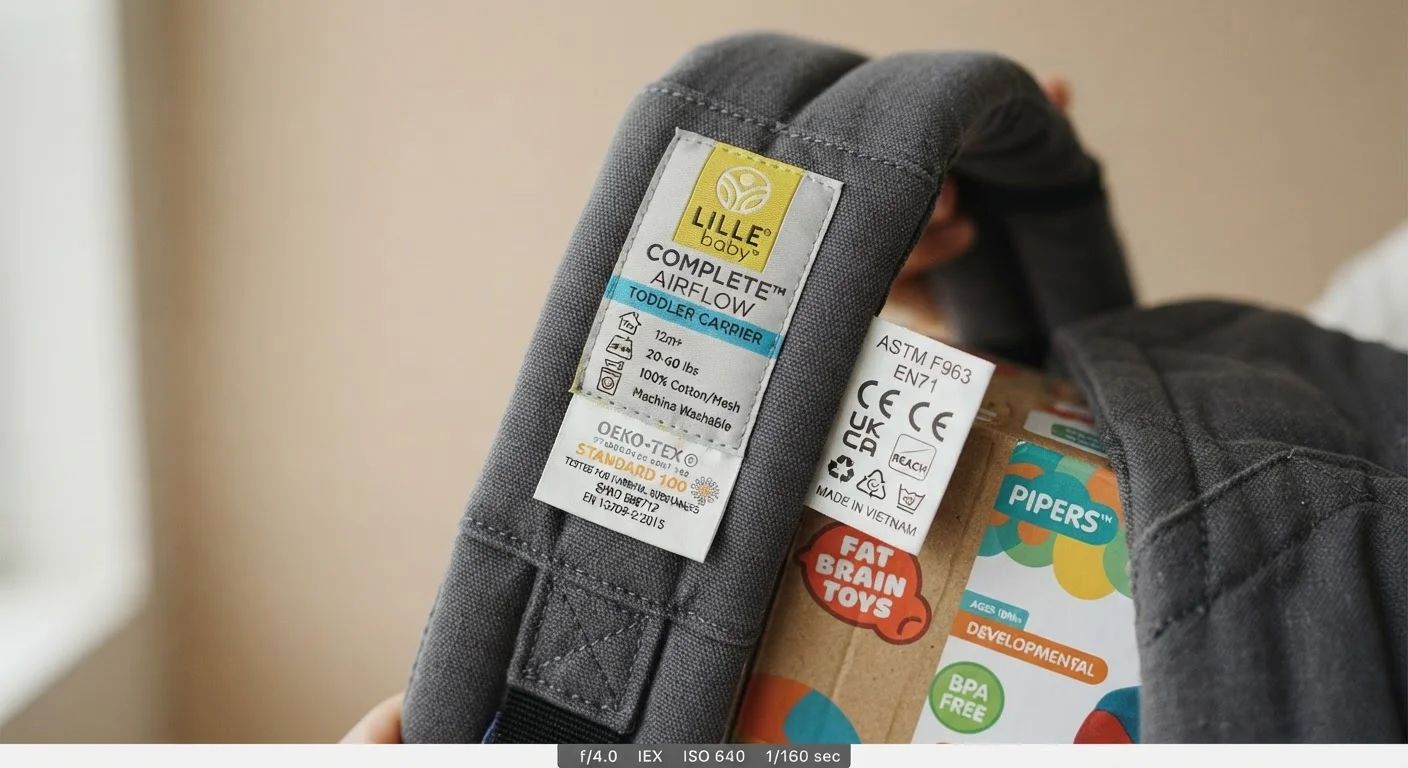
ASTM F963
Primary U.S. toy safety standard
ASTM F963 covers a wide range of physical, mechanical, and chemical hazards in toys; the CPSC has made compliance with it a mandatory federal requirement for toys sold in the U.S.
3rd-party
Testing required for most regulated children's products
Under the Consumer Product Safety Improvement Act (CPSIA), most children's products subject to a mandatory standard must be tested by a CPSC-accepted third-party laboratory before sale.
Mandatory vs. Voluntary: A Meaningful Distinction
The Consumer Product Safety Commission (CPSC) establishes legally binding safety rules for many children's product categories - including cribs, car seats, children's sleepwear, and toys. Products in these categories must comply before they can be sold in the U.S., and most require testing by a CPSC-accepted third-party laboratory. This is mandatory compliance, and it carries real legal weight.
Voluntary standards - published by organizations like ASTM International or the Juvenile Products Manufacturers Association (JPMA) - represent consensus among industry experts about what constitutes responsible design and performance. These are meaningful benchmarks, but participation is not legally required unless the CPSC formally adopts a voluntary standard into its regulations. Some manufacturers meet voluntary standards as a way of demonstrating quality beyond the legal floor; others may cite them selectively.
The practical takeaway: a product that references only a voluntary standard may still be well-made, but it hasn't necessarily cleared a government-mandated bar. Third-party testing versus manufacturer claims explains how to weigh these differences when the label isn't clear.
Look for the Children's Product Certificate
Manufacturers of regulated children's products are required to issue a Children's Product Certificate (CPC) based on third-party testing. Many make these available on their website or will provide them on request. A company that readily shares its CPC - including the testing lab's name and the specific standards tested - is demonstrating a level of transparency worth noting.
What Age Ratings and Warning Labels Are Actually Telling You
The '3+' or '18 months and up' labels on toys are frequently misread as suggestions about developmental appropriateness. They are primarily hazard warnings. Age ratings on children's toys under ASTM F963 - the main U.S. toy safety standard - reflect the presence of small parts that pose choking risks, sharp edges, or other physical hazards that are statistically more dangerous for children below a certain age.
A toy labeled '3+' isn't necessarily too complex for a younger child - it may simply contain components that are unsafe for children who still mouth objects. Conversely, a toy with no age restriction isn't automatically safe for all children; it may just have no regulated hazards within the scope of the standard. For a closer look at how these and other marks get misread, our article on safety labels families commonly misread walks through the most common ones.
The Limits of Any Safety Rating
A safety certification is a snapshot, not a guarantee. It reflects how a product performed against specific tests at a specific point in time. It does not account for how the product is assembled, maintained, combined with other products, or used over years of wear. A car seat that passes federal crash testing is evaluated under controlled laboratory conditions - not every real-world collision scenario.
This matters particularly for products with a long use life. A crib that met the standards of a decade ago may not meet current ones; standards are updated as new hazard data emerges. The CPSC recall database is worth checking for any significant purchase, especially secondhand items, because safety marks are not retroactively removed when a recall is issued.
Material composition is another gap. A product may carry a valid safety rating but still contain substances - such as certain plasticizers or surface coatings - that warrant attention for sensitive populations. Our article on hidden risks in children's product materials covers the most evidence-based concerns in this area.
How to Use This Knowledge Before You Buy
When evaluating a product's safety claims, a few practical questions cut through the noise quickly: Who set the standard - a government regulator or an industry group? Who did the testing - the manufacturer or an independent laboratory? Does the standard cover the specific hazard you're concerned about, or a different risk category entirely?
Products in the Product Safety & Quality space vary enormously in how much transparency manufacturers offer. A company that clearly cites the specific ASTM or CPSC standard number, names the testing laboratory, and makes its Children's Product Certificate (CPC) available on request is showing accountability. Vague language like 'designed with safety in mind' or 'rigorously tested' with no supporting detail is a signal to ask more questions.
For a structured way to apply these checks before any significant purchase, the family safety checklist for new products is a practical starting point. Knowing how to read the label is half the job - the other half is knowing what the label was never designed to tell you.
Frequently Asked Questions
ASTM certification means a product was tested against a specific voluntary industry standard. It reduces certain risks but does not guarantee the product is free from all hazards. The scope of an ASTM standard is narrow - it covers defined test scenarios, not every possible use case.
Manufacturers of children's products must certify compliance with applicable CPSC rules and, for most regulated categories, back that certification with testing by a CPSC-accepted third-party laboratory. The CPSC can test products on the market and issue recalls if they fail. Compliance is a legal baseline, not a seal of excellence.
Not necessarily. Some product categories have no mandatory federal safety standard, so the absence of a label may simply reflect that gap. However, a missing label on a product category where standards do exist - such as car seats or cribs - is a serious red flag.
UL Listed typically applies to products evaluated against UL's own published safety standards, often for electrical safety. UL Certified is a broader designation covering products tested to various applicable standards. Both indicate independent third-party testing, but the scope differs by product type.
Yes. Safety marks reflect evaluation at a point in time and are not automatically removed after a recall. A recall may be issued because of new failure data, field incidents, or design defects discovered after initial certification. Checking the CPSC recall database directly is the most reliable way to verify a product's current status.
For mandatory categories, the CPSC can conduct market surveillance and testing. For voluntary certifications, the certifying body (such as UL or JPMA) may conduct factory audits and re-testing. Self-declared labels from manufacturers have no independent verification unless the product is later tested by a third party.
The content provided on our blog site traverses numerous categories, offering readers valuable and practical information. Readers can use the editorial team’s research and data to gain more insights into their topics of interest. However, they are requested not to treat the articles as conclusive. The website team cannot be held responsible for differences in data or inaccuracies found across other platforms. Please also note that the site might also miss out on various schemes and offers available that the readers may find more beneficial than the ones we cover.