

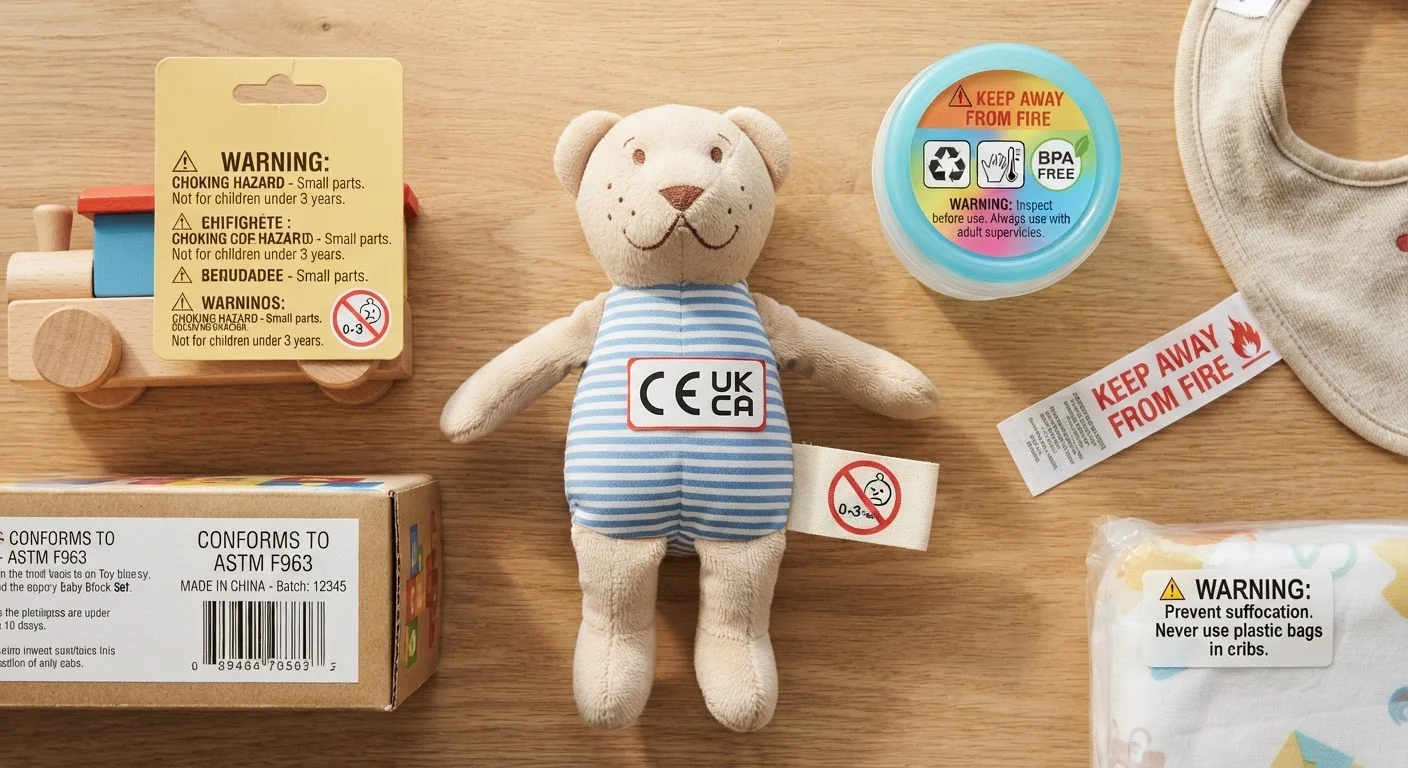
Why Label Language Trips Up Even Careful Shoppers
Safety labels are designed to protect families - but only when readers understand what they actually communicate. The gap between what a label implies and what a standard requires can be surprisingly wide. Marketing language and regulatory language share the same physical space on packaging, which makes it easy to conflate the two.
Understanding these distinctions isn't about being overly cautious; it's about making smarter decisions with the information in front of you. As explored in our article on why families overlook product safety, time pressure and trust in familiar packaging are two of the most common reasons safety details get skimmed instead of read.
The myths below cover the label categories most commonly misread by US families, along with what the relevant standards actually say.
Myth
An age label like "3+" means the toy is appropriate for a three-year-old's developmental stage.
Fact
Age-grading labels are primarily determined by physical safety - specifically choking hazard risk - not developmental appropriateness.
Under ASTM F963, the primary driver of a "3+" designation is whether the product or its parts can fit into a small-parts cylinder, which approximates a young child's airway. A toy labeled "3+" may be developmentally complex for a five-year-old or completely unengaging for a six-year-old - the number has nothing to do with that. Parents should use age grades as a floor for physical safety, not a guide to developmental suitability.
Myth
A "flame-resistant" label means the product won't catch fire.
Fact
Flame-resistant means the material resists igniting or self-extinguishes under specific, controlled test conditions - it does not mean fireproof.
Flame resistance is measured against standardized test methods, such as the California TB 117-2013 standard for upholstered furniture fill materials. A fabric that passes these tests under lab conditions may still ignite under prolonged or intense real-world exposure. The label signals that the product performed adequately in a specific scenario, not that it is immune to fire. Proper fire safety practices at home remain essential regardless of what any label says.
Myth
"Water-resistant" and "waterproof" mean essentially the same thing on product labels.
Fact
These are distinct, defined ratings with different protection thresholds - confusing them can lead to product damage or safety failures.
For electronics, the IEC 60529 IP (Ingress Protection) rating system assigns specific codes - such as IPX4 for splash resistance versus IPX8 for submersion - with precise test conditions for each. A device rated IPX4 can handle light rain; it is not designed to survive a drop in the bath. Many consumer product labels use "water-resistant" loosely without citing a test standard, which gives families no reliable information about actual performance limits. When water exposure matters for safety (car seats, children's electronics, helmets), look for the specific IP rating rather than the marketing description.
Myth
"Child-resistant" packaging means a child cannot open it.
Fact
Child-resistant means a package met a timed test where most young children could not open it - a meaningful portion still succeeded, and older children often can.
Under the Poison Prevention Packaging Act (PPPA), child-resistant closures must be opened by fewer than 80% of children under five within a set timeframe - meaning up to 20% of tested children did manage to open them. The standard also requires that most adults (85%) can open the packaging, which involves engineering trade-offs. "Child-resistant" is an access delay, not a barrier. It should never replace storing medications, cleaning products, and supplements completely out of reach. For more on where these definitions fall short, see our piece on why "child-proof" doesn't always mean what parents think.
Myth
If a product is sold in the US, it has been independently tested for safety before hitting shelves.
Fact
Many product categories sold in the US rely on manufacturer self-certification rather than mandatory third-party testing before sale.
The Consumer Product Safety Commission (CPSC) sets mandatory standards for certain categories - children's sleepwear, cribs, and car seats among them - that do require third-party testing before sale. However, many general consumer products are sold under a self-certification model, where the manufacturer attests compliance without independent lab verification. The CPSC monitors the market through post-sale surveillance and recall authority, but products can reach consumers before any independent review occurs. Recognizing which categories carry mandatory third-party testing requirements helps families prioritize where to look more carefully at label specifics. See also: reading between the lines of a product recall notice.
What Certification Marks Really Confirm
Spotting a mark like UL, ASTM, or CPSC-compliance language tells you something - but not everything. Certification marks confirm that a product met a specific standard at the time of testing, under defined laboratory conditions. They are not blanket guarantees of ongoing safety in every use scenario.
~80%
of child-resistant closures children under 5 could not open
The PPPA standard requires that no more than 80% of tested children under five can successfully open a child-resistant package, meaning the remaining 20% may still gain access.
IPX4-IPX8
Range of common consumer water-resistance ratings
The IEC 60529 IP rating scale spans multiple levels; IPX4 indicates splash resistance only, while IPX8 covers sustained submersion - a significant performance difference often obscured by marketing copy.
Marks from accredited third-party labs generally carry more evidentiary weight than self-declared compliance, because an independent body has audited the test results. For a detailed breakdown of what each major mark actually covers, our guide on what product safety certifications actually mean walks through the key standards families encounter most often.
Self-Declaration vs. Third-Party Certification
A label that says a product "meets safety standards" without naming an independent certifying body may reflect manufacturer self-declaration only. For products used by infants and young children - car seats, cribs, high chairs - federal regulations mandate third-party testing. For other categories, the distinction matters and is worth verifying before you assume independent oversight has occurred.
When a label references compliance without naming the standard number (e.g., "meets applicable safety requirements"), that language is largely uninformative. A meaningful label names the specific standard, such as ASTM F963 for toys or FMVSS 213 for car seats. If that specificity is missing, it's worth researching further before purchase.
For families assessing children's gear more broadly, what "safety rated" actually means on family products provides a practical framework for evaluating what labels do and don't promise.
The content provided on our blog site traverses numerous categories, offering readers valuable and practical information. Readers can use the editorial team’s research and data to gain more insights into their topics of interest. However, they are requested not to treat the articles as conclusive. The website team cannot be held responsible for differences in data or inaccuracies found across other platforms. Please also note that the site might also miss out on various schemes and offers available that the readers may find more beneficial than the ones we cover.