

Why Recall Notices Are Hard to Read
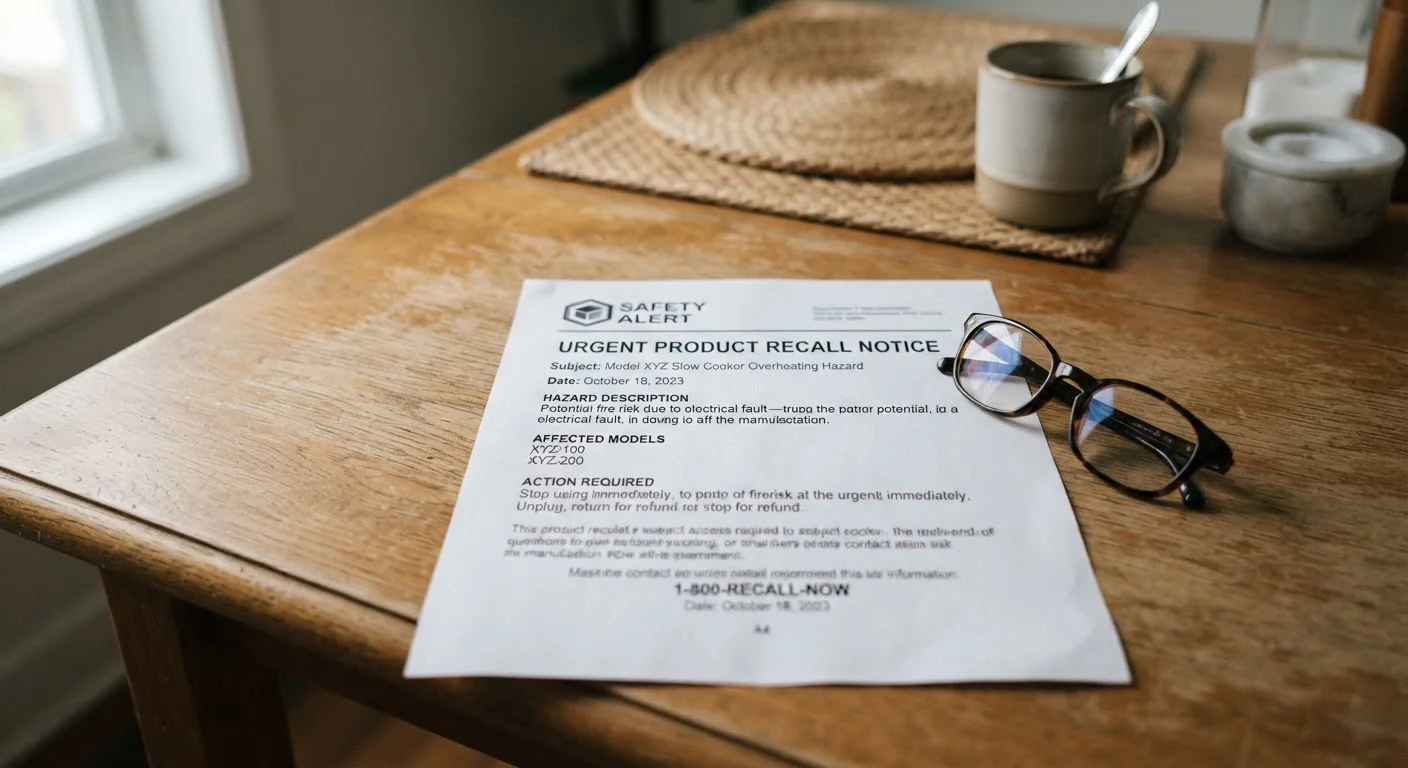
Recall notices are written by legal and regulatory teams, not communication specialists. That means dense passive voice, bureaucratic phrasing, and technical identifiers sit alongside information families urgently need. The result: parents either over-react and discard a safe product, or under-react and keep using something they shouldn't.
Understanding the structure of a notice - what each section is actually telling you - removes most of that confusion. Every recall notice, regardless of the agency issuing it, tends to follow a predictable format covering the hazard, the affected units, and the remedy. Once you know what to look for in each section, the document becomes far more legible.
It also helps to know who issued the notice. In the U.S., consumer product recalls come through the CPSC, food and drug recalls through the FDA or USDA, and vehicle recalls through NHTSA. The issuing agency shapes the language conventions and the remedy options you'll see.
Decoding the Hazard Description
The hazard section is the most important part of any recall notice - and the most frequently misread. Two phrases to distinguish immediately: "can cause" versus "poses an unreasonable risk of." The first implies a documented occurrence; the second is often precautionary, based on design analysis rather than reported injuries.
Look for the incident and injury count. A notice reporting zero injuries with thousands of units sold describes a very different risk profile than one reporting dozens of emergency room visits. Neither is trivial, but your response - especially the urgency of stopping use - should be calibrated accordingly.
Also note the conditions under which the hazard occurs. A product recalled because it poses a choking risk when a specific detachable part is removed is not the same as one that poses a spontaneous fire risk. If the hazard only activates in a specific, avoidable scenario, that context matters for how you manage the interim period before completing the remedy.
Voluntary vs. Mandatory Recalls
Most consumer product recalls in the U.S. are voluntary - meaning the manufacturer initiates them, typically in cooperation with the CPSC. Mandatory recalls are ordered by the agency when a company does not act voluntarily. Both types carry the same consumer obligations, but voluntary recalls are far more common and do not imply the hazard is less serious.
Identifying Whether Your Unit Is Actually Affected
A recall notice covers a defined subset of units - not every product ever made under that name. The affected-units section will list some combination of: model numbers, UPC or SKU codes, date-of-manufacture ranges, and lot or batch codes. These identifiers are typically printed on the product's base, back panel, or inside a battery compartment.
Cross-reference carefully. A model number that differs by a single letter or digit may or may not be included. When in doubt, the manufacturer's recall hotline (always listed in the notice) can confirm whether your specific unit qualifies. This matters because claiming a remedy for an unaffected unit wastes time, and - more importantly - assuming you're not affected when you are keeps a hazardous item in use.
If you no longer have the product's packaging, the model number stamped on the item itself is usually sufficient. For a step-by-step method for searching official databases, that guide walks through exactly how to match identifiers against government records.
Understanding What the Remedy Actually Offers
Recall notices offer one or more of three remedies: a full refund, a free repair, or a replacement product. These are not equivalent in terms of protection or inconvenience.
- Refund: Returns your money and removes the hazard entirely. The most complete outcome, though it requires sending back or disposing of the item.
- Repair: A technician or mailed kit addresses the specific defect. Evaluate whether the fix genuinely resolves the hazard or only partially mitigates it - the notice's hazard description helps you assess this.
- Replacement: You receive a new or updated version of the product. Confirm whether the replacement model has the same defect corrected or is simply a newer production run.
Processing times vary. Some remedy programs are resolved within days; others take weeks because of parts availability or high claim volume. Ask when you contact the manufacturer so you can plan appropriately - particularly if the recall requires you to stop using the item immediately.
Register Products at Purchase
Registering a new product with the manufacturer - using the card included in the box or the brand's website - means you'll be notified directly if a recall is issued. This is especially valuable for items like car seats, cribs, and high chairs where recall response times matter most.
Putting the Notice in Context
A single recall notice doesn't tell you everything about a product's overall safety record. A brand with one recall on a specific part isn't inherently less reliable than one with no recalls - sometimes it signals a more transparent safety monitoring process. Conversely, repeat recalls on the same product line or hazard type are worth noting.
Building better habits around product safety - before and after purchase - reduces the stakes of any individual notice. Our family safety checklist for new products covers what to check at the point of purchase, and understanding why families skip safety checks helps identify the habits that leave gaps. Recall notices are one signal in a larger picture - reading them accurately keeps that picture in focus.
This article is for general informational purposes only and does not constitute legal or safety advice. For product-specific guidance, contact the manufacturer or the relevant safety agency directly.
Frequently Asked Questions
Not always. Recalls range from urgent stop-use orders to precautionary notices about low-probability risks. Read the hazard description carefully - it will indicate whether continued use poses an imminent danger or a risk that only occurs under specific conditions.
Recall notices include identifiers such as model numbers, UPC codes, date-of-manufacture ranges, or lot codes. These are usually found on the product's label, bottom panel, or packaging. Compare them directly to the notice's affected-unit description.
You typically don't need a receipt. Most recall programs accept proof via model number, a photo of the product, or a brief registration form. Contact the manufacturer's recall hotline listed in the notice for guidance specific to that program.
Remedies proposed in a recall are reviewed by the relevant safety agency before they are announced. A repair fix, for example, must address the identified hazard. That said, if you have doubts about a remedy's adequacy, you can submit feedback to the overseeing agency.
The CPSC database at recalls.gov is a central resource for consumer product recalls. For food, use the FDA or USDA recall portals. For vehicles, check NHTSA's SaferCar database. See our guide on <a href="/smart-shopping/product-safety-quality/verifying-a-product-recall-how-to-search-official-databases">searching official recall databases</a> for a step-by-step walkthrough.
Selling or donating a recalled product is generally inadvisable and in some cases illegal, particularly for children's items. The CPSC prohibits the resale of recalled children's products, and many resale platforms have policies against listing them.
The content provided on our blog site traverses numerous categories, offering readers valuable and practical information. Readers can use the editorial team’s research and data to gain more insights into their topics of interest. However, they are requested not to treat the articles as conclusive. The website team cannot be held responsible for differences in data or inaccuracies found across other platforms. Please also note that the site might also miss out on various schemes and offers available that the readers may find more beneficial than the ones we cover.