

Start here
How a Newborn Changes Your Role as a Driver
Essential safety
Car Seat Basics Every Parent Needs to Know
Know the risk
Sleep Deprivation and Driving: A Real Risk
Daily habits
Managing Distractions with an Infant On Board
Put it together
Planning Trips Around Your Baby's Needs
How a Newborn Changes Your Role as a Driver
Bringing a newborn home reframes almost everything, including how you drive. Before, mistakes behind the wheel had consequences for you and other road users. Now, there's a passenger who depends entirely on your decisions, cannot communicate danger, and is physiologically more vulnerable than any adult in the car.
This shift in responsibility isn't abstract. It shows up in concrete ways: you're more alert to road surface, braking distance, and how hard corners are taken. Some parents describe feeling almost hyper-aware in the first weeks. Others feel overwhelmed. Both responses are normal - but neither should distract from the mechanics of driving safely.
The Family Road Safety Playbook offers a broader framework for building household driving habits. For parents of newborns specifically, the most immediate priorities are correct seat installation, managing fatigue, and minimizing in-car distraction.
LATCH system
A standardized set of anchors built into vehicles and car seats that simplifies installation without using the vehicle's seat belt. It has combined weight limits (child plus seat) that vary by vehicle.
Child Passenger Safety Technician (CPST)
A nationally certified professional trained to inspect and correctly install child restraint systems. Many offer free checks at fire stations, hospitals, or community events.
Rear-facing orientation
A car seat position where the child faces the rear of the vehicle. This distributes crash forces across the child's back and head, and is the required position for all infants.
Drowsy driving
Operating a vehicle while fatigued or sleep-deprived. It measurably slows reaction time and impairs judgment, making it a significant and underrecognized road safety hazard.
Recline angle
The specific tilt at which an infant seat must be set to keep a newborn's head from falling forward and restricting their airway. The correct angle is specified in the seat's instruction manual.
Car Seat Basics Every Parent Needs to Know
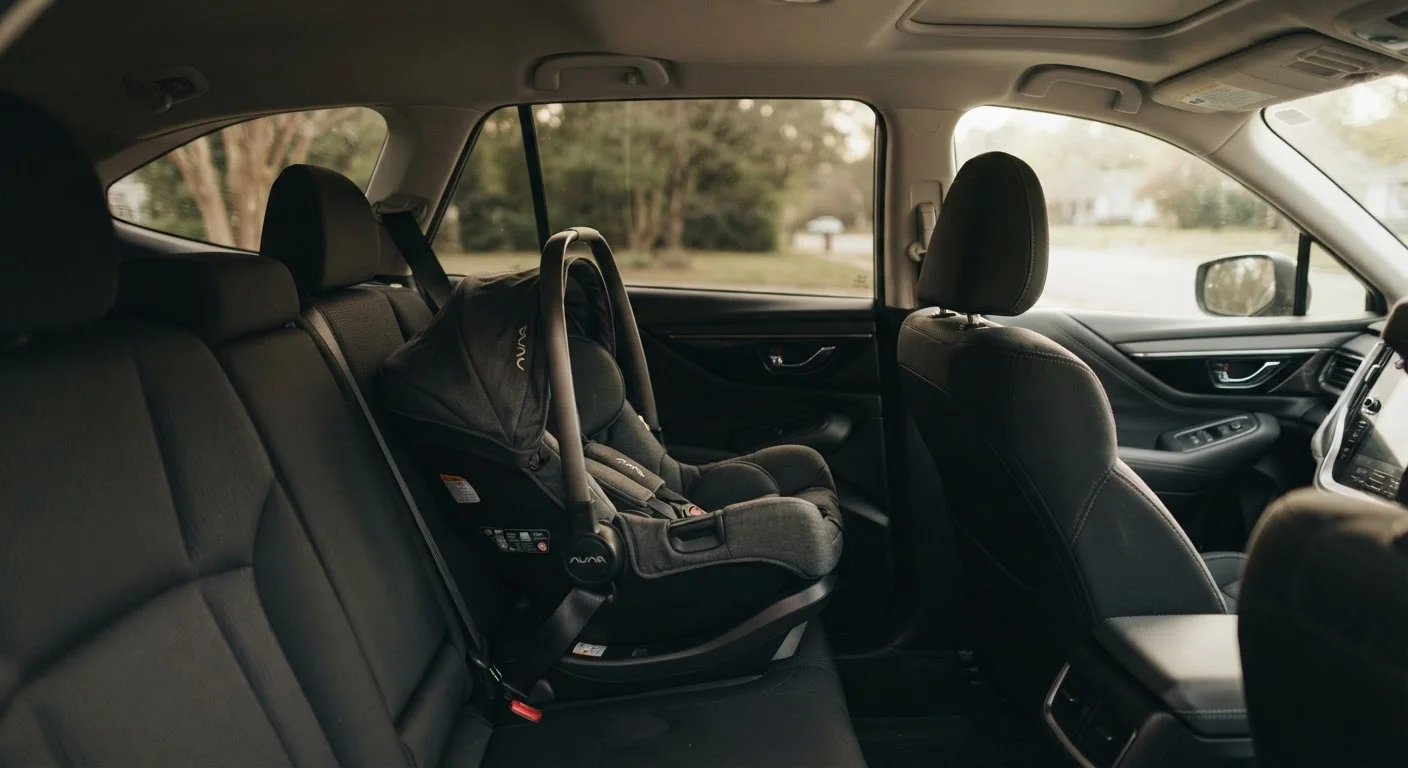
An infant car seat that isn't installed correctly provides significantly less protection than one that is. Research from the National Highway Traffic Safety Administration (NHTSA) has consistently found that a large proportion of child restraints are misused in some way - harness too loose, wrong recline angle, or seat placed in an airbag-active front position.
For newborns, the rules are clear: rear-facing, in the back seat, away from active airbags. The seat's recline angle matters too - most infant seats require a specific angle to keep a newborn's airway open during travel. Check both the seat manual and your vehicle owner's manual, as installation varies by car model.
The LATCH system (Lower Anchors and Tethers for Children) simplifies installation in many vehicles, but it has weight limits that include the child and seat combined. Beyond those limits, the seat belt installation method is typically required. Many fire stations and certified Child Passenger Safety Technicians (CPSTs) offer free installation checks - this is worth doing before the baby's first trip.
For a side-by-side comparison of how different seat orientations protect children at different stages, see our guide on rear-facing vs. forward-facing car seats. And for the full progression from infant to booster, car seat stages explained walks through each transition point.
Get a free seat check before baby arrives
Many hospitals, fire departments, and community organizations offer free car seat inspection events staffed by certified Child Passenger Safety Technicians. Getting your seat checked before your due date means you're not rushing the installation on the day you bring your baby home. Search the NHTSA website for inspection stations near you.
Sleep Deprivation and Driving: A Real Risk
New parents lose significant sleep - studies suggest new parents average substantially fewer hours per night in the first months, with multiple overnight wake-ups fragmenting what sleep they do get. Drowsy driving is not a minor inconvenience. Research published in peer-reviewed traffic safety journals has found that being awake for 18 consecutive hours produces driving impairment comparable to a blood alcohol concentration of 0.05%, and 24 hours without sleep pushes that comparison toward 0.10% - above the legal limit in every US state.
Warning signs while driving include: difficulty keeping eyes open, drifting between lanes, missing turns you know well, and an inability to recall the last few miles driven. If any of these occur, the only safe response is to stop.
Practical strategies include: swapping driving duties with a co-parent when possible, timing longer errands to follow rest periods, and being honest with yourself about your state before getting in the car. Night driving compounds fatigue risk - our article on night driving with the family covers this in detail.
Drowsy driving is not a judgment call
If you're showing signs of impairment from fatigue - heavy eyelids, lane drift, memory gaps - do not try to push through. Pull over in a safe, well-lit location and rest, or contact someone to take over the drive. The stakes are higher with an infant in the vehicle, but drowsy driving is dangerous regardless of who is in the car.
Managing Distractions with an Infant On Board
An infant introduces a category of distraction that most drivers haven't experienced before: an urgent sound you're instinctively wired to respond to. Crying triggers parental stress responses that can compete directly with focus on the road. Reaching back, turning around, or handing something to the baby while driving are all forms of manual and visual distraction.
The practical rules are simple, though not always easy to follow:
- Don't reach back while moving. If the baby needs attention, find a safe place to pull over.
- Set up before you drive. Pacifiers, blankets, and comfort items should be within the baby's reach before the trip begins - not retrieved at 40 mph.
- Mute or reduce non-essential alerts. Your phone and navigation should be configured before you leave the driveway.
- Use a co-pilot when possible. Having another adult in the car during the early weeks is the single most effective way to keep the driver focused.
Common driving habits that seem minor can significantly raise risk when combined with infant-related distraction. Our article on habits that quietly make family driving more dangerous is worth reading alongside this one.
Planning Trips Around Your Baby's Needs
Unplanned, rushed driving trips are higher-risk trips. With a newborn, it pays to think through even short journeys before starting the engine.
Most newborns travel best when recently fed and dry. Timing trips around feed schedules reduces the chance of sustained crying mid-journey. For longer drives, plan rest stops every 1-2 hours - both to attend to the baby and to give the driver a break. Pediatric guidance generally suggests limiting continuous car seat time to around two hours for newborns, given the semi-reclined position's effect on breathing. Always consult your pediatrician about your specific baby's needs.
Keep a small bag in the car stocked with essentials: diapers, a change of clothes, a feeding item if applicable, and a pacifier if your baby uses one. Being prepared means fewer moments of scrambling - and fewer distractions when something unexpected happens.
For longer family trips, the principles in our guide on long-distance road trips with kids scale up from these foundations. The habits you build now - deliberate preparation, fatigue awareness, distraction management - form the basis of safer family driving for years ahead.
This article provides general safety information for educational purposes. It is not a substitute for guidance from your pediatrician, a certified Child Passenger Safety Technician, or other qualified professional regarding your specific vehicle and child's needs.
Frequently Asked Questions
The vehicle itself is ready, but the driver may not be. New parents are often running on little sleep and high emotion. If you feel impaired, fatigued, or unsteady, wait until another adult can drive or until you've rested. The car seat must be correctly installed before the first trip - check this before discharge day.
Car safety experts generally advise against using a second-hand seat unless you can verify its full history. Seats involved in any crash - even a minor one - may have invisible structural damage. If the seat's manufacture date, expiry date, or crash history is unknown, err on the side of a new seat.
Most pediatric health bodies recommend limiting continuous time in an infant car seat to around two hours at a stretch, as the semi-reclined position can affect a newborn's breathing. For longer journeys, plan breaks to remove the baby from the seat. Always consult your pediatrician with specific concerns about your baby's needs.
Rear-facing mirrors marketed for checking on infants can be useful, but glancing at them while driving is still a visual distraction. If you need to check on your baby, pull over. The mirror is not a substitute for a second adult passenger who can monitor the baby directly.
Do not attempt to reach back or comfort the baby while moving. Acknowledge the sound calmly, signal, and exit the road or find a safe parking area as soon as it is practical to do so. Pulling over briefly is far safer than driving while distracted.
The transition from rear-facing to forward-facing should be guided by the seat manufacturer's weight and height limits, not by age alone. Rear-facing remains the safer orientation for as long as the seat allows. See our detailed explainer on <a href="/cars-driving/safe-family-driving/rear-facing-vs-forward-facing-car-seats-understanding-the-safety-difference">rear-facing vs. forward-facing seat differences</a> for more guidance.
The content provided on our blog site traverses numerous categories, offering readers valuable and practical information. Readers can use the editorial team’s research and data to gain more insights into their topics of interest. However, they are requested not to treat the articles as conclusive. The website team cannot be held responsible for differences in data or inaccuracies found across other platforms. Please also note that the site might also miss out on various schemes and offers available that the readers may find more beneficial than the ones we cover.