

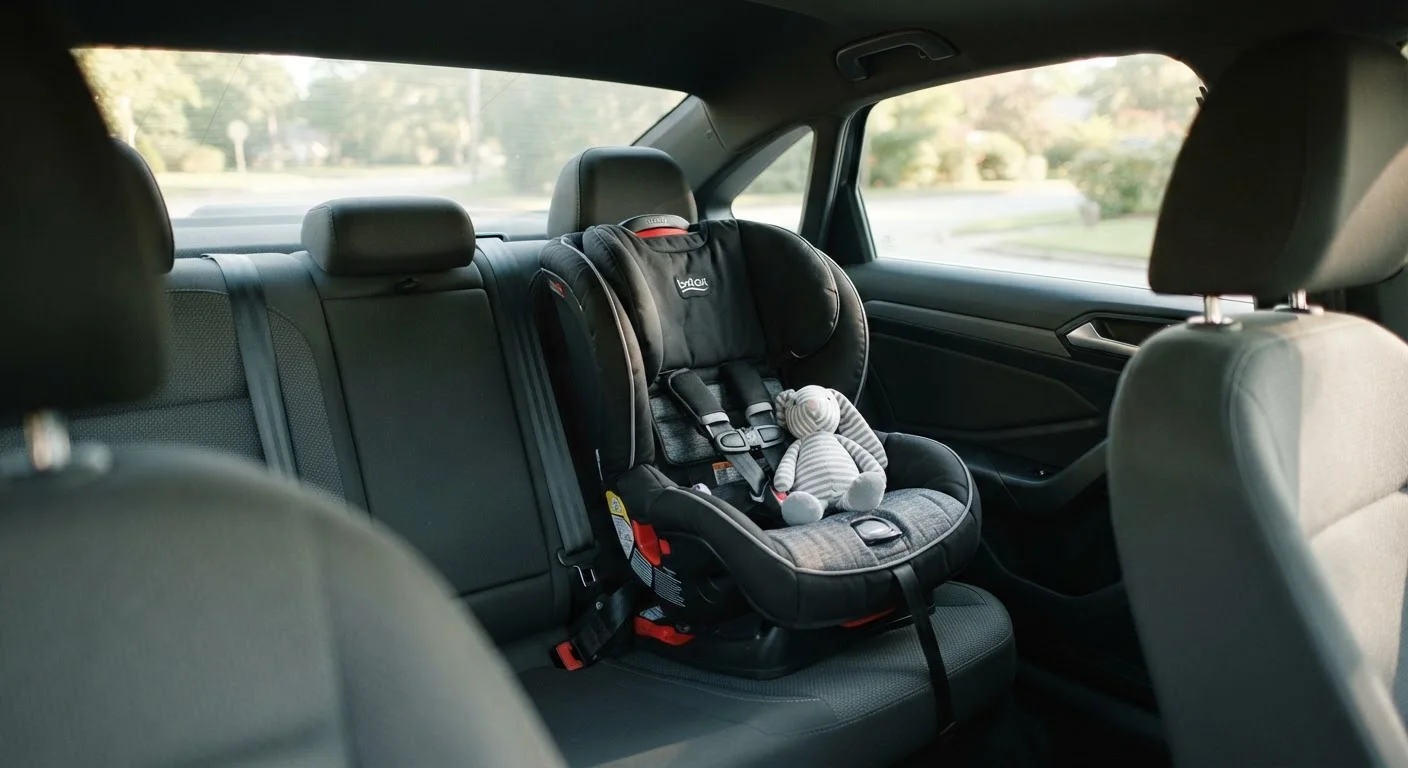
Stage 1: Rear-Facing Seats
Rear-facing car seats are the starting point for every child and the most protective configuration available for infants and toddlers. In a frontal crash - the most common and severe type - a rear-facing seat cradles the head, neck, and spine together, spreading crash energy across the entire back rather than allowing the head to snap forward.
Infant-only seats are designed specifically for newborns and smaller babies, typically up to 22-35 lbs depending on the model. Convertible seats can also start in rear-facing mode and accommodate larger infants, often up to 40-50 lbs rear-facing, making them a longer-term investment.
The key rule: keep your child rear-facing until they reach the seat's stated height or weight limit - whichever comes first. This is not an age milestone. Many children can remain safely rear-facing until age 3 or 4. See our guide to driving with newborns and infants for practical advice on managing early trips with a rear-facing seat installed.
Register Your Car Seat After Purchase
Registering your seat with the manufacturer ensures you receive safety recall notices promptly. Recalls on car seats are not uncommon, and an unregistered seat means you may never learn about a safety issue. Visit the manufacturer's website or complete the registration card included in the box.
Stage 2: Forward-Facing Seats with Harness
Once a child outgrows the rear-facing limits, a forward-facing seat with an internal harness is the appropriate next step. The five-point harness distributes crash forces across the shoulders, hips, and chest - the five strongest points of a child's body - providing substantially more protection than a booster and seat belt at this size.
Forward-facing seats typically accommodate children from roughly 20 lbs up to 65-90 lbs, depending on the seat. Some combination seats extend harness use to 120 lbs. Parents are encouraged to keep children in the harness configuration for as long as the seat allows rather than rushing to a booster.
~46%
Car seats used incorrectly
NHTSA estimates that nearly half of all car seats observed in studies show some form of misuse, most commonly harness slack or incorrect installation.
71%
Crash fatality reduction - rear-facing infants
According to NHTSA data, rear-facing car seats reduce the risk of fatal injury for infants up to 71% compared to riding unrestrained.
~77%
Injury risk reduction with booster vs. belt alone
Research cited by the Centers for Disease Control and Prevention (CDC) indicates children in booster seats have roughly 45% lower injury risk than those using seat belts alone - rising higher in some studies.
Installation matters as much as the seat itself. The harness must be snug, the chest clip at armpit level, and the seat anchored using either the LATCH system or vehicle seat belt - not both simultaneously unless the manufacturer explicitly allows it. When in doubt, have a certified technician verify your setup.
Stage 3: Booster Seats
Booster seats do one specific job: they lift a child so the vehicle's adult seat belt fits correctly. Without a booster, the lap belt typically cuts across the soft abdomen rather than the upper thighs, and the shoulder belt crosses the face or neck - both of which can cause serious internal injuries in a crash.
There are two main types. High-back boosters provide head and neck support and are suited for younger children or vehicles without headrests. Backless boosters are appropriate for older, taller children who can maintain correct sitting posture throughout a journey.
Children generally use a booster until they are at least 4 feet 9 inches tall and can pass the five-step test: back flat against the seat, knees bent naturally at the seat edge, lap belt across upper thighs, shoulder belt crossing the chest and shoulder, and able to stay in that position for the entire trip. For more on managing older children safely in the vehicle, see why children in the back seat still need adult supervision.
LATCH Has Weight Limits Too
The LATCH (Lower Anchors and Tethers for Children) system simplifies installation but is not always rated for heavier children. Most LATCH anchor systems are tested to a combined child-plus-seat weight of 65 lbs. Once your child exceeds the system's limit, switch to the seat belt installation method described in your car seat manual.
Stage 4: Seat Belt Only
The final stage is a properly fitting adult seat belt - and it should never arrive early. Most children are not ready until somewhere between ages 8 and 12, depending on their physical development. Size, not birthday, is the determining factor.
All children under 13 should continue riding in the back seat regardless of stage. The back seat remains the safest position in virtually all crash scenarios. For longer highway trips, this is especially relevant - our guide to motorway driving with children covers positioning and emergency procedures in detail.
Once a child moves to a seat belt alone, remind them regularly: lap belt across the upper thighs, shoulder belt across the chest and collarbone, never tucked behind the back or under the arm. Improper belt positioning reduces protection significantly and can cause what safety researchers call submarining - sliding under the lap belt in a crash.
This article is for general informational purposes. Always consult your car seat manual, vehicle owner's guide, and a certified Child Passenger Safety Technician for guidance specific to your child and vehicle.
Frequently Asked Questions
When your child reaches the maximum height or weight limit printed on the rear-facing seat - not before. Many modern convertible seats allow rear-facing up to 40-50 lbs, which for most children means age 3 or older. The AAP recommends staying rear-facing as long as the seat allows.
Backless boosters are appropriate for older, more mature children who can sit properly for an entire trip. High-back boosters provide additional head and neck support and are generally recommended for younger children or vehicles with low seat backs. Check the seat's manual for specific age and weight guidance.
The harness should pass the pinch test - you should not be able to pinch any excess webbing at the child's collarbone. Straps should lie flat, not twisted, and the chest clip should sit at armpit level. A loose harness significantly reduces crash protection.
It can be risky. Car seats have expiration dates (typically 6-10 years from manufacture) and should never be used after a moderate or severe crash. Without a complete history of the seat, verifying its condition is difficult. Check the seat's label and contact the manufacturer if uncertain.
Age is less important than size. A child is generally ready when they are at least 4 feet 9 inches tall, can sit with their back flat against the vehicle seat, knees bent comfortably at the seat edge, and the lap belt rests across the upper thighs - not the stomach.
The National Highway Traffic Safety Administration (NHTSA) maintains a searchable directory of inspection stations at nhtsa.gov. Certified Child Passenger Safety Technicians (CPSTs) can inspect and correct installations free of charge at many locations including fire stations, hospitals, and retail events.
The content provided on our blog site traverses numerous categories, offering readers valuable and practical information. Readers can use the editorial team’s research and data to gain more insights into their topics of interest. However, they are requested not to treat the articles as conclusive. The website team cannot be held responsible for differences in data or inaccuracies found across other platforms. Please also note that the site might also miss out on various schemes and offers available that the readers may find more beneficial than the ones we cover.