

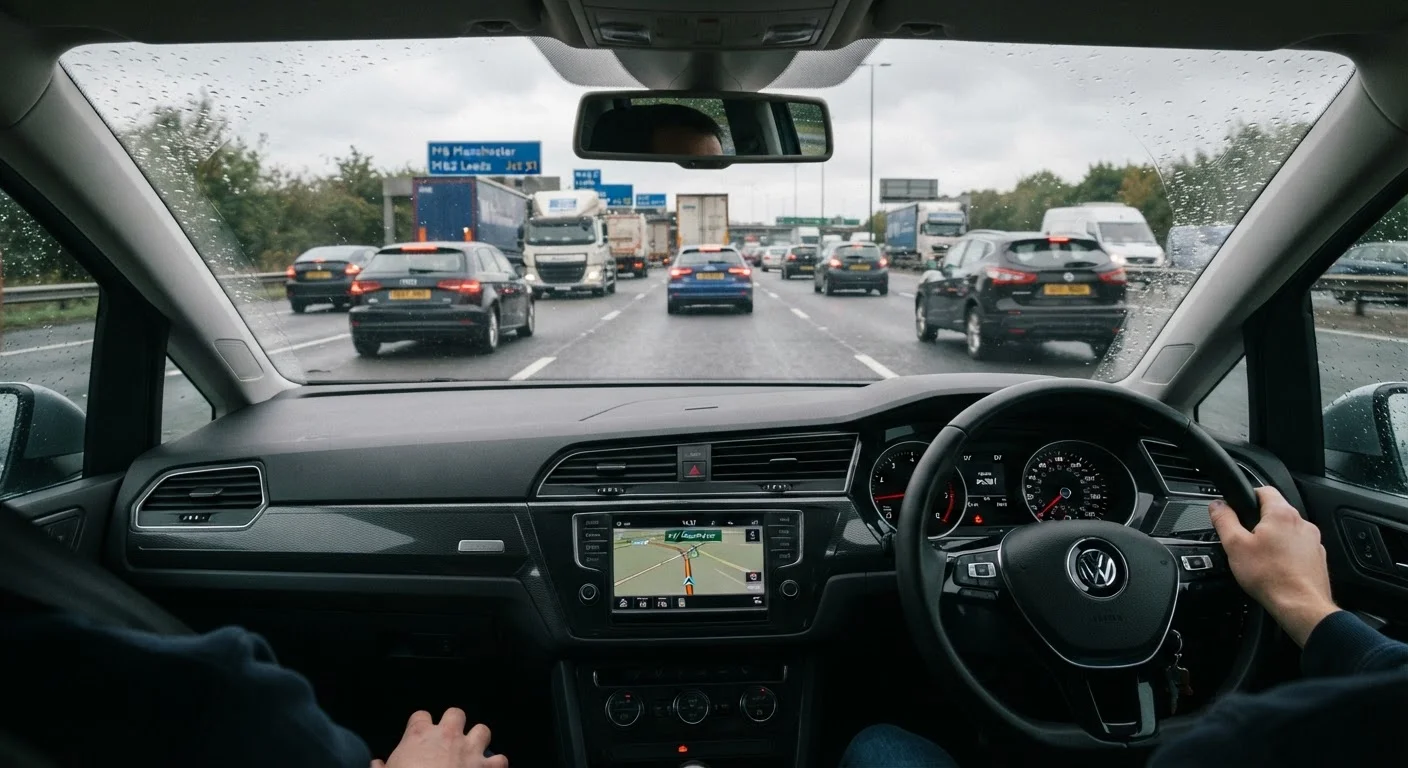
Why Motorway Skills Deserve Dedicated Attention
Motorways in the U.S. - interstate highways and limited-access freeways - carry traffic at sustained high speeds, often 65-75 mph. At those speeds, the margin for error shrinks considerably. A reaction delay of just one second translates into roughly 100 feet of unchecked travel. When children are on board, in-cabin distractions increase, which makes deliberate technique even more important.
The good news: controlled-access highways are statistically among the safer road types per mile traveled, partly because opposing traffic is separated and pedestrians are excluded. But that safety record depends on drivers following predictable, disciplined behavior - merging correctly, maintaining lane position, and knowing exactly what to do when something goes wrong.
See the Family Road Safety Playbook for a broader framework of safer family driving habits that complement the motorway-specific skills covered here.
Merging Onto the Highway: Technique and Timing
The on-ramp exists to let you match highway speed before you enter the travel lanes - not to ease gradually into traffic at 40 mph. Accelerate through the acceleration lane to match the prevailing flow before the merge point. Signal early, check your mirrors and blind spot, and choose a gap rather than forcing one.
With children in the vehicle, the merge moment is especially vulnerable. Avoid adjusting the radio, responding to backseat requests, or glancing at a navigation screen during the final 15-20 seconds of the ramp. If your vehicle has a blind-spot monitoring system, treat it as a supplement to a physical shoulder check - not a replacement.
On busy highways, if no gap is available, it is sometimes necessary to briefly slow at the merge point rather than dart across. This is a judgment call, but keeping the vehicle controlled is always preferable to a forced merge.
Acceleration Lane
The dedicated lane at a highway on-ramp designed to allow drivers to reach highway speed before merging into live traffic. It is not intended as a slow-merge zone.
Three-Second Rule
A following-distance guideline: choose a fixed roadside point and ensure at least three seconds pass between when the vehicle ahead passes it and when yours does. Increase to four or more seconds in adverse conditions.
Blind Spot
The area beside and slightly behind a vehicle that is not visible in the driver's mirrors. Always supplement mirror checks with a physical shoulder glance before changing lanes.
Fog Line
The solid white line marking the right edge of the travel lane on a highway. Stopping beyond this line on the shoulder places the vehicle further from moving traffic.
Hazard Lights
The four-way flashing indicator lights activated simultaneously to signal to other drivers that the vehicle is stationary or presenting a hazard. Should be activated immediately upon an emergency stop.
Lane Discipline at High Speed
In the U.S., the left lane on a multi-lane highway is widely - and in many states legally - reserved for passing. Driving at or below the flow of traffic in the left lane creates hazardous overtaking on the right. Keep right except to pass; once you have passed, return to the right lane promptly.
Maintain consistent following distance. The general rule taught in driver education is the three-second rule: pick a fixed point ahead, count three full seconds from when the vehicle in front passes it to when yours does. At highway speeds and with a loaded family vehicle, four seconds is a safer target. Wet or poor-visibility conditions warrant even more distance.
Children can make consistent lane discipline harder simply through noise and movement. Establish pre-trip rules: significant requests wait for a safe moment, and the driver should never turn to face the backseat while in motion. Common habits that quietly raise driving risk - including turning to talk to kids - are worth reviewing before any long journey.
Emergency Stops: What to Do and What to Avoid
A tire blowout, mechanical warning light, or sudden illness requires a structured response. The instinct to brake hard is usually wrong - at high speed, a sudden blowout can cause the vehicle to veer sharply if you overcorrect.
General guidance for an emergency stop on a highway:
- Grip the wheel firmly and keep the vehicle tracking straight.
- Signal and move to the right shoulder progressively - do not brake abruptly unless collision is imminent.
- Come to a complete stop as far to the right as possible, ideally beyond the white fog line.
- Activate hazard lights immediately.
- If it is safe to do so, exit the vehicle on the passenger side (away from traffic) and move well behind the barrier or up the embankment - never stand between your vehicle and moving traffic.
- Call for assistance before attempting any inspection or repair.
With children, the safest default in most situations is to keep everyone inside the vehicle with seatbelts on unless there is a fire or other immediate danger. A stopped vehicle on a shoulder is at some risk of being struck, but moving alongside live traffic on foot is generally more dangerous.
For longer trips where highway travel is unavoidable, planning ahead for driver fatigue and passenger restlessness reduces the risk of the inattention that often precedes emergencies.
When to Stay In vs. Exit the Vehicle
Conventional guidance generally recommends keeping occupants inside a stopped vehicle on a highway shoulder unless there is fire, smoke, or another immediate threat - because exiting alongside live traffic carries serious risk. However, if your vehicle is in a position where it is likely to be struck (for example, partially in a travel lane), moving occupants quickly behind a barrier may be the safer call. Use judgment based on conditions, and always call emergency services rather than attempting roadside repairs at highway speed.
Before You Drive: Vehicle Readiness and Child Restraints
Highway incidents often trace back to preventable vehicle issues. Before any motorway journey, check tire pressure and tread depth, confirm fluid levels, and verify that all lights are operational. A regular vehicle maintenance routine is the foundation of highway safety.
Confirm that all child restraints are correctly installed and that children are buckled before pulling away - not after merging onto the highway. Rear-facing seats, forward-facing seats, and boosters each have specific installation requirements. The Car Seat Stages guide covers the safety logic behind each transition point.
Loose items in the cabin become projectiles in a sudden stop at highway speeds. Secure bags, sports equipment, and any heavy items in the trunk or cargo area - not on rear seats or in the footwell behind the driver.
The content provided on our blog site traverses numerous categories, offering readers valuable and practical information. Readers can use the editorial team’s research and data to gain more insights into their topics of interest. However, they are requested not to treat the articles as conclusive. The website team cannot be held responsible for differences in data or inaccuracies found across other platforms. Please also note that the site might also miss out on various schemes and offers available that the readers may find more beneficial than the ones we cover.