

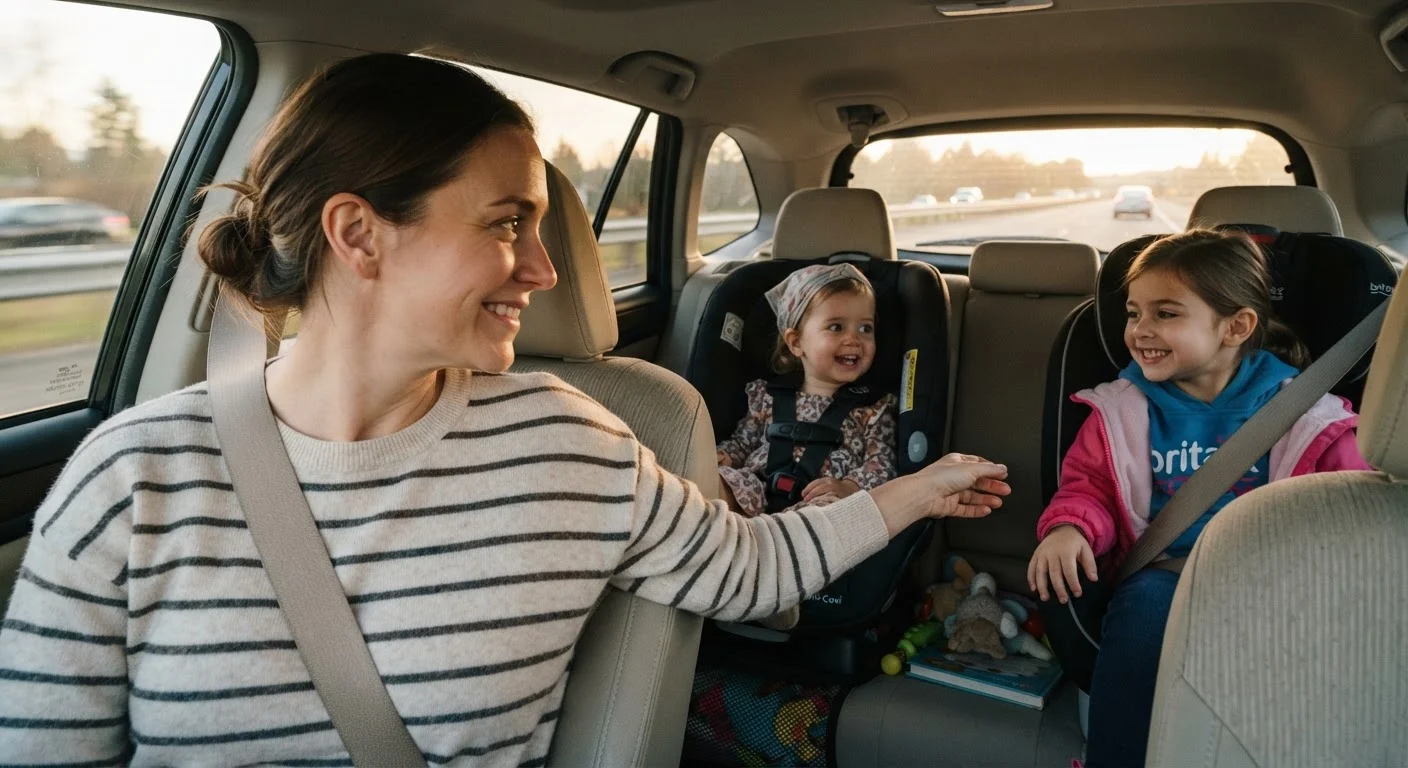
Why 'They're in the Back Seat' Isn't Enough
Parents often treat the back seat as a solved problem: child buckled, doors closed, drive begins. But the back seat is only as safe as the restraint system being used correctly - and that correctness needs ongoing human oversight to maintain.
Children shift positions. Harnesses loosen. Snacks get thrown. Siblings argue. A toddler can work a chest clip free within minutes of departure. None of these things are visible to a driver whose attention should be on the road, and none of them fix themselves.
Active supervision means an adult - ideally a dedicated passenger, not the driver - is watching, adjusting, and managing what happens in those rear seats throughout a trip. It's a specific responsibility, not a passive one. Habits that quietly raise driving risk often start with small back-seat moments that escalate into driver distraction.
What Supervision Actually Involves
Effective back-seat supervision has three practical dimensions:
- Restraint integrity: Harness straps should be snug before departure and checked again on longer trips. The chest clip belongs at armpit level - not at the belly, where it offers little protection. For a deeper look at how different seat types protect children, see our guide on car seat stages from infant to booster.
- Behavioral management: Children passing objects forward, yelling, or hitting a sibling all create distraction for the driver. An adult in the back seat can de-escalate before things reach the driver's attention.
- Emergency readiness: If a child chokes, has a medical event, or is injured in a collision, an adult in close proximity can respond immediately rather than the driver pulling over first.
Use a Pre-Trip Checklist for Restraints
Before every trip, run through three checks: harness snugness (pinch test at the shoulder - no slack), chest clip position (at armpit level), and that the buckle is fully latched. This takes under 30 seconds and removes the most common sources of restraint failure. Make it a habit the child participates in - narrating what you're checking helps them learn why it matters.
Supervision doesn't require constant intervention. Much of it is preventive - setting expectations before the trip, packing entertainment within easy reach, and ensuring children are comfortable so they're less likely to self-adjust during the journey.
The Driver's Role - and Its Limits
Drivers bear legal responsibility for the vehicle, but they cannot safely supervise the back seat while driving. Turning around, reaching back, or being drawn into conversation with a child in distress all compromise driving performance in measurable ways.
When a second adult isn't available, preparation does the work that supervision would otherwise do. This means:
- Completing a full restraint check before the vehicle moves - not in the driveway while half-distracted.
- Establishing clear, consistent rules about staying buckled and keeping hands to themselves.
- Pulling over promptly and safely whenever a back-seat issue genuinely requires attention.
On longer trips, where fatigue compounds distraction, the challenge is amplified. Our guide on long-distance road trips with kids covers how to plan ahead so driver alertness and passenger safety don't compete with each other.
When You're the Only Adult in the Car
Solo drivers with children in the back seat face the hardest version of this challenge. The practical answer is preparation over reaction: complete all restraint checks before moving, set behavioral expectations clearly before departure, and commit to pulling over rather than reaching back or turning around while driving. It takes longer, but it keeps both the child and other road users safer.
Building the Habit Early - and Why It Compounds
Children who grow up riding in supervised, well-managed vehicles internalize what safe car travel looks like. They understand that buckles stay on, that the driver isn't to be disrupted, and that the car is a space with rules - not an extension of the living room.
These habits carry forward. A child who learned to stay buckled and stay calm becomes a passenger who does the same as a teenager - and eventually a driver who sets the same expectations. The conversations about safe driving before teens get behind the wheel are far easier when the groundwork was laid years earlier in the back seat.
Start with the youngest passengers. Driving with newborns and infants introduces habits that scale naturally as a child grows through each seat stage and eventually into a forward-facing belt-positioning booster.
~46%
Car seats with installation errors
The CDC and child passenger safety researchers have consistently found that close to half of observed child restraint systems show some form of misuse, including harness slack and incorrect clip placement.
~1 in 4
Child road fatalities with unrestrained children
According to the CDC, approximately one in four children killed in motor vehicle crashes were unrestrained at the time of the collision.
3x
Increased distraction risk from rear-seat children
Research published in the journal Accident Analysis & Prevention found that interactions with child passengers can be significantly more distracting to drivers than adult passenger conversations.
Frequently Asked Questions
The back seat is statistically safer than the front seat for children, but that safety depends on correct restraint use and appropriate supervision. An unsupervised child who has loosened their harness or is leaning out of position is no longer protected as the seat was designed.
Yes. Toddlers and young children frequently unbuckle harness clips or chest clips once they learn how, and older children may loosen straps without realizing the danger. Regular checks and pre-trip conversations about staying buckled are important habits.
Check fit before every trip. Children grow quickly, clothing layers change with seasons, and straps can be loosened or twisted between uses. The harness should lie flat against the chest, with the clip at armpit level and no more than one finger of slack at the collarbone.
No. A driver who turns around, reaches back, or is distracted by a child in the rear is a less safe driver. Effective supervision of back-seat passengers is a job for a dedicated adult passenger, not the person behind the wheel.
There is no fixed age, but children generally cannot be expected to monitor their own restraint safety or manage emergencies independently until early adolescence at the earliest. Even then, adult awareness of what is happening in the rear seats remains important.
Signal and pull over safely as soon as possible - do not attempt to re-buckle a child while the vehicle is in motion. Use a calm, firm tone to explain why staying buckled is non-negotiable, and re-buckle fully before continuing.
The content provided on our blog site traverses numerous categories, offering readers valuable and practical information. Readers can use the editorial team’s research and data to gain more insights into their topics of interest. However, they are requested not to treat the articles as conclusive. The website team cannot be held responsible for differences in data or inaccuracies found across other platforms. Please also note that the site might also miss out on various schemes and offers available that the readers may find more beneficial than the ones we cover.