

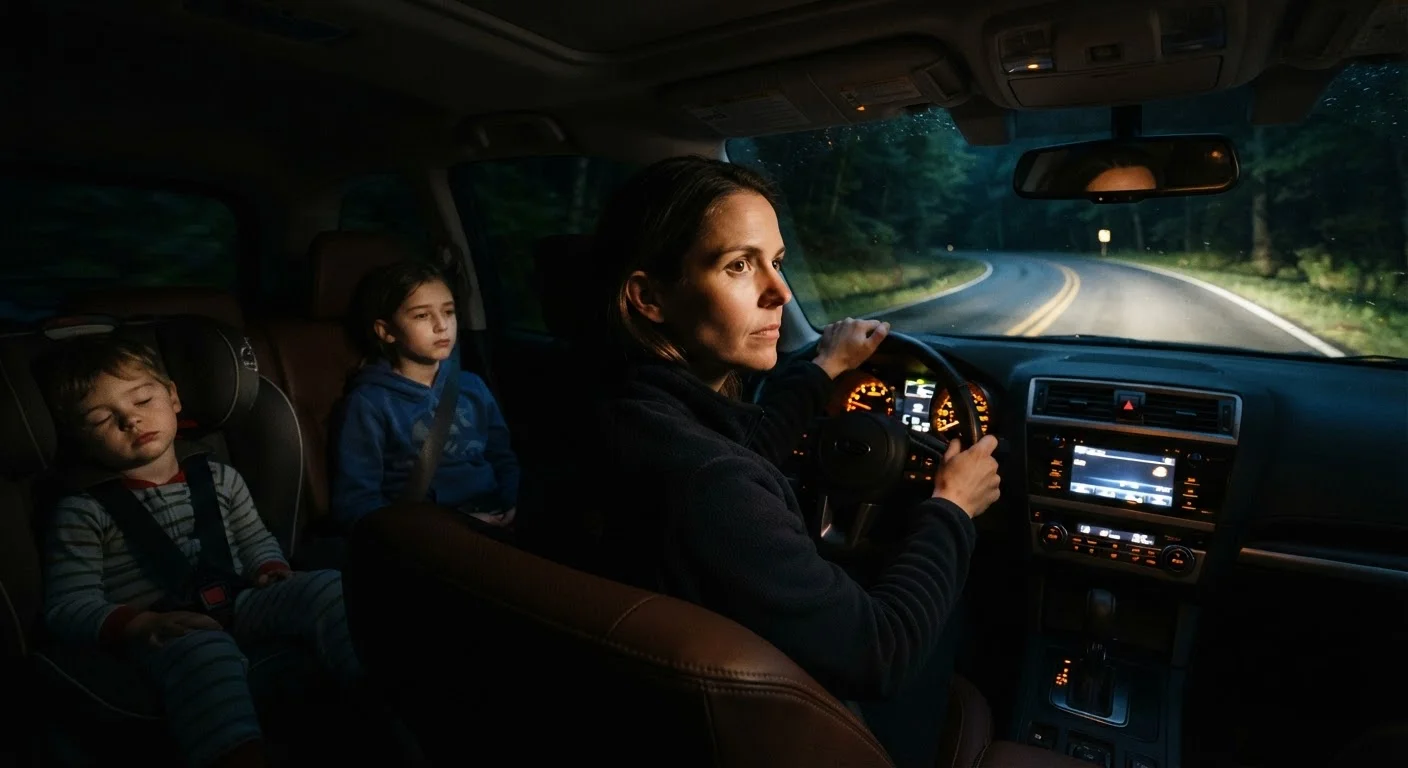
What Your Eyes Are Actually Doing After Dark
Daytime driving and night driving use fundamentally different visual systems. In bright conditions, your eyes rely on cone cells concentrated in the center of your retina - sharp, color-sensitive, and fast. After dark, your visual system shifts toward rod cells distributed toward the periphery. Rods are more sensitive to low light but provide less detail and recover slowly from bright flashes.
This matters practically. When an oncoming car's headlights hit your eyes, your night-adapted vision is temporarily wiped out. Recovery can take several seconds - long enough to travel hundreds of feet at highway speeds. During that window, any pedestrian, animal, or stopped vehicle in your path is effectively invisible.
Speed compounds the problem. Standard low-beam headlights illuminate roughly 160 to 250 feet ahead. At 60 mph, a vehicle travels that distance in under three seconds. That's a margin with almost no room for error, which is why the concept of overdriving your headlights - traveling faster than you can safely stop within the illuminated distance - is a genuine hazard, not just a technical term.
~50%
of fatal crashes occur at night
According to the National Safety Council, roughly half of all traffic fatalities in the U.S. occur in darkness, despite significantly less traffic volume after dark.
3 sec
Glare recovery time after oncoming headlights
Vision researchers note that after exposure to bright oncoming headlights, night-adapted vision can take several seconds to recover - during which hazards on the road are effectively invisible.
3×
Higher fatality rate per mile at night vs. day
The National Highway Traffic Safety Administration (NHTSA) has reported that the fatality rate per mile driven at night is approximately three times higher than during daylight hours.
How Fatigue Changes the Equation for the Whole Family
The human body follows circadian rhythms that create predictable dips in alertness regardless of how much sleep you've had. The deepest trough falls between roughly 2 a.m. and 5 a.m. A secondary dip occurs in the early to mid-afternoon. These aren't just times when you feel sleepy - they correspond to measurable reductions in reaction time, decision-making quality, and hazard detection.
For a parent driving kids home from a late event, a holiday gathering, or a long road trip, the overlap between these fatigue windows and actual driving time is often unavoidable. What makes it more dangerous is that fatigue also impairs your ability to recognize how impaired you are. Drivers frequently underestimate their own drowsiness until a serious lapse occurs.
Children asleep in the back seat can create a false sense of calm. The car is quiet, the road is clear, and the temptation to push through rather than stop is strong. But planning your driving windows around rest stops remains one of the highest-impact safety decisions you can make on any long family drive.
Plan Your Stop Before You Need It
Before any night drive over an hour, identify one or two places along the route where you could stop safely - a rest area, a gas station, a well-lit parking lot. Having this planned in advance removes the friction of making that decision when you're already fatigued. Fatigue impairs judgment about fatigue itself, so a pre-committed plan is more reliable than an in-the-moment call.
The Distraction Layer Kids Add After Dark
Research on driver distraction consistently shows that the presence of passengers - especially children - increases cognitive load. During daylight, an experienced driver can often manage brief interruptions without significant risk. After dark, that buffer shrinks considerably.
A child asking for a snack, siblings arguing, or a toddler who woke up crying all require some degree of mental response. Even if you don't turn around or reach into the back seat, processing the request pulls attention from the road. Combined with reduced visibility and the neurological effects of fatigue, these micro-distractions accumulate in ways that don't happen as predictably in daylight conditions.
This isn't a reason to avoid night driving with children - it's a reason to reduce every other variable you can control. That includes habits that quietly raise risk, such as adjusting in-car entertainment systems or reaching for items while moving. Set expectations with kids before you leave: quiet voices, no sudden loud noises, requests held until you reach a stop.
Practical Steps That Make a Real Difference
Several adjustments are low-effort and have a meaningful effect on night driving safety:
- Clean your windshield inside and out. Interior film from outgassing plastics scatters light and amplifies glare badly. A clean windshield dramatically reduces the starburst effect around oncoming headlights.
- Check and aim your headlights. Vibration and minor impacts over time can misalign headlights downward or to one side. A mechanic can check aim during any routine service visit. See the car maintenance hub for more on keeping your vehicle road-ready.
- Dim your instrument cluster and infotainment display. Bright interior screens cause your pupils to constrict, reducing how well your eyes adapt to the dark outside.
- Increase your following distance. The standard three-second gap is a minimum for daylight. At night, four to five seconds gives you more time to react to hazards within your headlight range.
- Use high beams on unlit roads and switch off promptly for oncoming traffic. Many drivers under-use high beams out of habit.
For families with infants or very young children, managing sleep deprivation as a new parent adds another layer - a fatigued driver at night with a newborn on board faces compounding risks worth taking seriously.
Headlight Technology Varies Significantly
Not all headlights provide the same illumination. Older halogen systems typically illuminate far less road than modern LED or adaptive headlight systems. If your vehicle is older, be aware that your effective visibility range may be shorter than you assume. Yellowed or oxidized headlight lenses can reduce light output substantially - lens restoration or replacement is an inexpensive fix that many families overlook.
When Stopping Is the Right Call
No schedule, arrival time, or family commitment outweighs the decision to stop when you are too fatigued or impaired by conditions to drive safely. This sounds obvious, but social pressure - wanting to get home, not wanting to disappoint - works against rational judgment at exactly the moment judgment is already compromised by fatigue.
Signs that stopping is warranted include: lane drifting, difficulty maintaining a consistent speed, missing familiar turns, or any microsleep - those momentary blackouts where you lose a second or two without realizing it. If you notice any of these, pull off at the next safe opportunity. A rest area, gas station, or parking lot is a valid stop.
For longer family trips, the Family Road Safety Playbook covers how to structure driving shifts and build rest into your itinerary from the start, rather than treating it as a fallback. That kind of planning - done before you leave - is far more reliable than willpower exercised on a dark highway at midnight.
Frequently Asked Questions
Reduced visibility, glare from oncoming headlights, and natural fatigue cycles all intensify after dark. Peripheral vision narrows significantly in low light, and hazards like pedestrians or debris appear much later. Reaction times that are adequate in daylight can fall short when a problem is spotted only at the edge of headlight range.
Look toward the right edge of your lane rather than directly at oncoming lights. Make sure your windshield is clean inside and out, since film and smearing dramatically amplify glare. Anti-reflective glasses can help some drivers, but the most reliable approach is speed reduction and increased following distance.
Missing exits, drifting within your lane, blinking frequently, and finding your thoughts wandering are all warning signs. If you catch yourself doing any of these, find a safe place to stop. Briefly opening a window or turning up the radio may buy a few minutes but are not reliable substitutes for rest.
High beams extend your visible range significantly on unlit roads, but they must be switched off for oncoming traffic and vehicles ahead of you. Use them whenever road conditions and traffic allow, then drop back to low beams before causing glare for other drivers.
Include headlights in any routine vehicle walk-around, especially before long trips. Misaligned, dim, or yellowed headlights provide far less usable light than drivers assume. Many states include headlight inspection in annual vehicle inspections, but checking function and aim more frequently is a reasonable habit.
Research consistently shows that passengers - especially children - increase cognitive load on the driver. After dark, when attention is already stretched by reduced visibility and fatigue, in-car noise or requests from kids create an outsized distraction risk. Setting clear expectations before departure can help reduce interruptions.
The content provided on our blog site traverses numerous categories, offering readers valuable and practical information. Readers can use the editorial team’s research and data to gain more insights into their topics of interest. However, they are requested not to treat the articles as conclusive. The website team cannot be held responsible for differences in data or inaccuracies found across other platforms. Please also note that the site might also miss out on various schemes and offers available that the readers may find more beneficial than the ones we cover.