

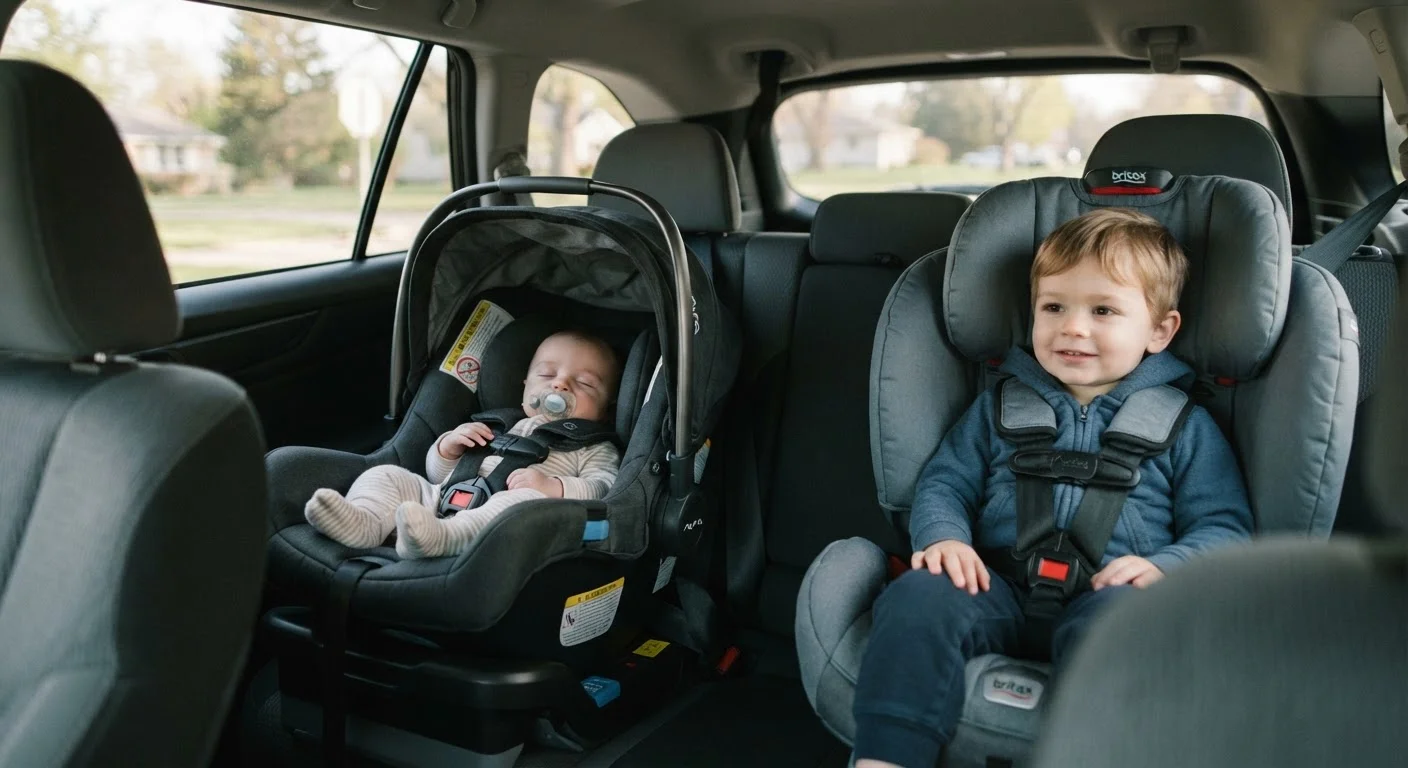
Option A
Rear-Facing Car Seat
The established first line of protection for young children.
Best for: Infants and toddlers who have not yet reached their seat's maximum rear-facing height or weight limit.
Option B
Forward-Facing Car Seat
The next stage of restraint once rear-facing limits are outgrown.
Best for: Children who have exceeded their rear-facing seat's limits and are not yet large enough for a belt-positioning booster.
How Each Seat Manages Crash Forces
The core difference between rear-facing and forward-facing seats is not just direction - it is how each position distributes the energy of a collision across a child's body.
In a frontal crash, which accounts for the majority of serious collisions, a rear-facing seat works by cradling the child's entire back, head, and neck in a rigid shell. As the vehicle decelerates rapidly, the seat moves with the child rather than against them, spreading the deceleration forces over the largest possible surface area. This is especially important for young children, whose heads are proportionally heavier and whose spinal structures are still developing.
A forward-facing seat, by contrast, uses a five-point harness to hold the child in place. When a frontal crash occurs, the child's body is thrown forward against the harness straps. The head continues to move forward momentarily - a motion known as head excursion - placing greater stress on the neck and spine. While a properly harnessed forward-facing seat still provides strong protection, the biomechanical load is distributed differently and less broadly than in rear-facing mode.
For a broader look at how restraint systems change across childhood, see our guide to car seat stages.
| Criterion | Rear-Facing Seat | Forward-Facing Seat |
|---|---|---|
| Crash force distribution | Spread across head, neck, and back | Concentrated on harness contact points |
| Head and neck protection | Shell cradles head; minimal neck stress | Head excursion places stress on neck |
| Appropriate age range | Infancy until seat limits reached | After rear-facing limits; before booster stage |
| Harness strap direction | At or below child's shoulders | At or above child's shoulders |
| Transition trigger | Exceeds seat's height or weight limit | Exceeds harness height or weight limit |
| Leg room concern | Not a safety factor; legs may touch seat back | Child's feet should reach floor or hang comfortably |
When to Make the Transition
One of the most persistent misconceptions parents encounter is the idea that turning one year old - or reaching a certain weight - automatically signals the time to switch to forward-facing. Current guidance from pediatric and traffic safety organizations is consistent: children should remain rear-facing until they reach the maximum height or weight limit specified by their seat manufacturer, not an age milestone.
Modern convertible car seats are designed to accommodate rear-facing children well beyond infancy, often up to 40-50 pounds depending on the model. Many toddlers can comfortably and safely remain rear-facing until age three or four when the right seat is in use.
71%
Reduction in fatal injury risk, rear-facing vs. adult belt
NHTSA data indicates rear-facing child restraints reduce the risk of fatal injury by approximately 71% compared to seat belts alone for young children.
~46%
Car seats with at least one critical misuse error
Research published in traffic safety literature has consistently found that roughly half of observed car seats have at least one critical installation or usage error.
Age 4+
Typical age many children can safely remain rear-facing
With convertible seats rated to higher weight limits, many children can remain in the rear-facing position until age four or older before reaching the seat's maximum limits.
It is also worth noting that a child's legs touching or pressing against the vehicle seat back is not a safety concern that warrants early transition. The relevant limits are the harness height markers and weight capacity printed on the seat itself.
Parents of newborns will find additional installation and travel guidance in our article on driving safely with infants.
Installation and Fit: Where Safety Can Break Down
Even the most protective seat design fails if it is not installed correctly or if the harness is not fitted properly. Studies by the National Highway Traffic Safety Administration (NHTSA) have consistently found that a significant proportion of car seats in everyday use have at least one installation or fit error.
For rear-facing seats, the most common issues include excessive recline angle, loose base installation (more than one inch of movement at the belt path), and harness straps that are routed above the child's shoulders rather than at or below them.
For forward-facing seats, common errors include harness straps routed below the shoulders (straps should be at or above shoulder level in forward-facing mode), chest clip positioned too low, and insufficient tightening - the harness should pass the pinch test, meaning you cannot pinch any slack at the collarbone.
Both configurations require the seat to be placed in the back seat of the vehicle. Children under 13 should always ride in the rear, and the rear-center position is generally considered the most protective when it offers a proper fit. For more on supervising children in the back seat, see why back-seat supervision still matters.
Free seat checks by certified Child Passenger Safety Technicians (CPSTs) are available through Safe Kids Worldwide and many fire stations and hospitals across the US. NHTSA's website maintains a locator for these inspection stations.
This article is for general informational purposes only. Always consult your car seat manual, vehicle owner's manual, and a certified Child Passenger Safety Technician for guidance specific to your child and vehicle.
The content provided on our blog site traverses numerous categories, offering readers valuable and practical information. Readers can use the editorial team’s research and data to gain more insights into their topics of interest. However, they are requested not to treat the articles as conclusive. The website team cannot be held responsible for differences in data or inaccuracies found across other platforms. Please also note that the site might also miss out on various schemes and offers available that the readers may find more beneficial than the ones we cover.