

Our Verdict
Driver assistance features are a genuine safety advance, and vehicles equipped with them generally show lower crash and injury rates. However, they are driver-support tools, not autonomous safety nets - each requires an attentive human behind the wheel to function as intended. Families benefit most when every driver in the household understands both the capabilities and the limits of these systems.
Families who want to understand how to use their vehicle's built-in safety technology responsibly and avoid over-relying on it.
What Common Driver Assistance Features Actually Do
Modern family vehicles often come equipped with a cluster of driver assistance technologies, sometimes bundled under names like "safety suite" or "driver confidence package." Understanding each system individually helps you use them correctly.
- Automatic Emergency Braking (AEB): Uses cameras or radar to detect an imminent collision and applies the brakes if the driver hasn't responded. Some systems also detect pedestrians or cyclists.
- Lane-Keeping Assist (LKA): Monitors lane markings and applies gentle steering corrections - or alerts - when the vehicle drifts without a turn signal active.
- Blind-Spot Warning (BSW): Uses rear sensors to alert the driver when a vehicle is detected in a blind spot, typically via a light in the mirror housing.
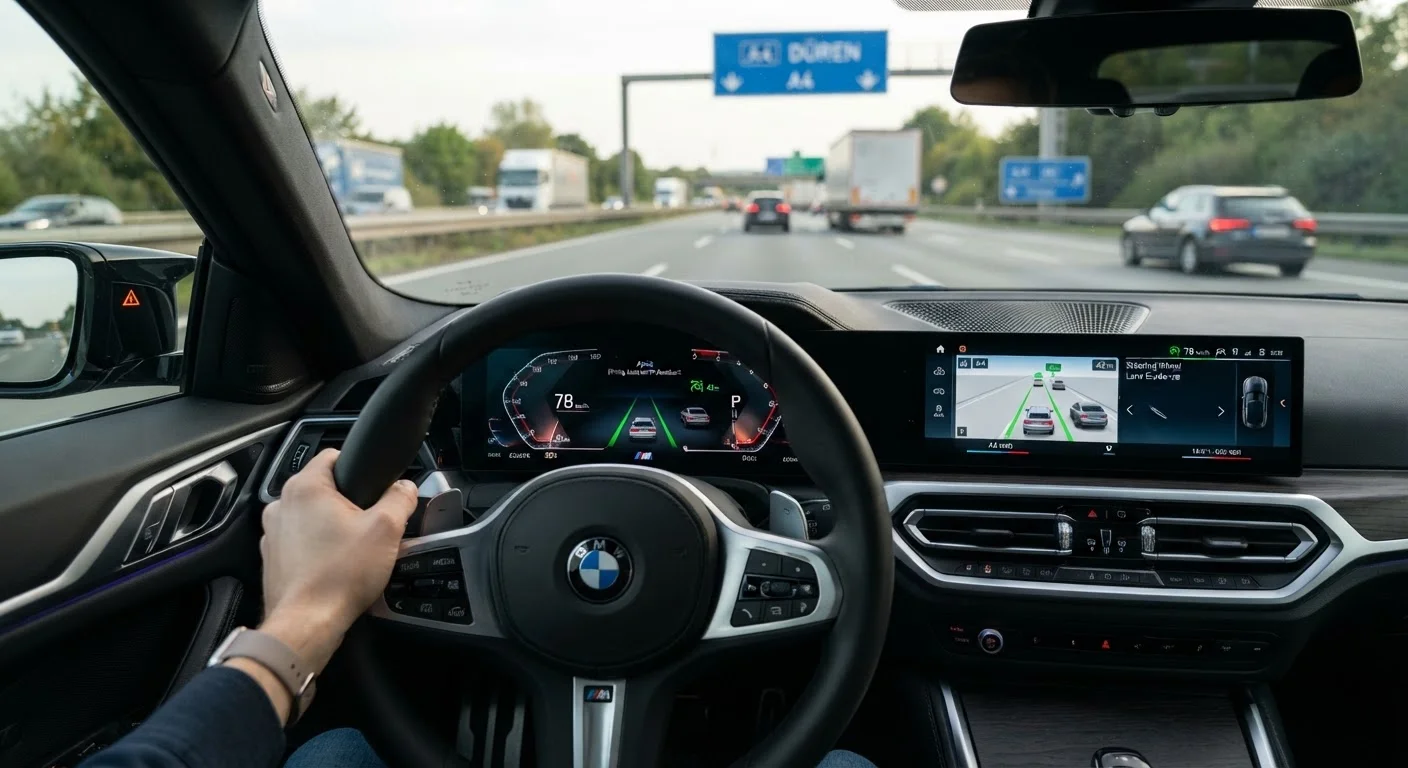
- Adaptive Cruise Control (ACC): Maintains a set following distance from the vehicle ahead, automatically slowing and accelerating within set parameters.
- Rear Cross-Traffic Alert: Warns drivers of approaching vehicles or pedestrians when reversing out of a parking space.
Each system targets a specific, well-documented crash type. AEB, for instance, is aimed at the rear-end collisions that account for a significant share of injury crashes. Used alongside good driving habits - see our guide on habits that quietly make family driving more dangerous - these features provide a meaningful additional layer of protection.
The Real Benefits: What the Data Shows
Reduces rear-end collision frequency and severity
Automatic emergency braking has demonstrated consistent reductions in rear-end crashes in insurance and highway safety research. Even partial braking before impact meaningfully reduces injury severity.
Compensates for brief, unavoidable inattention
Lane-keeping assist and blind-spot warnings provide a safety margin during the short lapses in attention that occur on every long drive, particularly relevant for parents managing passengers.
Helps less experienced drivers build awareness
Blind-spot warnings and rear cross-traffic alerts can reinforce where drivers should be checking, supporting safer habits especially in newer drivers in the household.
Documented reduction in lane-change crashes
Vehicles equipped with blind-spot warning systems show lower rates of sideswipe and lane-change collisions compared with unequipped vehicles in peer-reviewed safety studies.
Adaptive cruise control reduces highway fatigue
By maintaining consistent following distance automatically, ACC reduces the low-level cognitive load of speed management on long highway stretches, potentially reducing driver fatigue.
Research from highway safety organizations consistently shows that vehicles equipped with AEB experience fewer rear-end crashes than those without. Blind-spot warning systems have been linked to reductions in lane-change crashes. These are not marginal improvements - they address crash patterns that affect ordinary drivers every day.
~50%
Reduction in rear-end crashes with AEB
IIHS research has found that vehicles with forward collision warning and automatic emergency braking experience substantially fewer rear-end crashes than those without.
23%
Fewer lane-change crashes with blind-spot warning
According to IIHS data, blind-spot warning systems are associated with a roughly 23% reduction in lane-change injury crashes.
For families, the practical value is clear: assistance systems help during the moments of inattention that are almost inevitable on a long school-run or a motorway trip with restless kids in the back. They don't eliminate risk, but they can narrow the window between a close call and an actual collision. For more on how distraction affects driving, our companion article on distracted driving research is worth reading alongside this one.
The Limitations You Need to Know
Sensors impaired by weather and road conditions
Heavy rain, snow accumulation, ice, or mud on cameras and radar units can degrade or disable systems without triggering an obvious alert to the driver. Regular cleaning of sensor areas is necessary.
Encourages over-reliance and slower reaction times
Automation bias - the well-documented tendency to trust automated systems uncritically - can slow a driver's manual response precisely at the moment a system fails or reaches its limits.
Lane-keeping assist requires clearly marked roads
Faded lane markings, construction zones, and complex junctions can cause the system to disengage or behave unexpectedly, at times when attentive driving is already most demanding.
AEB has minimum thresholds and scenario limits
Automatic emergency braking may not activate for stationary objects at high speed, crossing pedestrians outside the detection arc, or certain low-light conditions - situations where driver attention remains critical.
System behavior varies significantly between vehicles
There is no standardized implementation across manufacturers: how aggressively a system intervenes, when it disengages, and what it detects all differ, making assumptions based on one car risky when driving another.
Damage or calibration errors reduce effectiveness silently
After a minor collision or windshield replacement, camera-based systems may require professional recalibration. An uncalibrated system may appear functional while providing degraded or incorrect alerts.
No driver assistance system is infallible, and several failure conditions are common enough that every driver should be aware of them.
Sensor sensitivity: Cameras and radar sensors can be impaired by heavy rain, snow, mud, ice on the bumper, or even a cracked windshield. A system that appears to be functioning - no warning light - may be operating at reduced effectiveness. This connects directly to why routine maintenance items are easy to overlook - keeping sensors clean and the windshield intact is part of keeping your safety systems working.
Speed and situation limits: AEB systems typically have minimum speed thresholds and may not respond effectively to crossing pedestrians, stationary objects at speed, or unusual road scenarios. Lane-keeping assist requires clear, well-marked lane lines to function - faded markings or complex junctions can confuse the system.
Automation bias: Research in human factors consistently finds that people who trust automated systems too much become slower to intervene when those systems fail. A driver who expects lane-keeping assist to handle drifting may react more slowly when the system disengages - exactly when attention is most needed.
When Systems Disengage Without Warning
Many driver assistance features have built-in conditions under which they automatically turn off - for example, when speed drops below a threshold, when the steering wheel is released too long, or when sensor quality degrades. Drivers should know their vehicle's specific disengagement cues. Consulting the owner's manual for your model is the most reliable way to understand these conditions, as they vary considerably between manufacturers and model years.
Staying in the Driver's Seat - Literally and Figuratively
The most important thing driver assistance features cannot do is replace judgment. They don't know that a child has run into the road beyond the sensor's range, that road conditions ahead have changed, or that the car in your blind spot is braking hard.
The correct mental model is that these systems act as a backup for moments of genuine inattention - not as a reason to reduce attentiveness in the first place. On high-speed routes with children on board, that distinction matters enormously. Our guide to motorway driving with children covers the skill set that technology supports but cannot replace.
Practically speaking, take time to read your vehicle's owner manual section on driver assistance features. Know the conditions under which each system disengages, what the warning indicators look like - a useful reference if you're unsure is our overview of dashboard warning lights - and how to override a system if it activates incorrectly. That knowledge makes you a more effective driver, not a more complacent one.
The content provided on our blog site traverses numerous categories, offering readers valuable and practical information. Readers can use the editorial team’s research and data to gain more insights into their topics of interest. However, they are requested not to treat the articles as conclusive. The website team cannot be held responsible for differences in data or inaccuracies found across other platforms. Please also note that the site might also miss out on various schemes and offers available that the readers may find more beneficial than the ones we cover.