

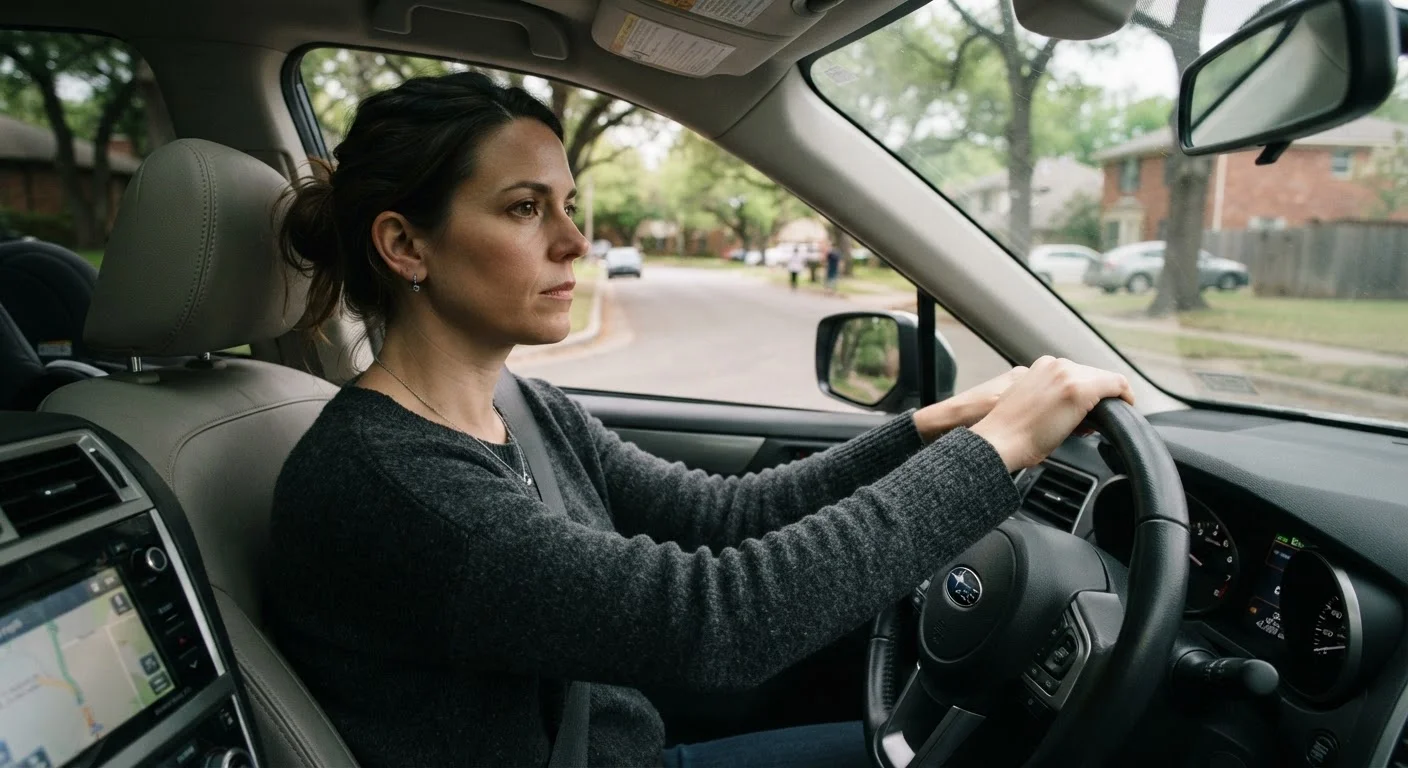
Why Distracted Driving Research Matters for Families
Most parents think of distracted driving as a teenage problem - phones face-up on the seat, eyes drifting to social media at a red light. But road safety research consistently shows that experienced adult drivers, including parents navigating busy daily routines, are far from immune. The distractions familiar to family life - a crying infant, a squabbling sibling pair, a navigation app announcing a reroute - carry measurable safety consequences.
Understanding what the research actually shows, rather than what feels intuitive, is the first step toward building genuinely safer habits. The myth-busting below draws on peer-reviewed findings and guidance from highway safety organizations. For a broader framework, see the Family Road Safety Playbook.
Myth
Using a hands-free phone is safe because my hands stay on the wheel and my eyes stay on the road.
Fact
Hands-free calling still imposes significant cognitive distraction, which measurably reduces hazard detection and reaction time.
The National Safety Council and multiple peer-reviewed simulator studies have found that drivers engaged in hands-free phone conversations miss visual cues they would otherwise catch, a phenomenon sometimes called inattention blindness. The brain's capacity to process the driving environment is genuinely reduced when it is simultaneously constructing and following a phone conversation - even without a physical device in hand. Hands-free is lower-risk than handheld, but it is not risk-free.
Myth
Experienced drivers can multitask effectively - years on the road mean automatic responses handle the basics.
Fact
The brain does not truly multitask; it rapidly switches between tasks, and switching itself consumes cognitive resources.
Neuroscience research consistently shows that what feels like multitasking is actually fast task-switching. Each switch incurs a small performance cost. For routine stretches of familiar road, automation of certain driving skills does reduce load - but that same familiarity can breed overconfidence. Unexpected hazards, by definition, require full conscious attention, and a brain partly allocated to another task is slower to redirect. Experience does not eliminate cognitive limits.
Myth
Children in the back seat aren't really a distraction - parents tune them out.
Fact
Research has found that children in the vehicle can be a substantial source of driver distraction, comparable in frequency to mobile phone use.
An Australian study published in Accident Analysis & Prevention found that children were a distraction during a significant proportion of observed driving time. Parents frequently turned to look, reached backward, or engaged in extended conversation. Unlike a phone call, children generate unpredictable demands - a dropped toy, a sudden cry, a question requiring an answer - that interrupt attention at uncontrollable moments. Acknowledging this risk is the first step to managing it, for instance by pulling over when a child urgently needs physical attention.
Myth
Voice-activated controls are completely safe because I don't need to look at or touch anything.
Fact
Voice command use can leave the driver in a state of elevated cognitive distraction for an extended period after the task ends.
Research commissioned by the AAA Foundation for Traffic Safety found that using in-vehicle voice systems - including relatively sophisticated ones - imposed moderate-to-high cognitive workload. Crucially, the mental residue of the interaction did not disappear the moment the task completed; in some tests, measurable impairment persisted for up to 27 seconds afterward. At highway speeds, a vehicle travels a significant distance during that window. Voice controls are a convenience tool, not a safety solution.
Myth
A quick glance at my phone takes less than a second - it's not long enough to matter.
Fact
Studies suggest the average driver's eyes are off the road for around five seconds when reading or sending a text, even when it feels instantaneous.
The five-second figure - cited in research by the Virginia Tech Transportation Institute and echoed in NHTSA guidance - represents average observed glance duration for reading a text message. At 55 mph, five seconds is enough to travel the length of a football field without eyes on the road. The subjective sense that a glance was brief does not correspond reliably to its actual duration. Memory compression makes brief distractions feel shorter in retrospect than they were in real time.
The Cognitive Load Behind Common Habits
Distraction researchers typically separate impairment into three categories: visual (eyes off road), manual (hands off wheel), and cognitive (mind off driving). The third category is the most underappreciated. You can have both hands on the wheel and eyes forward and still be meaningfully impaired if your working memory is occupied with a demanding conversation or a mental to-do list.
Studies using driving simulators have found that cognitive load - the mental effort required by a secondary task - reduces a driver's ability to detect and respond to hazards, narrows the useful visual field, and slows reaction time. This matters acutely for parents, whose in-car environment routinely generates competing demands. Adjusting the sat-nav, mediating a backseat argument, or answering a child's question all draw on the same finite pool of attention. The habits that quietly raise family driving risk are often the most normalized ones.
27 sec
Cognitive recovery time after voice commands
AAA Foundation for Traffic Safety research found measurable impairment could persist for up to 27 seconds after completing a voice-activated task.
~75%
Distraction time attributed to children in-car
An Australian observational study found children were a source of driver distraction during a substantial share of total driving time observed.
Applying the Research to Everyday Family Driving
Knowing the evidence is useful only if it changes behavior. A few practical principles follow logically from what distraction research shows:
- Set navigation before moving. Programming a destination while stationary eliminates a manual, visual, and cognitive distraction simultaneously.
- Pull over for complex conversations. If a child needs meaningful attention - a medical concern, a distressing emotion - stopping is the safer choice, not talking while driving.
- Treat voice commands as a tool, not a safety guarantee. Using a voice assistant for a quick task is lower-risk than typing, but it still imposes a cognitive cost. Reserve it for simple, fast interactions.
- Know what driver assistance features actually do. Lane-keeping assist and automatic emergency braking reduce certain collision risks, but they do not compensate for sustained inattention. See what driver assistance features do and don't do for a clear-eyed overview.
If you're planning a long family trip where fatigue compounds distraction risk, planning that trip with safety as the foundation is worth reading before you leave. And when the time comes to discuss these realities with a new driver in the family, the conversation you have before their first lesson shapes habits that can last a lifetime.
Don't Rely on Feeling 'Fine' as a Safety Signal
Cognitive distraction is largely invisible to the person experiencing it. Drivers impaired by a demanding phone conversation typically do not feel impaired - they report feeling in control. This is one reason distracted driving is underreported and underestimated as a crash factor. Use objective rules (navigation set before departure, phone on do-not-disturb while moving) rather than in-the-moment self-assessment to manage risk.
The content provided on our blog site traverses numerous categories, offering readers valuable and practical information. Readers can use the editorial team’s research and data to gain more insights into their topics of interest. However, they are requested not to treat the articles as conclusive. The website team cannot be held responsible for differences in data or inaccuracies found across other platforms. Please also note that the site might also miss out on various schemes and offers available that the readers may find more beneficial than the ones we cover.