

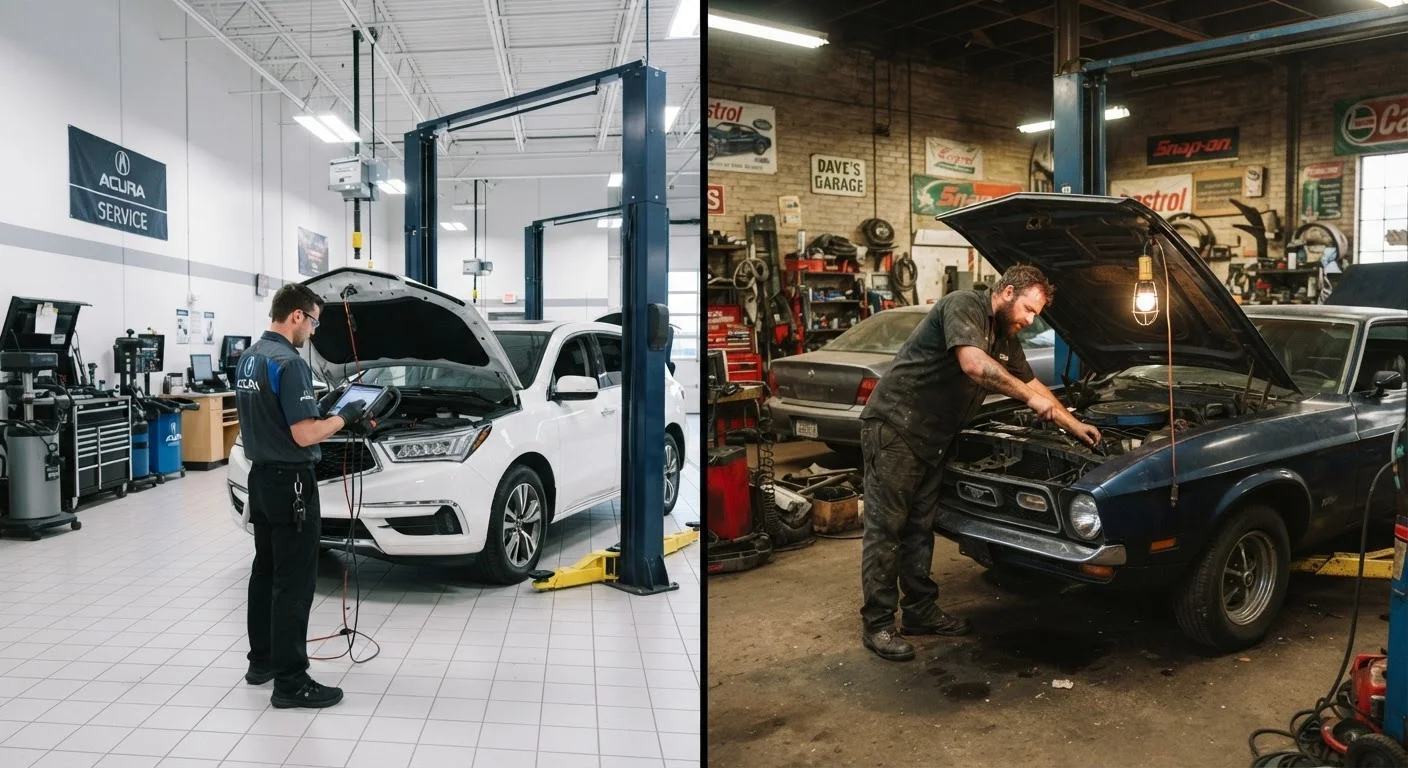
Our Verdict
Main dealers make the most sense for newer vehicles still under manufacturer warranty or complex brand-specific repairs. Independent garages frequently offer better value for older, out-of-warranty cars, provided you choose a reputable shop with certified technicians. The best long-term strategy for most families is to use each type of provider at the right stage of ownership.
| Best for | Recommended |
|---|---|
| Vehicles under manufacturer warranty or needing brand-specific diagnostics | Main Dealer |
| Out-of-warranty vehicles and budget-conscious routine maintenance | Independent Garage |
| Families prioritizing convenience, loaner cars, and a single point of contact | Main Dealer |
| Owners seeking a long-term mechanic relationship and transparent pricing | Independent Garage |
What Each Option Actually Offers
Main dealerships are franchised outlets authorized by a vehicle manufacturer. Their service departments employ technicians trained specifically on that brand, use proprietary diagnostic software, and stock manufacturer-approved (OEM) parts. Independent garages, by contrast, are privately owned shops serving multiple makes and models. Many employ ASE-certified technicians and use aftermarket or OEM-equivalent parts sourced through the open market.
Both can legally service your vehicle. The practical differences show up in cost structure, specialization, and the customer experience - factors that shift in importance depending on your car's age and condition. See our family car maintenance schedule guide for a clear breakdown of what each service interval actually involves.
| Main Dealer | Independent Garage | |
|---|---|---|
| Typical labor rate | Higher (brand overhead included) | Generally more competitive |
| Parts used | OEM at list price | OEM or OEM-equivalent, flexible sourcing |
| Technician training | Brand-specific factory training | ASE-certified, multi-make experience |
| Diagnostic software | Proprietary manufacturer tools | Aftermarket tools; varies by shop |
| Warranty claim handling | Seamless, direct with manufacturer | Owner must coordinate separately |
| Convenience extras | Often includes loaner cars, courtesy transport | Varies widely by shop |
| Best vehicle age | New to 3 years (in-warranty) | 3+ years, out-of-warranty |
The Warranty Question Most Owners Get Wrong
A common misconception is that servicing at an independent garage automatically voids a new-car warranty. Under the Magnuson-Moss Warranty Act, a manufacturer cannot void your warranty simply because you used a non-dealer service provider - unless they can prove the independent work directly caused the defect being claimed.
The key condition: the shop must use parts and fluids that meet the manufacturer's specifications. Always ask your independent garage to document the spec of every part installed, and keep those records. Where things get more complicated is with extended warranties or service contracts sold by dealers - these are separate agreements with their own terms, so read the fine print carefully before assuming the same protections apply.
Protect Your Records Either Way
Whichever provider you use, keep every service invoice, parts receipt, and inspection report - stored digitally if possible. If a warranty dispute arises, documentation showing the correct parts and fluids were used is your strongest protection. A well-organized service folder also adds credibility and value when you eventually sell the vehicle.
Cost Differences: What the Numbers Typically Look Like
Labor rates at main dealers tend to run higher than independent garages - a gap that reflects real overhead differences including specialized equipment, factory training programs, and brand licensing costs. For routine jobs like oil changes, brake pad replacement, or cabin air filter swaps, that gap can be meaningful on a family budget.
Parts pricing is another factor. Dealers generally stock OEM parts at list price. Independent garages often have flexibility to source OEM-equivalent parts at lower cost, though quality varies by supplier. For choosing the right engine oil, the spec matters more than where you buy it - so confirm your garage is using oil that meets your manufacturer's viscosity and certification requirements.
For families managing tight household budgets, our guide to keeping a family car maintained affordably covers how to prioritize spending without cutting corners on safety-critical items.
~30%
Typical labor rate premium at dealerships
Industry estimates commonly suggest dealer labor rates run roughly 30% higher than independent garages, though this varies significantly by region and vehicle brand.
3-5 years
Typical new-car warranty period
Most US manufacturer warranties cover three to five years or a set mileage threshold, after which the cost advantage of independent servicing becomes more relevant.
Service History and Resale Value
Whether you use a dealer or an independent shop, a complete, documented service history is one of the most tangible ways to protect your car's resale value. Buyers and used-car appraisers look for evidence that servicing was done on schedule with appropriate parts - not just that it was done at a dealer.
A full stamp history from a reputable independent garage is generally preferable to a patchy dealer history with missed intervals. The service history explainer breaks down exactly what prospective buyers and dealers scrutinize when evaluating a used vehicle.
Keep physical receipts, digital records, and any inspection reports regardless of where you service. Some independent garages now offer digital service records through third-party platforms, which can be as credible as a stamped booklet if properly documented.
Making the Right Call for Your Family
The practical decision comes down to three factors: vehicle age, warranty status, and the nature of the work. New vehicles within their manufacturer warranty period benefit from dealer servicing primarily because warranty claim administration is smoother and brand-specific software diagnostics are available on-site. Once a vehicle is out of warranty - typically after three to five years - the dealer's premium often reflects brand overhead rather than superior service quality.
For complex diagnostics on modern vehicles with advanced driver-assistance systems (ADAS) or hybrid powertrains, verify that any independent garage has the appropriate equipment and training before booking. Not all independents are equipped equally. Staying on top of routine maintenance to prevent expensive repairs matters far more than which type of provider you use - the worst outcome is deferred maintenance, wherever it happens.
The content provided on our blog site traverses numerous categories, offering readers valuable and practical information. Readers can use the editorial team’s research and data to gain more insights into their topics of interest. However, they are requested not to treat the articles as conclusive. The website team cannot be held responsible for differences in data or inaccuracies found across other platforms. Please also note that the site might also miss out on various schemes and offers available that the readers may find more beneficial than the ones we cover.