

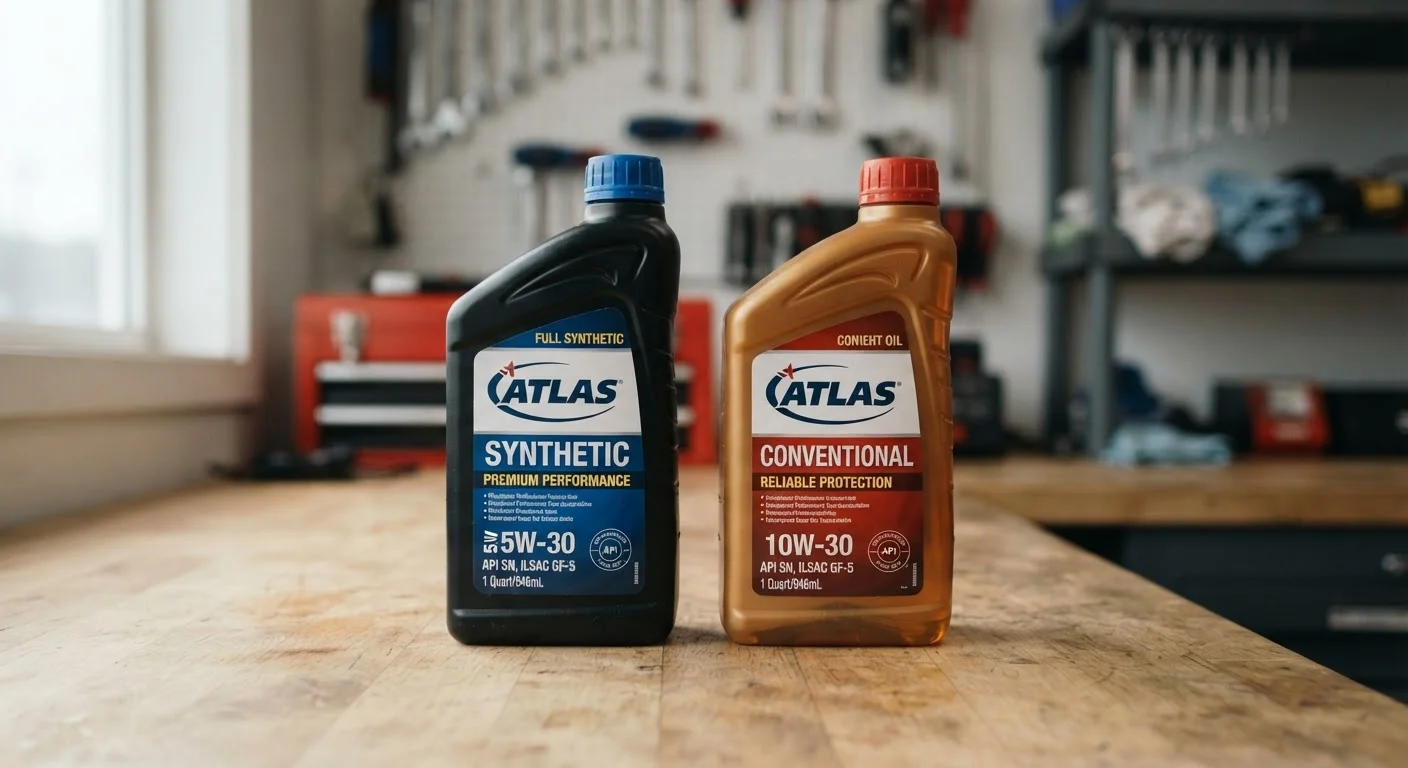
Option A
Synthetic Engine Oil
The engineered, high-performance formulation.
Best for: Drivers with newer vehicles, extreme climate conditions, longer service intervals, or high-performance engines.
Option B
Conventional Engine Oil
The time-tested, straightforward lubricant.
Best for: Owners of older or simpler engines with regular driving patterns and frequent service intervals.
How These Two Oil Types Are Actually Made
The core difference between synthetic and conventional motor oil is their origin. Conventional oil is refined directly from crude petroleum. That refining process removes many - but not all - impurities, leaving behind molecules that vary in size and shape.
Synthetic oil, by contrast, is either built molecule-by-molecule from chemical compounds (fully synthetic) or made by further purifying and restructuring conventional base stock (synthetic blend). The result is a more uniform molecular structure that responds more predictably to heat, cold, and mechanical stress.
This isn't a marketing distinction - it's chemistry with practical consequences for how your engine behaves at startup on a cold January morning versus a long highway haul in August. See our family car maintenance schedule guide for how oil type fits into your broader service plan.
Side-by-Side: Key Differences at a Glance
The table below covers the criteria most families should weigh when choosing between oil types. These figures reflect general industry ranges, not guarantees for any specific product or vehicle.
| Criterion | Synthetic Oil | Conventional Oil |
|---|---|---|
| Base material | Engineered chemical compounds | Refined crude petroleum |
| Typical change interval | 7,500-10,000+ miles | 3,000-5,000 miles |
| Cost per quart (general range) | Higher | Lower |
| Cold-weather flow | Excellent | Adequate to good |
| High-temperature stability | Superior | Moderate |
| Suitability for modern engines | Required or recommended by most | May not meet spec |
| Suitability for older engines | Compatible, minor benefit gain | Well-suited |
One note worth emphasizing: the cost-per-change advantage of conventional oil narrows when you account for frequency. A family doing four conventional changes a year at lower cost may spend comparably to two synthetic changes - and log more shop visits in the process.
What Your Owner's Manual Actually Says
The single most authoritative source on oil type for your vehicle is the owner's manual - not the oil change shop's recommendation board. Manufacturers specify a viscosity grade (such as 5W-30) and, increasingly, a quality standard (such as API SP or ILSAC GF-6). Many engines built after the mid-2000s require or strongly recommend full synthetic to meet these standards.
Using a lower-grade oil than specified can, in theory, affect engine protection over time. Using a higher-grade oil in an engine designed for conventional is generally harmless, though it won't necessarily deliver additional benefit beyond what the engine was engineered to use.
Can You Switch Mid-Life Without Harm?
A common concern is that switching from conventional to synthetic will cause leaks in older engines. In well-maintained engines without pre-existing seal damage, this is generally not the case. Modern synthetic formulations are compatible with standard engine seals. If your engine already has seeping gaskets, those should be addressed regardless of oil type - not attributed to the switch itself.
For a wider look at which service intervals actually matter - and which myths are worth ignoring - see our piece on car maintenance myths that could be costing you money.
Does Synthetic Really Protect Better?
The performance advantages of synthetic oil are well-documented in engineering literature. Synthetic flows more readily at low temperatures, reducing the critical seconds at startup when metal-on-metal contact is highest. It also maintains viscosity stability at high operating temperatures better than conventional oil, which can thin out under sustained heat.
For everyday family driving - school runs, highway commutes, grocery trips - these advantages are real but incremental. Where synthetic pulls clearly ahead is under stress: towing a trailer, driving in stop-and-go traffic in summer heat, or cold-starting a vehicle in a Minnesota winter.
~50%
Reduction in engine wear at cold startup
Studies cited by the American Petroleum Institute indicate synthetic oils can significantly reduce engine wear during the critical cold-start phase compared to conventional oils.
2x
Typical change interval advantage
Synthetic oil change intervals are generally twice as long as conventional intervals under normal driving conditions, according to broadly published manufacturer guidance.
If you handle your own oil changes, our guide on DIY car maintenance explains when this is a reasonable task and what to watch for.
The content provided on our blog site traverses numerous categories, offering readers valuable and practical information. Readers can use the editorial team’s research and data to gain more insights into their topics of interest. However, they are requested not to treat the articles as conclusive. The website team cannot be held responsible for differences in data or inaccuracies found across other platforms. Please also note that the site might also miss out on various schemes and offers available that the readers may find more beneficial than the ones we cover.