

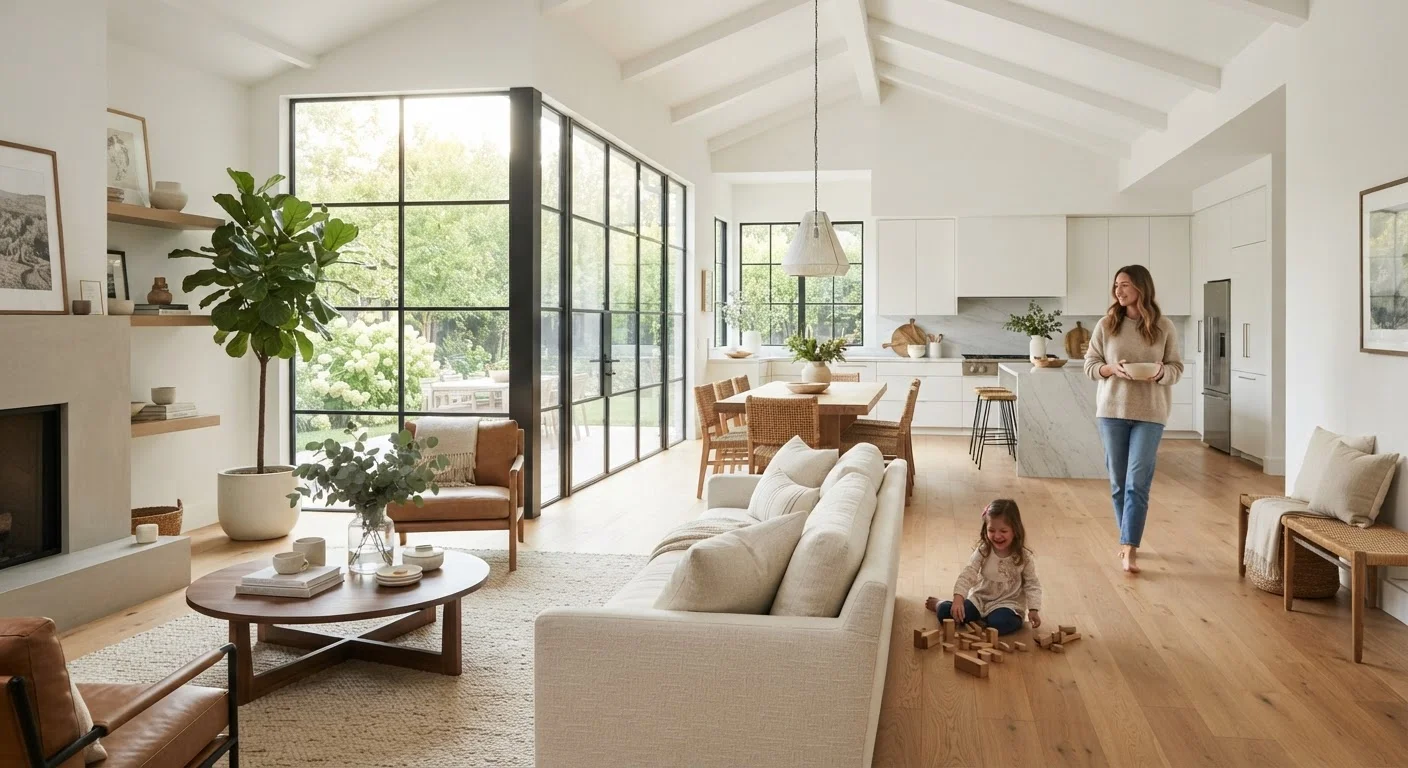
Why Designers Keep Talking About It
Walk into some rooms and you instantly relax. Others make you feel vaguely on edge - maybe slightly hemmed in, or unsure where to stand. The furniture might look fine in isolation, but something about the whole picture feels off. Interior designers would likely diagnose this as a flow problem.
Flow isn't a mystical quality reserved for glossy magazine interiors. It's a practical concept describing how well a space supports the way people actually use it. A family home needs to handle school bags dropped at the door, kids moving between rooms, adults carrying laundry, and guests finding their way to the kitchen. Flow is the design quality that makes all of that feel natural rather than effortful.
Understanding the concept gives you a useful lens for evaluating your own spaces - and a clear starting point for making changes that actually improve daily life rather than just shifting the aesthetic around.
The Two Types of Flow Designers Think About
Most interior designers work with two overlapping ideas when they talk about flow:
- Physical flow - the literal ability to move through a space without obstruction. This includes the width of pathways between furniture, how doors open without hitting obstacles, and whether the layout guides people logically from one area to the next.
- Visual flow - the way the eye travels across a room. A space with good visual flow has a coherent rhythm: colours relate to one another, furniture heights create a natural progression, and no single element jumps out as jarring or disconnected.
Both types reinforce each other. A room where you can't walk comfortably will also look wrong on some level - overcrowded, tense, unresolved. Fixing the physical arrangement usually improves the visual experience at the same time.
Flow Is Felt Before It's Seen
Most people don't consciously notice flow until it's missing. The discomfort of a poorly arranged room tends to register as a vague mood rather than a clear observation. That's why it's worth walking your rooms with fresh eyes - or asking a visitor for their first impression - rather than relying only on how a layout looks in photos.
If you've ever tidied a room thoroughly and still felt like something was off, the issue is likely structural rather than surface-level. See our article on why rooms feel cluttered even after tidying for more on the underlying causes.
What Breaks Flow in Family Homes
Several common patterns disrupt flow in everyday living spaces:
- Furniture pushed against all walls. This leaves a hollow centre and forces pathways through the middle of seating groups - the opposite of what makes a room work. Floating furniture toward the centre creates defined zones and usable edges. Our guide on furniture arrangement myths covers this in detail.
- Blocking natural desire lines. People instinctively take the shortest or most direct route between points. Placing a chair, ottoman, or table across that natural path creates constant low-level friction.
- Ignoring the transition between rooms. Flow doesn't just operate within rooms - it operates between them. A jarring colour change, a sudden drop in ceiling height, or a hallway piled with storage can interrupt the sense of cohesion throughout a home.
- Underestimating clearance needs. Design guidelines typically recommend a minimum of around 36 inches for main circulation paths and about 18 inches between a coffee table and sofa. In busy family homes with children and pets, more generous clearances make a real difference.
Try the 'First Steps' Test
Stand in your doorway and take three steps into the room without thinking. Where did your feet naturally take you? That desire line reveals how your brain interprets the space. If those three steps led you into furniture or a dead end, the layout is working against your instincts - and a simple rearrangement may be all you need.
Assessing Flow in Your Own Rooms
You don't need a design qualification to evaluate your home's flow. Try walking through each room as if for the first time - enter from the doorway and notice where your eye goes and where your feet naturally want to take you. Then ask:
- Can I walk from the door to every seating area or key surface without squeezing past furniture?
- Does the room have a clear focal point that the arrangement relates to?
- Are there areas that feel underused or awkward to reach?
- Do rooms connect logically, or does moving between spaces feel disjointed?
In open-plan homes - common in many modern family houses - the challenge is creating flow and definition at the same time. Without walls, it's easy for different activity zones to bleed into each other in ways that feel chaotic rather than connected. Rugs, lighting, and furniture groupings are the primary tools for solving this. Our article on zoning a room without walls explains practical approaches.
Even a dedicated work corner benefits from flow thinking. A workspace crammed against a busy circulation route will feel stressful; one positioned slightly apart - with a clear visual boundary - supports focus. See our guide on setting up a home working space for ideas.
Frequently Asked Questions
Good flow means people can move through your home comfortably without bumping into furniture or feeling uncertain where to go. It also means the eye travels naturally around a room without jarring interruptions. When flow works well, a space simply feels right - even if you can't immediately say why.
Common signs include furniture that forces you to squeeze past it, rooms that feel stuffy or awkward despite being tidy, and guests who gravitate toward doorways rather than sitting areas. If you regularly bump corners, redirect traffic through a room, or feel vaguely tense in a space, flow is likely the culprit.
Yes - rearranging what you already own is often the most effective first step. Pulling furniture slightly away from walls, angling seating toward a focal point, and clearing pathways of obstacles can dramatically improve a room's feel. Removing even one piece of furniture often opens a space more than any purchase would.
Flow matters in any sized home, but the challenges differ. Small homes struggle with physical clearance; larger homes can suffer from disconnection - rooms that feel isolated or hard to navigate between. Open-plan layouts have their own flow challenges around defining zones without blocking movement.
Colour transitions between adjoining rooms affect visual flow significantly. Abrupt contrasts can make a home feel fragmented, while a cohesive palette - even with variation - ties spaces together and makes movement feel more natural. This doesn't mean every room must match; it means the transitions should feel considered.
The content provided on our blog site traverses numerous categories, offering readers valuable and practical information. Readers can use the editorial team’s research and data to gain more insights into their topics of interest. However, they are requested not to treat the articles as conclusive. The website team cannot be held responsible for differences in data or inaccuracies found across other platforms. Please also note that the site might also miss out on various schemes and offers available that the readers may find more beneficial than the ones we cover.