

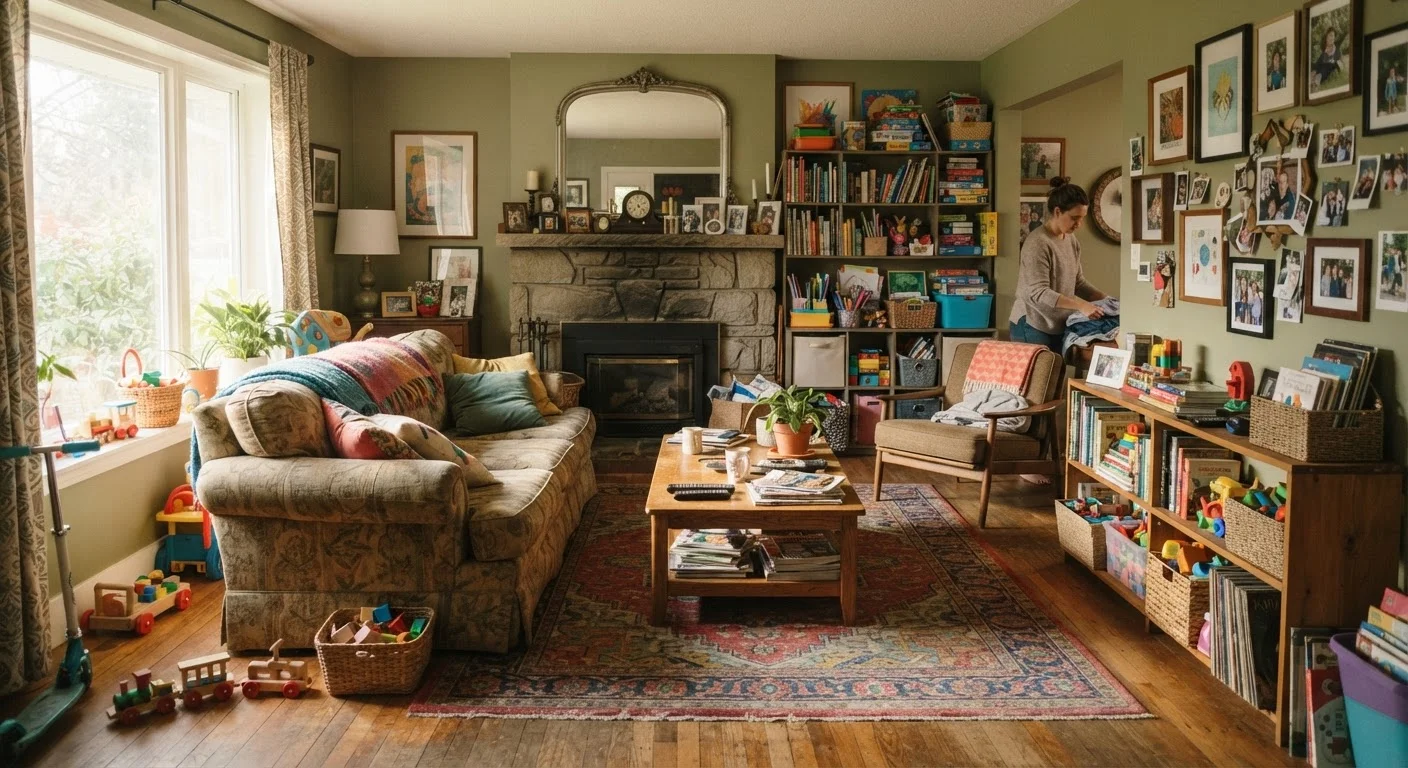
The Real Problem Isn't the Mess
Most families experience a frustrating cycle: spend an hour tidying the living room, stand back, and still feel vaguely dissatisfied. The cushions are straight. The remote controls are in the drawer. The kids' toys are in the basket. And yet - something still feels off.
The reason is that tidying solves a different problem than the one causing the discomfort. Physical mess (objects left out, stacks of mail, scattered shoes) is only one source of chaos. Visual clutter - the design and layout signals that make a room feel overwhelming - operates independently of whether surfaces are clear.
A room can be spotless and still feel exhausting to be in. Understanding why is the first step toward fixing it for good, rather than repeating the same tidy-and-reset loop every weekend.
Too Many Focal Points, No Clear Winner
Every well-composed room gives the eye somewhere obvious to land first. When a living room has a television, a gallery wall, a busy bookshelf, an oversized mirror, and a bold rug all competing equally for attention, the eye has nowhere to settle - and the brain reads that restlessness as chaos.
This is one of the most common structural causes of a room that feels cluttered without being messy. The solution isn't to remove everything - it's to establish a clear visual hierarchy. Choose one dominant focal point (often the seating arrangement anchored by a rug, or a media unit), and treat everything else as supporting rather than competing.
Try the 'One Focal Point' Test
Stand in the doorway of your living room and notice where your eyes land first - and second, and third. If you can identify more than two competing points of equal visual weight, that's likely a key driver of the cluttered feeling. Try covering or grouping secondary items to give one element clear dominance, then reassess how the room reads.
See how furniture placement plays into this in our guide on furniture arrangement myths that shrink rooms - several common habits actively work against visual calm.
Scale, Proportion, and the Breathing Room Problem
Furniture that doesn't match the scale of the room creates persistent visual tension. An oversized sectional crammed into a small living room leaves no breathing space and forces traffic paths into awkward positions. Conversely, small, scattered pieces in a large room look fragmented and unsettled - which registers as clutter even when every surface is bare.
A useful rule of thumb: furniture should leave enough clear floor space that you can comfortably walk around each piece without turning sideways. Rugs should be large enough to anchor the seating group - a rug that only catches the front legs of a sofa leaves the arrangement looking unmoored.
~60%
Of visual calm comes from layout, not cleanliness
Interior design research consistently indicates that spatial arrangement and visual hierarchy have a greater impact on perceived order than surface tidiness alone.
3
Maximum colors for a cohesive living room palette
Design practitioners commonly recommend limiting a room's palette to two to three main colors with one or two controlled accents to avoid visual noise.
12-18 inches
Recommended sofa clearance from walls
Floating sofas slightly away from walls is a widely recommended technique for creating breathing room and making arrangements feel more deliberate.
For families managing open-plan spaces, defining clear zones is an extension of this same principle. Our article on zoning a room without walls covers practical techniques including rug placement, lighting, and furniture grouping.
Surfaces Without a Purpose Invite Accumulation
Every flat surface in a living room will attract objects over time - this is essentially a law of family life. The difference between surfaces that look curated and surfaces that look chaotic comes down to whether each one has a defined purpose and a clear limit.
A console table that exists purely as a landing spot will collect mail, keys, school papers, and random objects within days of being cleared. The same table with a basket, a lamp, and a small plant has defined its own function - and anything that doesn't fit that function visually reads as out of place, which makes it easier to notice and remove.
This doesn't require minimalism. It requires intention. Three objects placed deliberately read as a vignette; fifteen objects placed randomly read as clutter, regardless of the count.
Clutter Isn't Always a Storage Problem
It's tempting to reach for more storage bins, baskets, and shelving units as a first response to a chaotic room. But adding storage without addressing layout or visual hierarchy can make things worse - more objects, more surfaces, more visual noise. Diagnosing the root cause first will save time and money.
If storage gaps are part of the problem, our room-by-room decluttering audit offers a structured way to identify where things are falling through the cracks - room by room.
Color, Pattern, and Visual Noise
A room can be beautifully organized and still feel visually loud if it contains too many competing colors, patterns, or textures. Each pattern the eye encounters is a small cognitive task - identifying it, categorizing it, moving on. Stack enough of them together and the cumulative effect is fatigue and overwhelm.
This doesn't mean rooms need to be beige and bare. It means being deliberate: choose a limited palette (generally two to three main colors with one or two accents), and repeat those choices across cushions, art, and accessories rather than introducing a new color with every item. Repeating a color grounds the eye and creates cohesion - which the brain reads as calm.
Wall color matters too. A fresh, considered paint choice can dramatically change how ordered a room feels. If you're considering a repaint, our guide to painting a room without mess or regrets walks through the process cleanly from prep to finish.
Frequently Asked Questions
Cleaning removes dirt; tidying relocates objects - but neither addresses the underlying layout or design issues that make a room feel chaotic. Problems like mismatched furniture scale, too many focal points, or surfaces with no designated purpose will persist regardless of how often you tidy.
The most common cause is a lack of visual hierarchy - the room has no clear focal point, so the eye travels restlessly across every surface and object. Combine that with inconsistent furniture scale and undefined zones, and the result feels overwhelming even when nothing is technically out of place.
Start by establishing one strong focal point - a sofa arrangement, a rug, or a media unit - and orient everything else toward it. Pull furniture slightly away from walls to create breathing room, and reduce the number of surface items to a deliberate few rather than an accumulation.
Yes. Highly saturated colors on multiple walls, or too many accent colors competing for attention, add visual noise. A limited, cohesive palette - even a warm neutral - gives the eye a place to rest and makes the same amount of furniture feel less crowded.
It can, if the storage itself becomes a focal point or the many storage items create visual noise. Open shelving packed with mismatched objects often adds to visual clutter rather than reducing it. Closed storage or thoughtfully curated open shelves tend to read as calmer.
Oversized furniture in a small room crowds the visual field and leaves no breathing space. Undersized pieces in a large room create scattered, unanchored arrangements that feel incomplete and busy. Matching furniture to the room's proportions is one of the highest-impact changes you can make.
The content provided on our blog site traverses numerous categories, offering readers valuable and practical information. Readers can use the editorial team’s research and data to gain more insights into their topics of interest. However, they are requested not to treat the articles as conclusive. The website team cannot be held responsible for differences in data or inaccuracies found across other platforms. Please also note that the site might also miss out on various schemes and offers available that the readers may find more beneficial than the ones we cover.