

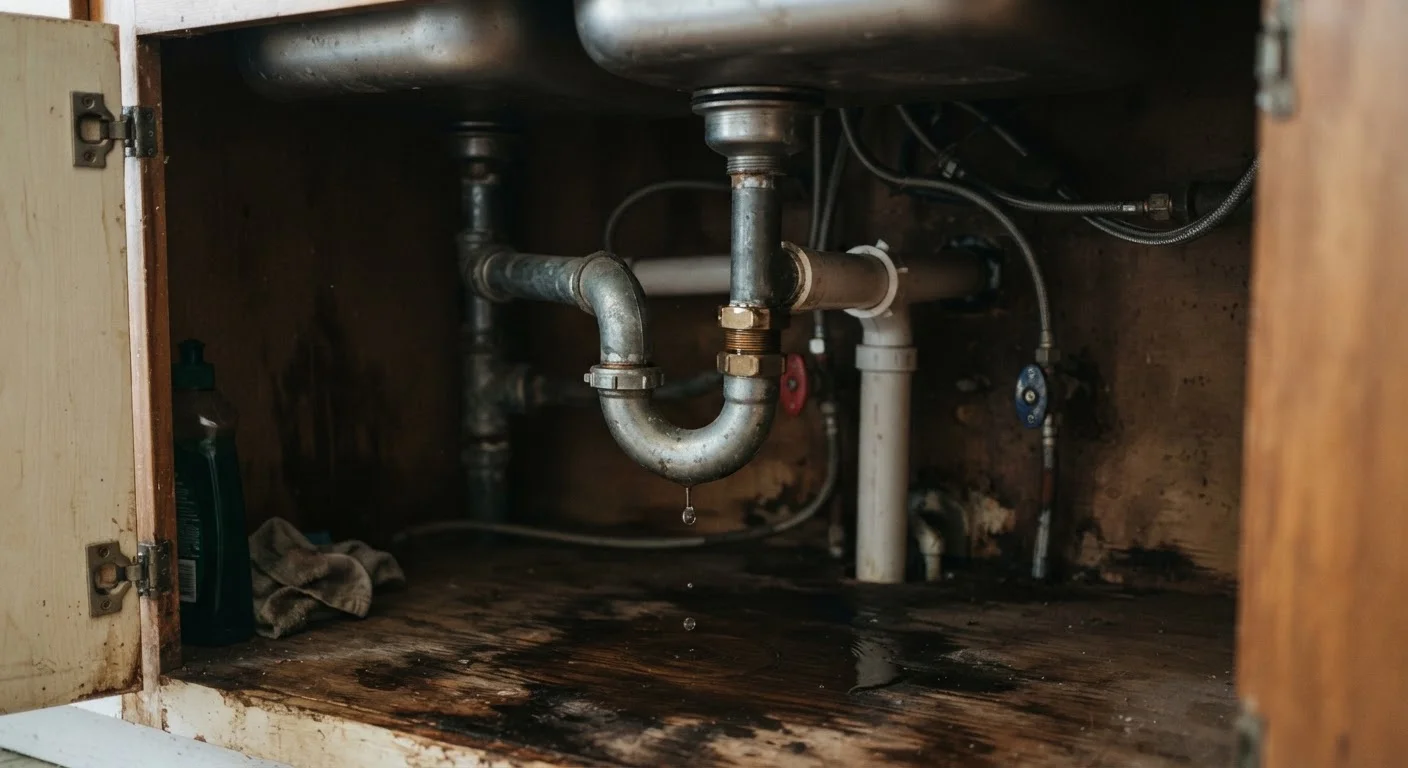
Why Small Plumbing Problems Rarely Stay Small
Plumbing issues have a predictable pattern: they start subtle, stay hidden, and then announce themselves at the worst possible moment - often through a water-stained ceiling, a flooded cabinet, or a utility bill that's doubled without explanation. The encouraging truth is that most expensive plumbing repairs are preceded by early warning signs that families can learn to recognize and act on.
Unlike a broken appliance or a cracked window, plumbing problems often develop out of sight. That invisibility makes it easy to defer action. A dripping faucet becomes background noise. A slow drain gets a temporary fix. A toilet that runs briefly after flushing gets written off as normal. But water is persistent - it finds every weakness and exploits it over time.
Understanding which oversights carry the highest risk is the first step. The mistakes below aren't obscure technical failures. They're everyday gaps in awareness that cost families hundreds - sometimes thousands - of dollars in avoidable repairs. For a broader look at how deferred maintenance creates financial strain, see why small leaks become big problems.
Ignoring a running toilet and assuming it's a minor quirk.
Why it happens: The sound of a running toilet is easy to tune out, and many families assume it's normal or will resolve on its own. The problem isn't visible, so urgency feels low.
Treating slow drains as a nuisance rather than a warning sign.
Why it happens: A drain that's slow but functional doesn't feel like an emergency, so families often pour chemical drain cleaners down and consider the issue solved - even when it returns.
Never testing shut-off valves under sinks or behind toilets.
Why it happens: Shut-off valves are out of sight and only matter in emergencies. Most families don't think about them until water is already spraying - at which point a seized valve becomes a genuine crisis.
Pouring grease and food debris down the kitchen drain without a second thought.
Why it happens: Liquid grease seems harmless going down, and families don't see the accumulation happening inside the pipes. Over time, it solidifies and catches other debris, forming stubborn blockages.
Skipping annual checks on supply lines to washing machines, dishwashers, and refrigerators.
Why it happens: Appliance supply lines are hidden and rarely inspected. Rubber hoses in particular degrade over time, and a burst washing machine hose can release a significant volume of water in minutes.
When to Call a Professional - and When You Can Handle It
Not every plumbing task requires a licensed plumber, but some absolutely do. Testing a toilet flapper, clearing a slow drain, or checking a shut-off valve are generally within reach for a careful homeowner. However, any work involving the main water supply line, in-wall pipe repairs, gas-adjacent systems, or work that may require a permit should be handled by a qualified professional.
Some Plumbing Work Requires a Licensed Professional
In most U.S. jurisdictions, repairs involving the main water line, in-wall or in-slab pipe work, and any gas-adjacent plumbing require a licensed plumber and may need a permit. Attempting this work without proper licensing can void homeowner's insurance coverage and create liability issues if the home is ever sold. Always verify your local code requirements before starting any plumbing project beyond basic maintenance.
If you're unsure whether a job is genuinely DIY-appropriate, a useful framework is to ask: what's the worst realistic outcome if something goes wrong? For guidance on making that call confidently, read our realistic framework for hiring a tradesperson versus tackling it yourself.
Preventive plumbing habits also connect to your home's overall maintenance picture. Bathroom surfaces - grout, sealant, and tile - play a bigger role in containing water than most families realize. Keeping bathroom surfaces in good condition reduces the chance of water migrating into walls and subfloors. Similarly, if your home has a basement, drainage and dampness issues often interact directly with plumbing problems - see maintaining a home with a basement for an honest overview. Addressing plumbing proactively is also one of the most straightforward ways families can protect their budget from unexpected shocks - a principle explored more broadly in the hidden habits that quietly derail family savings goals.
The content provided on our blog site traverses numerous categories, offering readers valuable and practical information. Readers can use the editorial team’s research and data to gain more insights into their topics of interest. However, they are requested not to treat the articles as conclusive. The website team cannot be held responsible for differences in data or inaccuracies found across other platforms. Please also note that the site might also miss out on various schemes and offers available that the readers may find more beneficial than the ones we cover.