

Our Verdict
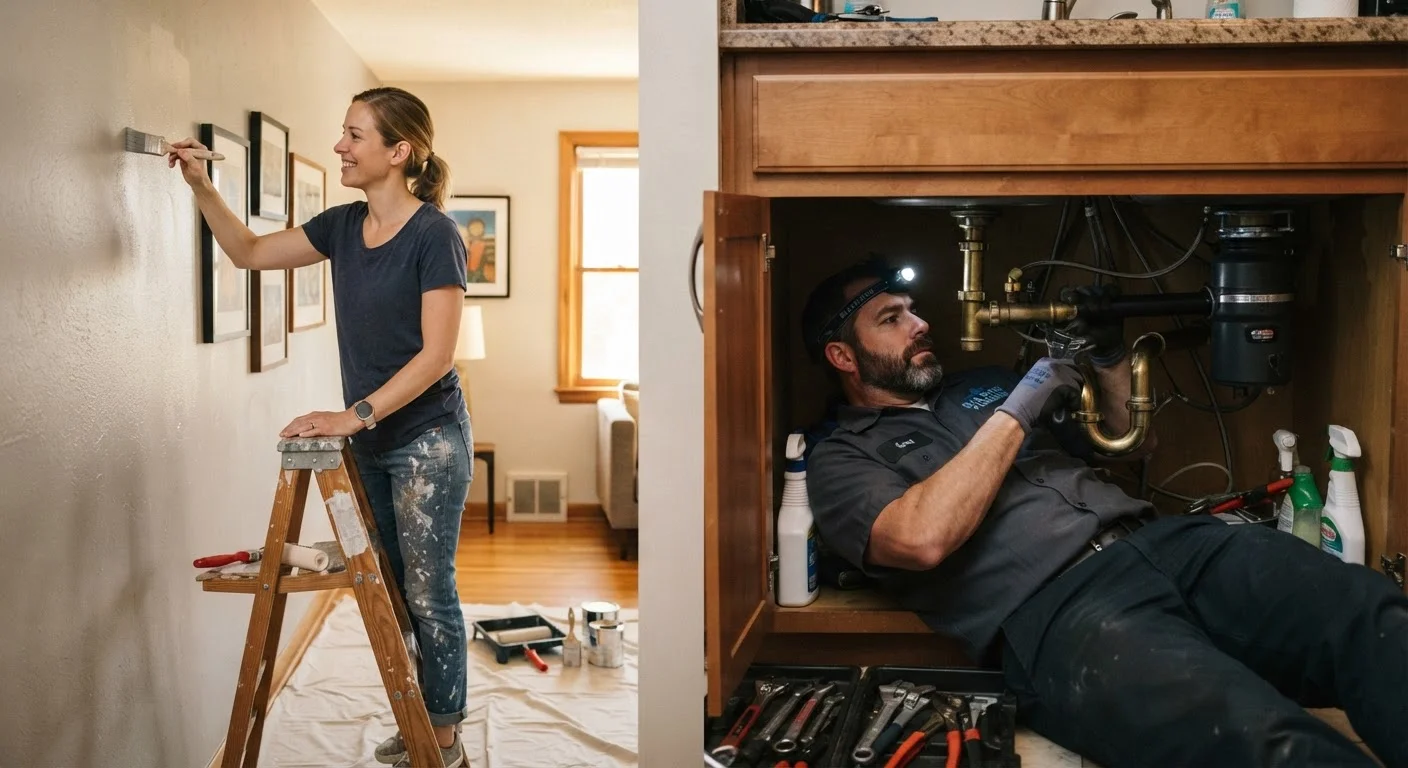
Neither DIY nor hiring a professional is universally better - the right choice depends on the specific task, your skill level, available time, and the consequences of error. Routine, low-risk maintenance often makes sense to handle yourself, while work involving safety systems, permits, or specialized tools almost always warrants a licensed professional.
| Best for | Recommended |
|---|---|
| Families comfortable with basic repairs and limited budgets | DIY |
| Complex, hazardous, or permit-required projects | Hiring a tradesperson |
| Time-pressed households with unpredictable schedules | Hiring a tradesperson |
| First-time homeowners building confidence on simple tasks | DIY (low-risk tasks only) |
Start With the Right Questions
Before reaching for your toolbox or searching for a contractor, the most productive first step is an honest self-assessment. Two questions cut through most of the noise: What are the real consequences if something goes wrong? and Do I have the knowledge, tools, and time to do this correctly?
Home repairs exist on a wide spectrum. Replacing a cabinet hinge, touching up exterior caulk, or swapping a showerhead are fundamentally different propositions from rewiring a circuit, repairing a gas line, or fixing a load-bearing wall. The former group is forgiving - mistakes are low-cost to fix. The latter can affect your family's safety, your home's structural integrity, or your insurance coverage if done improperly.
This framework helps you sort almost any task into the right category before committing time or money in the wrong direction.
The Case for DIY: Where It Genuinely Makes Sense
Handling repairs yourself can save money and build real competence over time - but only when the task is a genuine fit. DIY tends to work well when:
- The task is reversible. Painting a room, installing peel-and-stick tile, or assembling flat-pack furniture can be undone or redone if the result isn't right.
- The skill ceiling is reachable. Many maintenance jobs - patching drywall, unclogging drains, replacing outlet covers - require patience and the right tools, not years of training. Reliable tutorials exist, and the learning curve is manageable.
- Mistakes are affordable. If an error costs $30 in materials and a weekend afternoon, the risk-reward ratio is reasonable. If an error could mean $5,000 in remediation or a voided home warranty, the calculation changes.
- No permits are required. Cosmetic updates and minor repairs generally don't require permits. Work that changes the structure, electrical system, plumbing supply lines, or HVAC typically does - and unpermitted work can cause real problems when you sell your home.
For families building DIY confidence, low-stakes projects like yard and garden maintenance are an excellent starting point - physical effort matters more than technical know-how, and there's rarely a safety risk involved.
Start Small to Build Real Confidence
If you're new to home repair, choose one low-stakes project each season to develop skills gradually. Replacing a faucet aerator, recaulking a bathtub, or fixing a sticky door latch are all forgiving starting points. Documenting what you learn - including mistakes - makes each subsequent task easier and helps you recognize when a job is genuinely beyond your current skill level.
The Case for Hiring a Pro: When It's the Smarter Move
Hiring a qualified tradesperson isn't an admission of defeat - it's often the most economical and sensible decision available. Several clear signals point toward calling a professional:
- Safety systems are involved. Electrical panels, gas appliances, structural elements, and mains plumbing all carry risks that compound quickly if something goes wrong. Our guide to DIY electrical myths outlines why licensed electricians are essential for anything beyond the simplest tasks.
- Permits and inspections are required. Regulated work must be completed by licensed contractors in most jurisdictions. Skipping this step can affect your homeowner's insurance and create legal complications at resale.
- Specialized tools are needed. Some jobs require equipment - pipe cameras, pressure testers, concrete saws - that isn't practical to rent or buy for a single repair.
- Time is genuinely scarce. A professional completes in hours what might take an inexperienced homeowner a full weekend - sometimes longer if complications arise.
Small plumbing problems are a good example of where professional intervention pays off early. Tasks that seem minor, like a slow drain or a running toilet, can escalate significantly if the root cause is misdiagnosed. See our overview of plumbing fixes families overlook for context on how quickly costs can grow.
Don't Let Sunk Costs Drive the Decision
One of the most common DIY pitfalls is continuing a project after realizing it's beyond your skill level, simply because you've already spent money on materials or time. Stopping mid-project and calling a professional is almost always less expensive than compounding an error. A licensed tradesperson can often assess and correct a partially completed job, though it may cost more than if they had started from scratch.
Comparing the Trade-Offs Side by Side
Most families find it helpful to map the key variables before making a final call. The table below summarises the primary trade-offs across the dimensions that matter most.
| DIY | Hiring a Tradesperson | |
|---|---|---|
| Upfront cost | Lower (labour saved) | Higher (labour included) |
| Hidden costs | Tools, errors, time | Usually minimal if vetted |
| Time required | Variable, often longer | Typically faster |
| Safety for complex tasks | Higher risk without training | Lower risk with licensing |
| Permit compliance | Your responsibility to manage | Usually handled by contractor |
| Skill development | Builds over time | None for homeowner |
| Quality consistency | Varies by experience | More predictable |
Cost is rarely as simple as it looks. A DIY approach saves on labour but may require purchasing tools, materials in larger quantities than needed, or paying for a professional to fix errors later. Getting two or three quotes from licensed tradespeople gives you a reliable benchmark to compare honestly against the DIY cost - including your own time at a realistic hourly value.
A Practical Decision Process for Busy Families
When a repair comes up, work through these steps before deciding:
- Identify the task category. Is it cosmetic, mechanical, structural, or safety-related? The higher the category, the stronger the case for a professional.
- Check local permit requirements. Your local building department's website or a quick call can confirm whether the job needs a permit. Don't skip this step.
- Audit your tools and skills honestly. Not just whether you own the tools, but whether you know how to use them safely and accurately for this specific job.
- Estimate realistic time and cost. Factor in materials, potential error recovery, and the value of your time - not just the quote from a contractor.
- Consider the failure cost. A worst-case scenario for a simple task might be minor inconvenience. For complex work, it might be a flooded basement, a fire hazard, or an insurance claim denied because the work wasn't done by a licensed professional.
This same structured thinking applies beyond the home - DIY car maintenance decisions follow a nearly identical framework, with safety and permit considerations replaced by warranty and liability factors.
This article provides general guidance for informational purposes only. Always verify local building codes and permit requirements with your local authority, and consult a licensed professional for any work involving safety systems, structural elements, or regulated trades.
The content provided on our blog site traverses numerous categories, offering readers valuable and practical information. Readers can use the editorial team’s research and data to gain more insights into their topics of interest. However, they are requested not to treat the articles as conclusive. The website team cannot be held responsible for differences in data or inaccuracies found across other platforms. Please also note that the site might also miss out on various schemes and offers available that the readers may find more beneficial than the ones we cover.