

Why Keeping a Car Longer Makes Financial Sense
Buying a new or newer vehicle is one of the largest financial decisions a household makes, yet many families replace cars far sooner than necessary - often because they underestimate how manageable long-term ownership can be. As we explore in why families often spend more on cars than they intended, the pattern of premature replacement quietly drains budgets that could be strengthened instead.
The core principle is straightforward: depreciation is the largest single cost of owning a vehicle. Once a car is five or more years old, its annual depreciation slows dramatically. A well-maintained vehicle costing a few hundred dollars a year to service will almost always be cheaper to run than financing a replacement. The goal of this guide is to show families exactly which habits protect that investment - without requiring specialist knowledge or expensive professional visits for every minor item.
For a broader look at every financial dimension of ownership, the complete financial guide for families is worth bookmarking alongside this article.
What you will need
What You'll Need Before You Start
Most of the habits below require minimal tools and no mechanical expertise. The checklist below covers everything useful to have on hand for routine self-checks and informed conversations with a mechanic.
Owner's Manual
Provides manufacturer-specified service intervals, fluid types, and tyre pressures for your exact vehicle.
Tyre Pressure Gauge
Used to check tyre inflation against the recommended PSI, preventing uneven wear and improving fuel economy.
Funnel and clean rag
Useful for checking and topping up fluids such as engine oil, coolant, and windshield washer fluid without spillage.
Maintenance log or smartphone app
Tracks service history and upcoming intervals so nothing is missed and records are available if you sell the vehicle.
Step-by-Step: Building a Low-Cost Maintenance Routine
The steps below are ordered by frequency and impact. Work through them as a starting framework, then adapt to your vehicle's manufacturer schedule - found in the owner's manual or a dealership service portal.
Read and follow your manufacturer's service schedule
Open the owner's manual and locate the maintenance schedule - typically a table listing services by mileage or time intervals. Note the next due date for oil changes, filter replacements, coolant flushes, spark plugs, and timing belt or chain inspection. Set calendar reminders for each. This schedule is designed specifically for your engine and drivetrain; following it is the highest-return maintenance habit available to any owner.
Check engine oil level and condition monthly
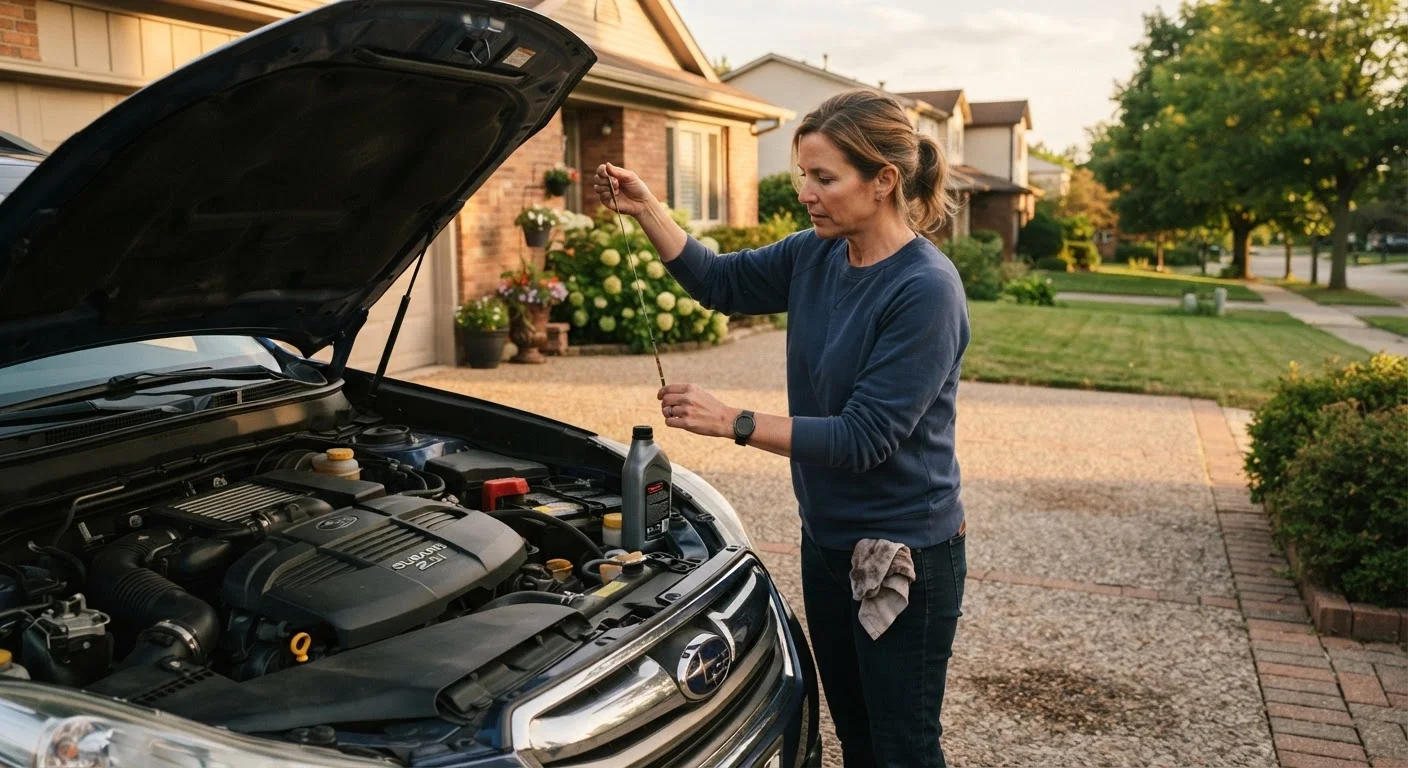
With the engine cold and parked on level ground, pull the dipstick, wipe it clean, reinsert it fully, and withdraw it again. The oil level should sit between the minimum and maximum markers. Also assess colour: fresh oil is amber; very dark or gritty oil suggests it is overdue for a change. Low oil level between services can indicate a leak or consumption issue worth mentioning to a mechanic promptly.
Maintain correct tyre pressure and inspect tread depth
Check all four tyres - and the spare - at least once a month and before long trips. The correct pressure is printed on the sticker inside the driver's door jamb (not on the tyre sidewall, which shows maximum pressure). Use a gauge when tyres are cold for an accurate reading. For tread depth, insert a quarter into a groove: if the top of the coin is visible, the tyre is approaching the legal minimum and should be inspected by a professional. Correct pressure also meaningfully reduces fuel consumption.
Monitor and top up other essential fluids
Beyond engine oil, check coolant, brake fluid, power steering fluid (if applicable), and windshield washer fluid regularly. Most reservoirs are translucent with marked levels. Brake fluid that has darkened significantly should be flagged to a mechanic - it absorbs moisture over time and can affect braking performance. Never mix fluid types; always use the specification listed in the owner's manual.
Replace air and cabin filters on schedule
A clogged engine air filter restricts airflow and can reduce fuel efficiency and engine performance. Cabin air filters affect interior air quality and HVAC efficiency. Both are typically inexpensive parts and, for many vehicles, straightforward to replace with basic guidance from the owner's manual. Check your manufacturer's recommended interval - commonly every 15,000-30,000 miles depending on driving conditions.
Address warning lights and unusual noises promptly
Dashboard warning lights and new sounds - squealing brakes, knocking from the engine, vibrations under acceleration - are early signals that something needs attention. Ignoring them rarely saves money; problems that are inexpensive to fix early often become costly if left. A mechanic can read fault codes with an OBD-II scanner (many auto parts stores offer this free) to identify issues before committing to repairs.
Keep a service record and store receipts
Every oil change, tyre rotation, and repair receipt tells the story of how a vehicle has been cared for. A complete service history gives you leverage when discussing repairs with a mechanic, helps you spot recurring issues, and adds tangible value if you eventually sell. A simple folder, notebook, or dedicated app works equally well. Consistent documentation costs nothing and takes minutes to maintain.
For a detailed breakdown of which specific services deliver the strongest financial protection, see routine maintenance that prevents expensive repair bills. Families watching their budget closely will also find practical strategies in keeping a family car well-maintained on a tight budget.
The 'Small Bills Over Big Bills' Mindset
Thinking of routine maintenance as a series of manageable, predictable costs - rather than an inconvenience - makes it easier to stay consistent. A $50 oil change today is far less disruptive to a family budget than a $3,000 engine repair caused by neglect. Building maintenance costs into your monthly household budget, even as a small line item, removes the friction that leads to skipped services.
Driving Habits That Quietly Extend - or Shorten - Vehicle Life
Mechanical condition is only partly determined by what happens in a workshop. How a vehicle is driven daily has a measurable effect on the lifespan of brakes, tyres, transmission, and engine components. Aggressive acceleration and hard braking increase wear rates significantly. Letting the engine warm for 30-60 seconds before driving in cold weather reduces cold-start stress on oil-dependent components.
Short trips - under five miles - are harder on an engine than longer ones, because the engine never fully reaches operating temperature, allowing moisture to accumulate in the oil. If your household has a second vehicle, considering whether both cars are pulling their weight financially can inform smarter usage decisions.
Safe, smooth driving also reduces accident risk - which ties directly to maintenance costs. The safe family driving hub covers the habits that protect both passengers and the vehicle itself. And before assuming a money-saving shortcut is worthwhile, check common myths about saving money on cars - some popular tips backfire.
Don't Confuse Deferring With Saving
Skipping or postponing a scheduled service rarely saves money in practice. Manufacturer intervals are set to prevent cumulative damage; each missed service increases the risk that the next one reveals a more serious - and more expensive - problem. If cost is a concern in a given month, strategies for maintaining a vehicle on a tighter budget offers practical ways to prioritise without simply deferring everything.
The content provided on our blog site traverses numerous categories, offering readers valuable and practical information. Readers can use the editorial team’s research and data to gain more insights into their topics of interest. However, they are requested not to treat the articles as conclusive. The website team cannot be held responsible for differences in data or inaccuracies found across other platforms. Please also note that the site might also miss out on various schemes and offers available that the readers may find more beneficial than the ones we cover.