

What Unit Pricing Actually Tells You
The total price on a package tells you what you'll hand over at the register. The unit price tells you what you're actually getting for that money. These two numbers are related but they answer very different questions - and for families managing a grocery budget, the unit price is almost always the more useful one.
Unit price strips away package size as a variable. A 32 oz bottle of dish soap priced at $3.99 and a 16 oz bottle priced at $2.49 look close in cost at a glance. But their unit prices - about $0.12 per oz versus $0.16 per oz - tell you the larger bottle delivers more soap per dollar. That gap compounds quickly across a full grocery run.
The same logic applies when comparing store brands to name brands, or standard sizes to club-store quantities. Without a common unit of measure, you're essentially guessing. With it, the comparison takes seconds.
~30%
Potential savings from unit price comparisons
Consumer advocacy research consistently finds shoppers who compare unit prices can reduce grocery spending by an estimated 20-30% on comparable products without changing brands.
32 states
States with some form of unit pricing law
According to the National Conference of State Legislatures, a majority of US states have enacted unit pricing requirements, though the scope and enforcement vary significantly.
< 10 sec
Time to manually calculate unit price
Dividing package price by total quantity using a phone calculator takes under ten seconds and works wherever shelf labels are absent or unclear.
How to Read a Shelf Label
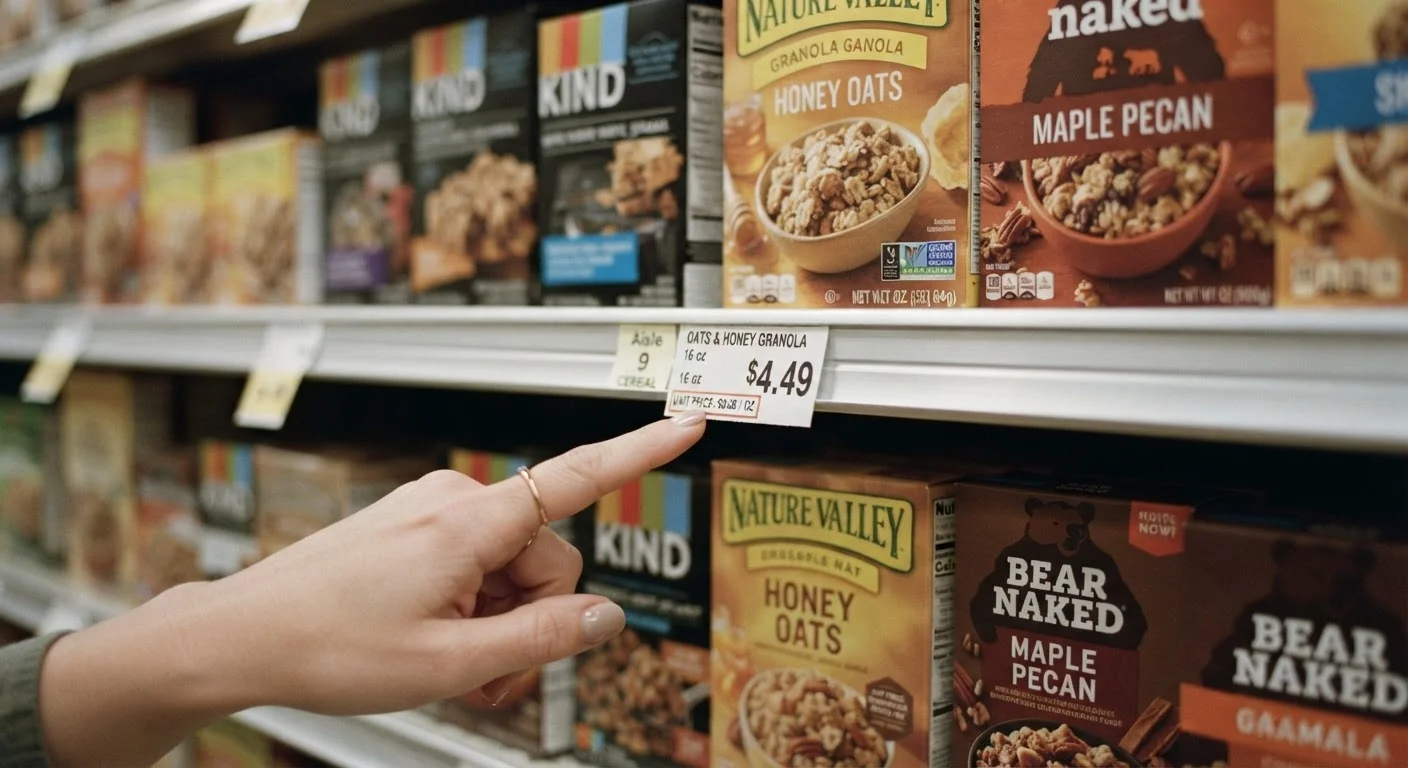
A standard grocery shelf label typically shows four things: the item name, the total price, the package size, and the unit price. The unit price is most often printed in smaller text - sometimes in a corner, sometimes on a separate line - and will read something like $0.18/oz or $1.24/lb.
The unit of measurement matters. Always check that you're comparing the same unit across products. One label might display cost per fluid ounce while another shows cost per pound. This comes up most often with liquid products, where fluid ounces (volume) and ounces (weight) are not interchangeable.
Use the Same Unit When Comparing
Before comparing unit prices between two products, confirm both labels use the same unit of measurement. Mixing fluid ounces with ounces by weight, or count with weight, will give you a misleading comparison. If units differ, calculate each manually using a consistent measure.
For products not covered by unit pricing rules - or in stores that don't display them - you can calculate it yourself: Total Price ÷ Total Quantity = Unit Price. A $5.76 package containing 24 items works out to $0.24 per item. It takes about ten seconds with a phone calculator and can reveal surprising differences between options sitting right next to each other on the shelf.
When Bigger Isn't Always Cheaper Per Unit
Conventional shopping wisdom says: buy bigger to save more. That's often true - but not reliably. Retailers sometimes price mid-size packages more competitively than their largest offering, particularly during promotions. A "family size" version of a cereal or snack might actually carry a higher unit price than the standard size when a sale is running on the smaller package.
Manufacturer coupons can flip the math further. A coupon applied to a smaller package may reduce its unit price below the larger size. This is worth checking anytime you're holding a coupon alongside a bulk option.
Bulk purchasing works well for some household staples but can quietly backfire with perishables or items your family goes through slowly. A low unit price means nothing if half the product expires before it's used. The real unit cost, once you account for waste, can be far higher than the label suggests.
It's also worth noting that a very low price per unit doesn't always indicate quality. A low price sometimes signals a manufacturing or safety trade-off worth being aware of, particularly for products where material quality matters.
Putting Unit Pricing to Work for Your Family
The most practical way to use unit pricing is to make it a quick, consistent habit rather than an intensive analysis. Focus it where your household spends the most - cleaning supplies, pantry staples, personal care, and pet food tend to show the biggest per-unit gaps between options.
For convenience products like pre-cut produce, portioned snacks, or ready-made meals, unit pricing can quantify exactly what you're paying for the time savings. Understanding the real cost of convenience helps families decide when that premium is worth it and when a small amount of prep work saves a meaningful amount of money.
Unit price is one input - not the whole picture. For a fuller view of what household purchases actually cost once you include fees, subscriptions, and other attached costs, see our guide on unit pricing, total cost, and hidden fees. Combining that awareness with consistent unit price comparisons gives families a reliable, low-effort way to keep their grocery spending honest.
Frequently Asked Questions
It's usually printed in smaller type in one corner of the shelf label - often the upper left or lower left. It's typically shown as a dollar amount followed by 'per oz,' 'per lb,' 'per count,' or another standard unit. If you can't find it, check if the store has a per-unit column on its price tag strip.
Not always. A lower unit price only saves money if you actually use the product before it expires or goes to waste. Storage space, upfront cash outlay, and your household's consumption rate all factor in. Our related article on <a href="/smart-shopping/saving-and-deals/why-buying-in-bulk-isnt-always-the-cheaper-choice">why bulk buying isn't always cheaper</a> covers this in detail.
Not every retailer is required to display unit prices, and requirements vary by state. Large grocery chains in many states are legally required to post them, but smaller stores, discount outlets, and some specialty shops may not. When labels are absent, you can calculate unit price yourself by dividing the total price by the quantity.
Yes - it's one of the most effective ways to compare brands head-to-head. Because different brands often use different package sizes, the sticker price alone is misleading. Unit price normalizes everything to the same measurement so the comparison is apples-to-apples.
Divide the total price by the total quantity. For example, a $4.50 jar containing 18 oz works out to $0.25 per oz. Most smartphones have a calculator app that makes this quick to do in the aisle.
Yes. Unit pricing is useful for paper goods, cleaning supplies, personal care products, pet food, and many other household staples. Whenever a product is sold in varying sizes or quantities, unit price gives you a reliable way to compare true cost.
The content provided on our blog site traverses numerous categories, offering readers valuable and practical information. Readers can use the editorial team’s research and data to gain more insights into their topics of interest. However, they are requested not to treat the articles as conclusive. The website team cannot be held responsible for differences in data or inaccuracies found across other platforms. Please also note that the site might also miss out on various schemes and offers available that the readers may find more beneficial than the ones we cover.