

Where the Money Goes When Manufacturing Gets Cheap
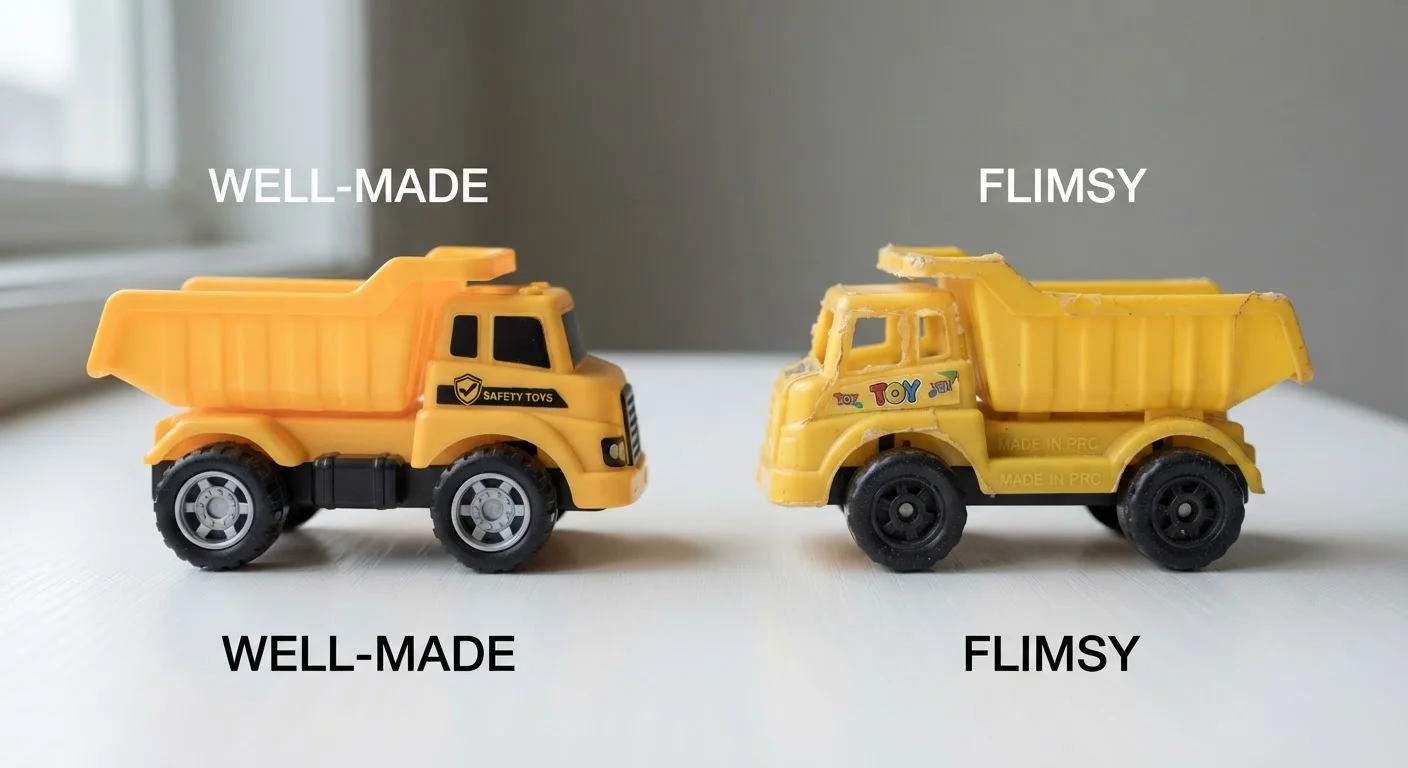
Every product has a cost floor - a minimum amount it realistically takes to produce something that performs safely and reliably. When a retail price falls well below that floor, something had to give during production. Understanding what typically gets cut helps families make smarter calls at the point of purchase.
Common cost-reduction levers include switching to lower-grade raw materials, reducing wall thickness in plastic components, skipping third-party safety testing, using untreated or substandard fasteners, and omitting quality control steps on the production line. None of these are immediately visible on a product listing or packaging. The savings are real to the manufacturer; the risks are transferred to the buyer.
This dynamic is most consequential in categories where physical integrity matters: electrical devices, children's toys, protective gear, and infant products. In those areas, the margin between a well-made product and a dangerous one is sometimes a few cents of material - or a skipped lab test.
Check Before You Buy in Safety-Critical Categories
For products used by children or that carry electrical or structural risk, spend two minutes before purchasing: look up the certification number on the certifying body's public database, check the CPSC recall database at SaferProducts.gov, and confirm the manufacturer is traceable. These steps take less time than a return - and matter far more for high-risk product types.
The Testing Gap Most Shoppers Don't Know Exists
Regulatory frameworks like those enforced by the US Consumer Product Safety Commission (CPSC) set mandatory minimums for many product categories. But compliance is not always verified before a product reaches a consumer. In practice, many manufacturers self-certify - meaning they declare compliance without submitting products to an independent accredited lab.
Third-party online marketplaces have widened this gap. A significant share of products sold through marketplace platforms - particularly imports - are not vetted by the platform in the same way a traditional retailer's own-bought inventory might be. The CPSC has publicly identified this as an area of ongoing concern.
Certification marks do provide meaningful guidance when they are legitimate. Marks such as UL Listed (for electrical products), ASTM compliance (for toys and recreational gear), or JPMA certification (for juvenile products) indicate that a product has been evaluated against a published standard. The caveat: counterfeit markings exist, so for high-stakes purchases it is worth checking whether the specific product model appears in the certifying body's public database.
392+
Marketplace import recalls in a recent CPSC annual report
The CPSC has documented a growing volume of recalls involving products imported and sold through third-party online marketplaces, reflecting gaps in pre-sale safety oversight.
~$1B
Annual consumer cost of unsafe product-related injuries
The CPSC estimates that injuries associated with consumer products cost the US economy hundreds of billions of dollars annually, with a meaningful share traceable to products that did not meet applicable safety standards.
40%+
Of recalled children's products sourced from third-party sellers
Analysis of CPSC recall data by consumer advocacy researchers has found that a significant proportion of children's product recalls in recent years involved goods sold through third-party online marketplace channels.
How to Recognise the Warning Signs
A dramatically low price in a regulated product category is a prompt to look closer - not necessarily a reason to walk away. Here are the signals worth examining:
- No verifiable certification: If a listing claims compliance but names no specific standard or certifying body, treat that as unverified.
- Vague or missing country-of-origin and manufacturer information: Legitimate products sold in the US must carry certain labeling; absence of traceable manufacturer details is a red flag.
- No or generic product documentation: Quality products typically come with warranty terms, safety instructions, and model numbers that can be looked up independently.
- Price significantly below the category norm: If a product type reliably sells within a certain price band from established retailers, a price that is 40-60% lower without a clear explanation warrants scrutiny.
- Few or suspiciously uniform reviews: Authentic review patterns vary; a product with hundreds of identical five-star reviews and no critical feedback is worth questioning.
For deeper guidance on evaluating products you cannot examine in person, see our guide to assessing product quality online. And if you want to understand the physical and documented signals that separate durable products from those built to fail, our piece on durable vs. cheap products covers that ground in detail.
The Real Cost of a Cheap Product That Fails
The financial framing of safety shortcuts tends to look one-sided at the point of sale. The sticker price is visible; the downstream costs are not. A product that fails early - or worse, causes harm - generates replacement costs, potential medical costs, and the less quantifiable but real cost of disruption to family life.
This is separate from the moral dimension of safety. From a purely practical standpoint, evaluating longevity alongside upfront cost often reveals that the apparent saving evaporates quickly. A car seat that doesn't meet current crash-test standards, a crib with recalled hardware, or an extension cord that overheats carries a potential cost no discount justifies.
It's also worth recognising that deal-seeking instincts - which are entirely rational for most household purchases - can work against families in specific contexts. Our article on deal-hunting habits that quietly cost more examines where this pattern shows up most often.
None of this means avoiding low prices categorically. It means applying different levels of scrutiny depending on what a product is designed to do - and who will be using it. Price is information. So is the absence of verifiable safety documentation. Together, they tell a more complete story than either alone.
Frequently Asked Questions
No - a low price alone does not confirm a product is unsafe. Cost efficiencies from manufacturing scale, simpler design, or reduced packaging can all lower prices without compromising safety. The concern arises when the price is dramatically below comparable regulated products, particularly in safety-critical categories like child gear, electrical devices, or protective equipment.
Look for recognized certification marks appropriate to the product category - such as ASTM, UL, or CPSC compliance markings in the US. For higher-stakes purchases, you can search the CPSC's recall database and request documentation from the seller. Independent lab test reports are more reliable than self-declared compliance labels.
They can carry higher uncertainty. Third-party sellers on major platforms are not uniformly subject to the same pre-sale safety vetting as established retailers. The US Consumer Product Safety Commission has noted that marketplace-sold imports are a growing area of concern for non-compliant products reaching consumers.
Children's toys, car seats, infant sleep products, helmets, electrical cords, extension leads, and smoke or carbon monoxide detectors are among the highest-risk categories. These products have direct consequences for physical safety, so cost-cutting in their production has serious potential implications.
Stop using the product immediately if you have concrete concerns. Report it to the US Consumer Product Safety Commission (CPSC) at SaferProducts.gov, and check whether a recall has been issued. Retain proof of purchase in case a refund or return is warranted.
For products where failure could cause injury - especially those used by children - spending within a verified, compliant price range is generally worthwhile. That said, the most expensive option is not automatically the safest; what matters most is documented compliance with relevant safety standards.
The content provided on our blog site traverses numerous categories, offering readers valuable and practical information. Readers can use the editorial team’s research and data to gain more insights into their topics of interest. However, they are requested not to treat the articles as conclusive. The website team cannot be held responsible for differences in data or inaccuracies found across other platforms. Please also note that the site might also miss out on various schemes and offers available that the readers may find more beneficial than the ones we cover.