

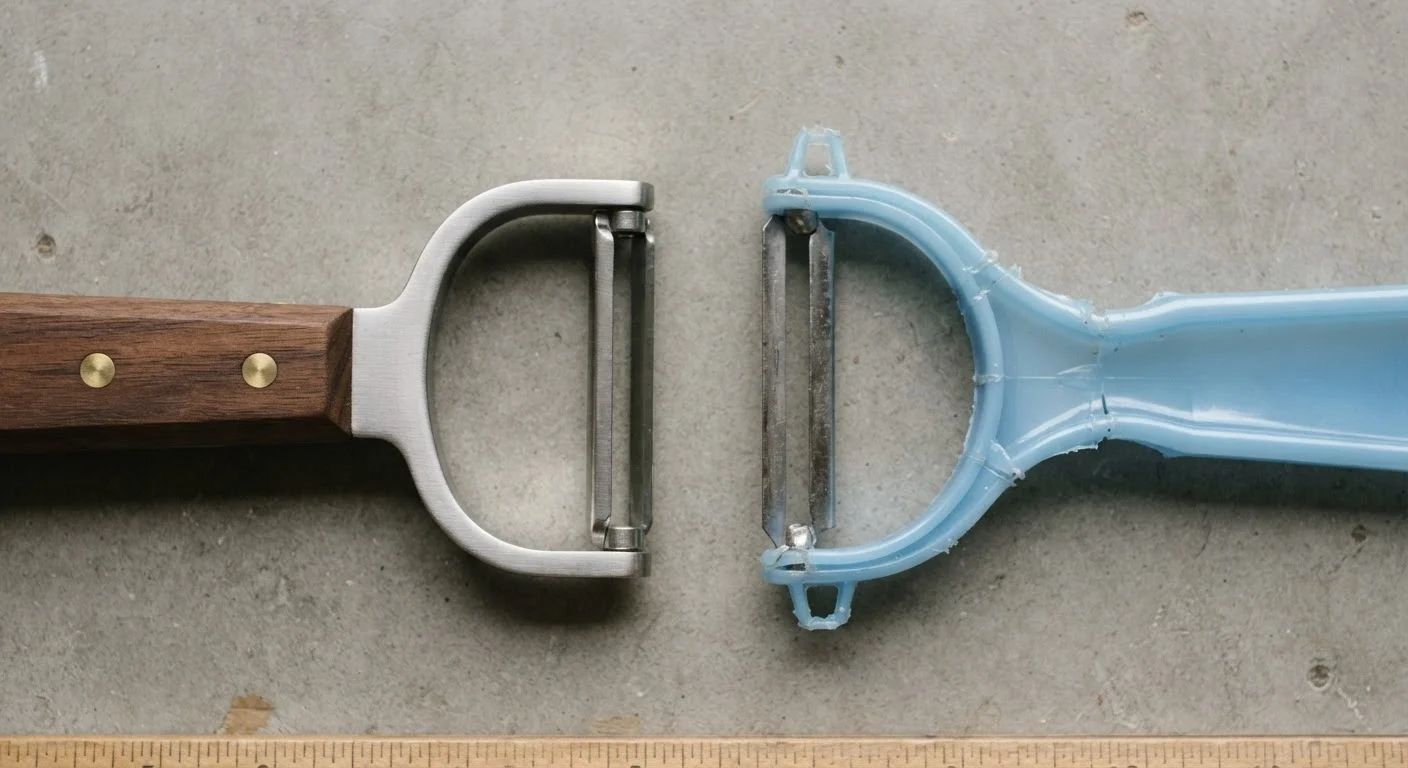
Option A
Durably Built Products
Designed to absorb real-world use without failing early.
Best for: Families who want fewer replacements, lower long-term cost, and confidence in safety for children.
Option B
Cheaply Made Products
Low upfront cost that often comes with hidden trade-offs.
Best for: Short-term, low-stakes uses where replacement cost and safety risk are both minimal.
What 'Durable' Actually Means in Physical Terms
Durability isn't a marketing claim - it's a set of observable, physical characteristics you can assess with your hands and eyes before spending a dollar. The clearest indicators are weight, joinery, and finish consistency.
Weight and density: Heavier isn't always better, but a product that feels surprisingly light for its size often uses thinner-gauge metal or lower-density plastic - materials that wear or crack sooner. Pick up two similar items; the one with more heft usually has more material in the places that take stress.
Seams and joints: Run your finger along any seam. Clean, tight joins where two materials meet indicate controlled manufacturing. Gaps, rough edges, or visible glue residue suggest that tolerances were cut to save time or money. On fabric items, count stitches per inch: tighter stitching distributes stress more evenly.
Surface finish: Uneven paint, bubbling, or soft plastic that dents under light thumb pressure are signs of shortcuts in materials or curing. These surface failures usually predict deeper structural issues rather than standing alone.
For online purchases where you can't handle the item, product quality evaluation methods help you replicate this assessment using photos, dimensions, and verified reviewer detail.
| Criterion | Durably Built | Cheaply Made |
|---|---|---|
| Weight & density | Heavier, consistent material thickness | Light, thin-gauge or hollow sections |
| Seams & joins | Tight, clean, flush | Gaps, rough edges, visible adhesive |
| Third-party certification | Named standard, independent lab mark | Vague or absent certification language |
| Warranty | Multi-year parts and labor coverage | 90 days or limited coverage only |
| Repairability | Accessible parts, available components | Sealed or non-serviceable construction |
| Hardware quality | Corrosion-resistant, tight tolerances | Plated, prone to stripping or loosening |
| Total cost over time | Lower due to fewer replacements | Higher when replacements are counted |
Documentation and Certifications That Signal Real Testing
Physical inspection tells you a lot, but documentation fills in what your hands can't reach - specifically, how a product performs under stress, over time, and against safety standards.
Third-party certifications: Look for marks from independent testing organizations (such as UL, ASTM, or JPMA for juvenile products in the US). These indicate a product was evaluated by a body with no financial stake in the outcome. A manufacturer can claim compliance internally; a third-party mark means an outside lab verified it. The presence and specificity of certification language matters - vague claims like "meets safety standards" without naming the standard are not the same thing.
Warranty structure: A manufacturer that offers a multi-year warranty on parts and labor is signaling confidence in their product's lifespan. Compare the warranty's actual coverage - what it excludes, whether it requires return shipping, and whether replacement parts are stocked. A 90-day warranty on a product expected to last five years is a red flag worth noting.
Repairability: Products designed to be repaired - with accessible parts, published manuals, and available components - are built by manufacturers who expect long-term use. Products with sealed, non-serviceable construction are designed for replacement. This matters both financially and environmentally. See our framework for evaluating longevity vs. low cost for a structured approach to this trade-off across categories.
~40%
Products recalled due to construction defects
The U.S. Consumer Product Safety Commission (CPSC) consistently finds structural or material failures among the leading causes of consumer product recalls.
3×
Longer lifespan in durable vs. cheap equivalents
Consumer Reports testing across appliance and tool categories has repeatedly found that better-constructed products last significantly longer under standardized use conditions.
Where Cheap Products Cut Corners - and Why It Matters
Cost-cutting in manufacturing is rational from a producer's standpoint, but it follows predictable patterns. Knowing where shortcuts typically occur helps you spot them.
Materials substitution: The most common cost reduction is swapping a more resilient material for a cheaper analogue - solid wood for particleboard, stainless hardware for plated steel that corrodes, food-grade plastic for lower-grade polymers. Particleboard furniture, for example, can hold significant weight initially but degrades rapidly with moisture exposure or repeated assembly. A very low price can sometimes indicate a safety problem rooted in exactly this kind of substitution.
Reduced fastener quality: Screws, bolts, and clips that strip easily or loosen after minimal use are a signature of cheap hardware. In children's furniture and gear, this matters beyond inconvenience - loosened fasteners can become structural failures or choking hazards.
Skipped testing cycles: Products that haven't undergone extended stress testing may perform acceptably initially but fail earlier than expected under real-use conditions. This is especially relevant for items like car seats, strollers, and play equipment, where fatigue failure has direct safety implications.
Before any significant family purchase, working through a family safety checklist that covers certifications, materials, and warning signs is a practical way to systematize this evaluation.
Making the Call: When Durability Is Worth It and When It Isn't
Not every purchase warrants the most robustly built option. The decision framework is simple: weigh frequency of use, safety stakes, and total cost of ownership against upfront price.
Items used daily - backpacks, cookware, children's furniture, car seats - experience far more cumulative stress than occasional-use items. For these, durable construction typically pays for itself through longevity alone, independent of any safety benefit. A product that costs 40% more but lasts three times as long represents better value by any calculation.
Conversely, for seasonal decorations, single-event party supplies, or short-term placeholders while you save for a better version, a cheaper option is a defensible choice - provided it carries no safety risk in the interim.
Reviews are another layer of due diligence, but only if they're trustworthy. Signals that indicate a review is genuine - such as verified purchase status, specific detail, and balanced language - help separate useful feedback from noise. Similarly, don't dismiss store-brand options outright; research on store brand vs. name brand quality shows the gap varies considerably by product category.
The goal isn't to always spend more. It's to spend with accurate information about what you're actually getting.
The content provided on our blog site traverses numerous categories, offering readers valuable and practical information. Readers can use the editorial team’s research and data to gain more insights into their topics of interest. However, they are requested not to treat the articles as conclusive. The website team cannot be held responsible for differences in data or inaccuracies found across other platforms. Please also note that the site might also miss out on various schemes and offers available that the readers may find more beneficial than the ones we cover.