

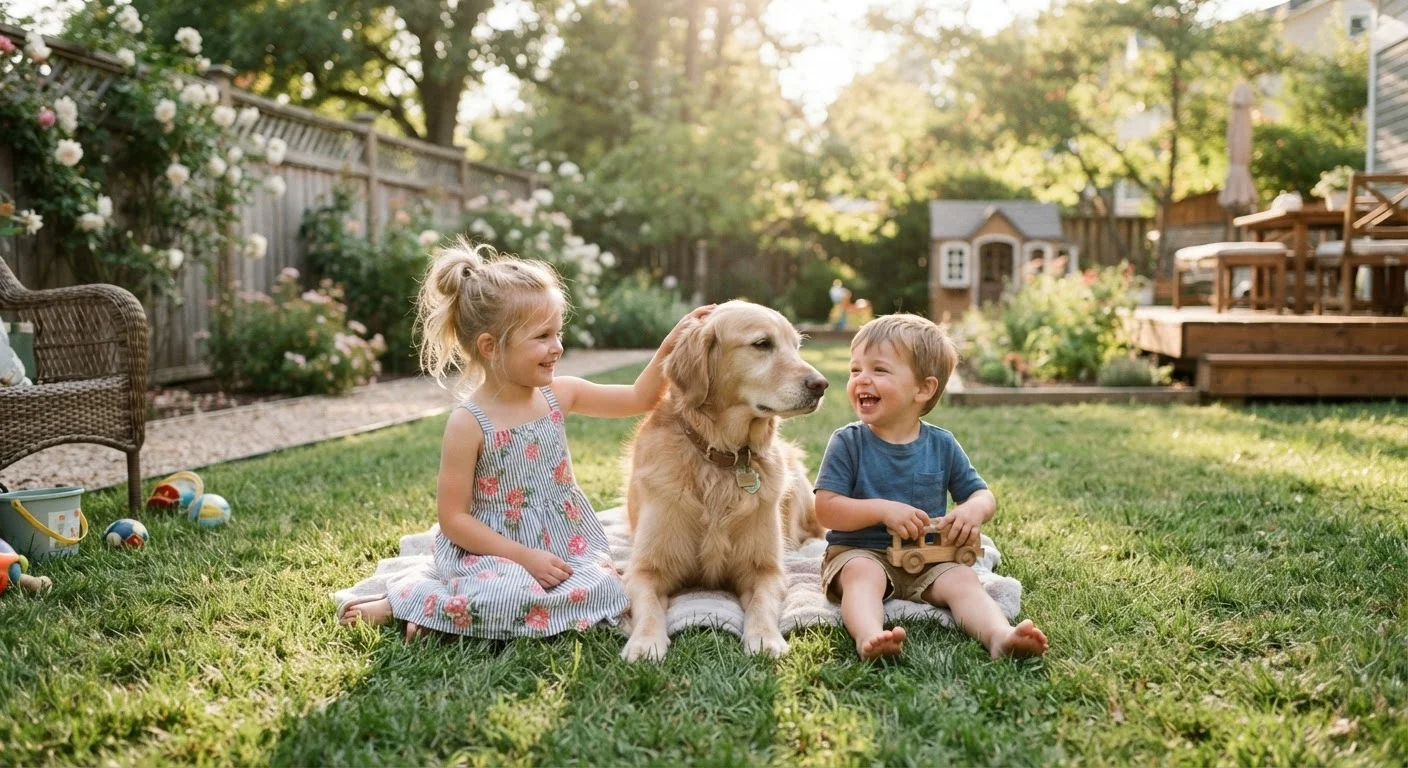
Why Calm Behavior Around Kids Requires Deliberate Training
Even a dog with a gentle temperament can become overwhelmed by the fast movements, high-pitched voices, and sudden hugs that come naturally to young children. What looks like aggression or bad manners is often a dog who simply hasn't learned how to cope with that level of stimulation. This is why calm behavior around kids isn't something that just develops on its own - it's a skill set your dog needs to build, one small step at a time.
Understanding the why behind your dog's reactions makes training far more effective. Dogs aren't naturally wired to interpret a toddler's lunge as a friendly gesture. They read body language differently than humans do, and children's behavior can look alarming from a dog's perspective. The good news: dogs are highly capable learners, and the methods that work best are also the most family-friendly. See our article on why positive reinforcement works better than punishment for the science behind this approach.
What you will need
Step-by-Step: Building Impulse Control and Child-Specific Calm
The steps below work for dogs of most ages and backgrounds. Progress at your dog's pace - some dogs move through these quickly; others need several weeks at a single stage. That's completely normal.
Reinforce a solid 'sit' and 'stay' in calm environments
Before introducing any child-related stimuli, make sure your dog can hold a 'sit-stay' for at least 10-15 seconds with moderate distractions. Practice in your living room, backyard, and hallway - anywhere your dog will eventually interact with kids. Keep sessions short: 3-5 minutes, two or three times a day.
Introduce child-like sounds and movements at a safe distance
Play recordings of children laughing, crying, and squealing at low volume while your dog is relaxed. Pair each sound with a treat. Gradually increase the volume over several sessions. Next, move around in ways that mimic children: run briefly past your dog, crouch down suddenly, wave your arms. Reward your dog for staying calm through each one.
Practice 'four paws on the floor' as a greeting rule
Jumping up is one of the most common complaints - and one of the most fixable. Ask for a 'sit' every time a person approaches. Completely ignore jumping (no eye contact, no pushing away) and reward the moment all four paws are on the ground. Consistency from every adult in the household is what makes this stick.
Do controlled, short introductions with a real child
With a calm child (ideally one your dog has already seen from a distance), ask your dog to sit. Have the child approach slowly from the side - not head-on - and offer the back of their hand to sniff. If your dog stays calm, reward generously. Keep these first sessions to under two minutes. End on a positive note before your dog loses focus.
Teach and practice 'leave it' as a de-escalation tool
Children drop food, toys, and other objects constantly. 'Leave it' teaches your dog to disengage from tempting items on cue. Start by covering a treat in your closed fist - when your dog stops pawing and looks away, reward with a different treat from your other hand. Gradually work up to dropped items on the floor, and eventually items a child is holding.
Build in a dog-safe retreat space and respect it as a rule
Every dog needs a place to go when they're done interacting - a crate, a mat, or a gated room where children are not allowed to follow. Train your dog to go to this space on cue ('go to your place') and reward them for settling there. Then make it a household rule: when the dog is in their spot, everyone leaves them alone.
Short Sessions Beat Long Ones Every Time
Dogs - especially those learning something new - retain information better in frequent short sessions than in one long training block. Aim for 3-5 minutes per session, two or three times daily. Always end before your dog loses interest, so the experience stays positive and your dog is eager to try again next time.
Keeping the Whole Family Involved Safely
Training works best when everyone in the household is consistent. Children can absolutely play a role - even young ones - when given age-appropriate tasks and clear boundaries. For a detailed breakdown of how to involve kids at different developmental stages, see our guide on involving kids in pet training.
Remind children never to approach the dog during meals, while sleeping, or when the dog has retreated to their designated safe space (such as a crate or bed). These boundaries protect both the child and the dog. If your dog is new to your home, our first month guide for new dogs covers how to set the right foundation from day one.
Supervision Is Non-Negotiable
Training builds better behavior - it does not eliminate risk. No dog, regardless of breed or temperament, should be left alone and unsupervised with a young child. Even a well-trained dog can be startled or overwhelmed. Adult presence at all times is the most important safety measure your family can maintain.
This article provides general training information and is not a substitute for professional behavioral guidance. If your dog shows signs of fear, anxiety, or aggression around children, consult a certified professional dog trainer or veterinary behaviorist before proceeding.
The content provided on our blog site traverses numerous categories, offering readers valuable and practical information. Readers can use the editorial team’s research and data to gain more insights into their topics of interest. However, they are requested not to treat the articles as conclusive. The website team cannot be held responsible for differences in data or inaccuracies found across other platforms. Please also note that the site might also miss out on various schemes and offers available that the readers may find more beneficial than the ones we cover.