

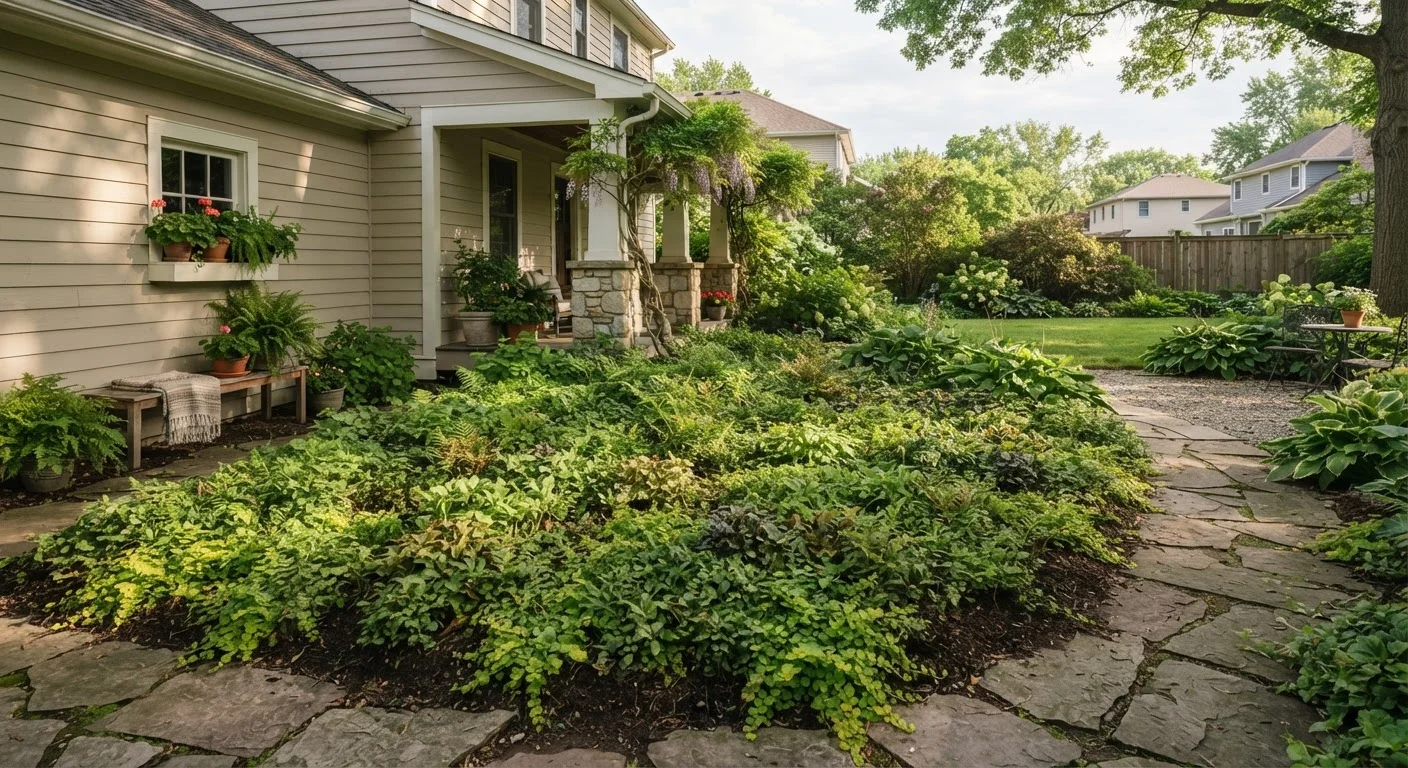
Why Ground Covers Deserve a Place in More Family Yards
If certain parts of your yard seem to fight you every season - thinning grass under a shade tree, bare slopes that wash out in rain, or a sun-baked strip that turns brown by midsummer - a ground cover may resolve those problems with far less ongoing effort than repeatedly reseeding or watering struggling turf.
Ground covers are low-growing plants that spread to form a living carpet, suppressing weeds and protecting soil in areas where mowing is awkward or grass simply won't thrive. Many require minimal watering once established, and none need the regular mowing that a lawn demands. For families already juggling a long list of seasonal yard tasks - outlined in our month-by-month lawn care guide - that reduction in upkeep can make a meaningful difference.
The options below span different light levels, moisture tolerances, and growth habits, so there is likely at least one that fits a real problem area in your yard.
Match the Plant to Your Conditions
Before selecting a ground cover, observe whether the area receives full sun, part shade, or full shade, and whether the soil drains well or stays moist. Choosing a plant suited to your actual conditions - rather than one you find attractive - is the single biggest factor in long-term success. A local cooperative extension office can advise on which options perform best in your region.
Six Ground Covers Worth Considering
Creeping Thyme
Creeping thyme forms a dense, fragrant mat that reaches only two to four inches tall. It tolerates foot traffic better than most ground covers - an important consideration in family yards where kids cut across planting areas. It thrives in full sun and well-drained soil, making it a practical choice for slopes, pathways edges, or the dry strips between pavers.
It produces small pink to purple flowers in early summer, which pollinators appreciate. Once established, it needs little supplemental water and does not require mowing, though a light shear after flowering keeps it tidy.
Creeping thyme tolerates foot traffic better than most ground covers - a real advantage in family yards.
Ajuga (Bugleweed)
Ajuga is one of the most reliable low-maintenance options for shady spots where grass consistently thins out. It spreads by runners, filling gaps quickly, and offers deep green to bronze-purple foliage depending on the variety. In spring it produces short spikes of blue or purple flowers that add seasonal interest without any effort on your part.
It handles moderate foot traffic and competes well with tree roots - two conditions that make many ground covers struggle. It does spread assertively, so it is worth edging it away from lawn areas annually.
Ajuga handles tree root competition and shade - exactly where lawn grass tends to give up.
Creeping Jenny
Creeping jenny produces bright chartreuse or golden-green foliage that spreads quickly along the ground, making bare or problem areas look intentional within a single season. It tolerates both full sun and partial shade, and it adapts well to moist spots near downspouts or low-lying areas where other plants struggle.
Small yellow flowers appear in summer. It can spread vigorously in consistently moist conditions, so it is best planted where you want broad coverage rather than in tight spaces near more delicate plants.
Creeping jenny is a smart pick for low-lying or moist areas where other options tend to rot or fail.
Pachysandra
Pachysandra is a classic choice for deeply shaded areas under mature trees - one of the trickier spots in any yard. It grows slowly at first but eventually forms a uniform, weed-suppressing carpet that needs virtually no attention once established. Its dark green foliage stays attractive year-round in most climates.
Because it spreads slowly, patience is required. Planting divisions about eight to twelve inches apart and mulching between them during the first season helps suppress weeds while the plants fill in. Japanese pachysandra is the most commonly available variety; native alternatives like Allegheny spurge are worth exploring if ecological impact is a priority - see our article on native vs. non-native plants for useful context.
Pachysandra is one of the few ground covers that genuinely thrives in deep shade under mature trees.
Clover
White clover has gained renewed interest as a lawn alternative or grass blend component. It fixes nitrogen from the air, which reduces the need for supplemental fertilizer, and it stays green through dry spells that leave turf grass brown. It also supports pollinators during its blooming period - an increasingly relevant consideration for many families.
Clover is soft underfoot and can handle moderate use. It does not hold up to heavy foot traffic or play areas as well as turf, so it works best in lower-traffic zones or mixed into existing lawn seed. For more on managing what grows in your lawn, practical weed control strategies can help you think through the balance.
Clover fixes nitrogen naturally, reducing fertilizer needs while staying green through dry periods.
Liriope (Lilyturf)
Liriope is a grass-like perennial that works especially well as a border plant or for filling slopes where erosion is a concern. It is notably drought-tolerant once established and holds up in both sun and shade - a flexibility that makes it useful in yards with varying light conditions. Purple flower spikes appear in late summer, followed by small dark berries.
It rarely needs division and does not spread aggressively, which makes it easier to manage long-term than some faster-spreading alternatives. In colder climates, foliage may look ragged by late winter; cutting it back to a few inches in early spring restores a tidy appearance.
Liriope's tolerance of both sun and shade makes it one of the most flexible choices for mixed-light yards.
Establishment Takes Time
Most ground covers take one to two full growing seasons before they fill in densely enough to suppress weeds on their own. During that window, mulching between plants and hand-pulling weeds as they appear is the most effective approach. See our guide on mulching strategies for practical tips on keeping that first season manageable.
Putting It All Together
No single ground cover works everywhere, and none is maintenance-free in the literal sense - especially during that first establishment season. But compared with the time and resources a struggling lawn patch demands year after year, most of these options represent a significant long-term reduction in effort.
Start with one problem area: identify the light level, check whether the soil drains or holds moisture, and choose accordingly. Plant at the spacing recommended on the plant tag, mulch between them, and water consistently through the first dry season. By the second year, most of these plants will have spread enough to handle themselves. For a broader view of what a well-maintained backyard actually involves across all seasons, our full-year backyard overview is a useful starting point.
The content provided on our blog site traverses numerous categories, offering readers valuable and practical information. Readers can use the editorial team’s research and data to gain more insights into their topics of interest. However, they are requested not to treat the articles as conclusive. The website team cannot be held responsible for differences in data or inaccuracies found across other platforms. Please also note that the site might also miss out on various schemes and offers available that the readers may find more beneficial than the ones we cover.