

Start here
What Is Cholesterol, Really?
Next
Breaking Down the Cholesterol Panel
Then
What the Numbers Generally Mean
Dig deeper
What Can Influence Your Cholesterol Levels?
Wrap up
Having an Informed Conversation With Your Doctor
What Is Cholesterol, Really?
Cholesterol is a waxy, fat-like substance found in every cell of the body. Despite its reputation, your body actually needs it - to build cell membranes, produce hormones, and help digest food. The liver makes most of the cholesterol your body requires; the rest comes from food.
The problem isn't cholesterol itself, but rather the balance of different types in your blood and how they interact with your arteries over time. Cholesterol doesn't travel through the bloodstream on its own - it's carried by proteins called lipoproteins. Different lipoproteins behave very differently, which is why your lab report breaks cholesterol into several measurements rather than just one.
Lipoprotein
A particle made of fat and protein that carries cholesterol through the bloodstream. Different types - like LDL and HDL - behave very differently in the body.
LDL (Low-Density Lipoprotein)
A lipoprotein that can deposit cholesterol in artery walls over time. Often called 'bad' cholesterol because elevated levels are linked to increased cardiovascular risk.
HDL (High-Density Lipoprotein)
A lipoprotein that helps remove cholesterol from artery walls and carry it to the liver. Often called 'good' cholesterol because higher levels are generally associated with lower heart disease risk.
Triglycerides
A type of fat found in the blood that is measured alongside cholesterol in a lipid panel. High levels may contribute to cardiovascular risk.
Lipid Panel
A standard blood test that measures total cholesterol, LDL, HDL, and triglycerides to give a picture of your blood fat levels.
Familial Hypercholesterolemia
An inherited genetic condition that causes very high LDL cholesterol levels from birth, regardless of diet or lifestyle. It requires medical management.
Breaking Down the Cholesterol Panel
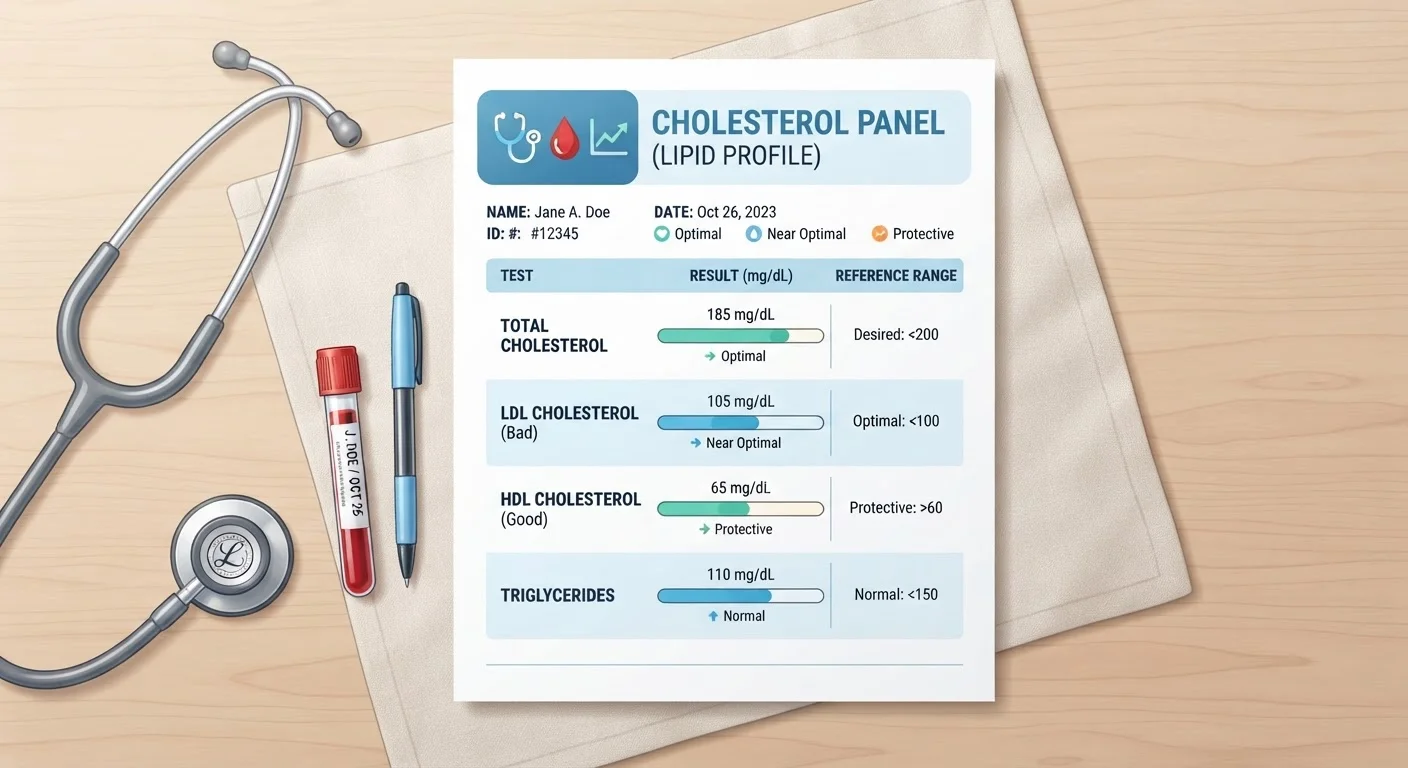
A standard lipid panel (also called a lipid profile) is a blood test that measures four values:
- Total cholesterol: The combined amount of cholesterol in your blood, including all lipoprotein types.
- LDL (low-density lipoprotein): Often called 'bad' cholesterol. LDL can deposit cholesterol in artery walls, contributing to plaque buildup over time.
- HDL (high-density lipoprotein): Often called 'good' cholesterol. HDL helps carry cholesterol away from arteries and back to the liver for processing.
- Triglycerides: A separate type of fat in the blood, not technically cholesterol, but measured in the same panel. Elevated triglycerides may contribute independently to cardiovascular risk.
You'll also sometimes see a non-HDL cholesterol value, which is simply total cholesterol minus HDL. This figure captures all potentially harmful cholesterol-carrying particles and is considered a useful overall marker by many clinicians.
For more context on how to read these figures alongside other lab values, see our guide on reading a lab report without a medical degree.
What the Numbers Generally Mean
The following ranges reflect widely cited general guidelines from organizations such as the American Heart Association and the National Institutes of Health. They are general reference points - not personal targets. Your doctor will interpret your results in the context of your age, family history, blood pressure, and other risk factors.
| Measurement | Generally Desirable | Borderline / Watch | High Risk (general) |
|---|---|---|---|
| Total Cholesterol | Below 200 mg/dL | 200-239 mg/dL | 240 mg/dL and above |
| LDL Cholesterol | Below 100 mg/dL | 130-159 mg/dL | 160 mg/dL and above |
| HDL Cholesterol | 60 mg/dL and above | 40-59 mg/dL | Below 40 mg/dL (men) / Below 50 mg/dL (women) |
| Triglycerides | Below 150 mg/dL | 150-199 mg/dL | 200 mg/dL and above |
Notice that HDL works in the opposite direction - a higher number is better. This is a common point of confusion when reading a panel for the first time.
Context Matters More Than Any Single Number
A total cholesterol reading of 210 mg/dL might prompt close monitoring in one person and be less concerning in another depending on their HDL level, family history, and other risk factors. Think of each measurement as one piece of a larger puzzle, not a standalone verdict.
What Can Influence Your Cholesterol Levels?
Cholesterol levels reflect a mix of factors - some within your control, some not.
Lifestyle factors
- Diet: Foods high in saturated fats (like fatty meats and full-fat dairy) and trans fats tend to raise LDL. Foods rich in soluble fiber and unsaturated fats can support healthier levels.
- Physical activity: Regular aerobic activity is associated with modest increases in HDL and reductions in triglycerides.
- Smoking: Tobacco use lowers HDL and damages artery walls, compounding cardiovascular risk.
- Body weight: Excess weight tends to raise triglycerides and lower HDL, though the relationship is not uniform across individuals.
Factors outside your control
- Genetics: Familial hypercholesterolemia is an inherited condition that causes very high LDL regardless of lifestyle.
- Age and sex: Cholesterol levels tend to rise with age. Estrogen generally raises HDL, so after menopause many women see their cholesterol profile shift.
- Underlying conditions: Thyroid disorders, kidney disease, and diabetes can all affect cholesterol metabolism.
Understanding these influences can help frame a productive conversation with your healthcare provider about which levers are most relevant for you. Cholesterol health often intersects with other measurements too - our blood pressure numbers decoded guide is a helpful companion read.
Having an Informed Conversation With Your Doctor
Knowing your numbers is a starting point - understanding what they mean for you specifically requires professional context. Clinicians today often use cardiovascular risk calculators that incorporate your cholesterol values alongside age, blood pressure, smoking status, and diabetes history to estimate your overall risk of a cardiac event over the next decade.
When you receive your lipid panel results, consider asking:
- What is my overall cardiovascular risk based on all my numbers together?
- Which of my values is most important to focus on right now?
- Are there lifestyle changes likely to make a meaningful difference for my situation?
- When should I be retested?
If you're also navigating other health metrics, it can help to see the full picture. Our article on what your BMI score can and cannot tell you explores how another common clinical number fits - and doesn't fit - into overall health assessment.
This article is for general informational purposes only and is not medical advice. Always consult a qualified healthcare professional for guidance about your personal health, symptoms, or lab results.
Frequently Asked Questions
General guidelines suggest total cholesterol below 200 mg/dL is desirable for most adults, but 'normal' depends on your individual risk factors. LDL, HDL, and triglyceride targets vary by person. Your healthcare provider is the right person to interpret your specific results.
Most health guidelines recommend adults aged 20 and older have their cholesterol checked every four to six years if they have no known risk factors. Those with higher cardiovascular risk may need more frequent testing - your doctor can advise the right schedule for you.
High cholesterol typically has no symptoms, which is why it's often called a 'silent' risk factor. The only reliable way to know your levels is through a blood test ordered by a healthcare provider.
The relationship is more nuanced than once thought. Saturated and trans fats have a stronger influence on blood LDL levels than dietary cholesterol alone. Current dietary guidance focuses more on the type of fat consumed than cholesterol content in food.
HDL (high-density lipoprotein) helps carry cholesterol away from artery walls toward the liver for removal, so higher levels are generally favorable. LDL (low-density lipoprotein) can deposit cholesterol in artery walls, so lower levels are generally preferred.
Yes. A standard lipid panel includes triglycerides alongside HDL, LDL, and total cholesterol. Triglycerides are a separate type of fat in the blood, and elevated levels may contribute independently to cardiovascular risk.
The content provided on our blog site traverses numerous categories, offering readers valuable and practical information. Readers can use the editorial team’s research and data to gain more insights into their topics of interest. However, they are requested not to treat the articles as conclusive. The website team cannot be held responsible for differences in data or inaccuracies found across other platforms. Please also note that the site might also miss out on various schemes and offers available that the readers may find more beneficial than the ones we cover.