

Why Speed and Stopping Don't Scale the Way You Think
Most drivers have an intuitive but incorrect mental model of stopping: go twice as fast, need twice the space. In reality, the physics work against you much more sharply. Braking distance scales with the square of speed, which means every incremental increase in velocity carries a disproportionate cost in stopping room.
At 30 mph, total stopping distance on a dry road is roughly 75 feet. At 60 mph - exactly double the speed - that figure climbs to around 240 feet under standard conditions. That's more than three times the distance, not two. For a family in a loaded SUV, the numbers climb further still. This gap between assumption and reality is where many accidents originate.
240 ft
Typical stopping distance at 60 mph on dry road
Based on standard driver reaction time and braking estimates from highway safety education resources.
~4×
Braking distance increase when speed doubles
Because braking distance scales with the square of speed, doubling velocity roughly quadruples the distance needed to stop.
50%+
Extra stopping distance in wet conditions
Rain significantly reduces tyre grip; safety guidance commonly references stopping distances increasing by half or more on wet roads.
The Two Parts of Every Stop
Every stop happens in two distinct phases, and understanding both helps explain why tailgating is so dangerous even at moderate speeds.
Thinking Distance
This is the distance your car covers while your brain processes a hazard and your foot moves to the brake. An alert driver typically takes around 1.5 seconds to react. At 60 mph, that's approximately 90 feet of road traveled before braking begins - and that's assuming no distraction. A glance at a phone, a crying child in the back, or fatigue can push that number significantly higher. See our guide to habits that quietly raise driving risk for a fuller look at how common routines affect reaction time.
Braking Distance
Once your foot is on the brake, the car still needs distance to decelerate to zero. This phase is governed by friction between your tyres and the road, the vehicle's weight, and brake condition. Worn tyres, a damp road surface, or extra passengers all extend this phase. The two add together to form total stopping distance - and the margin for error shrinks fast at highway speeds.
The Two-Second Rule - and When It Isn't Enough
The two-second following distance rule is widely taught because it's simple to apply in real time. Choose a stationary point - a sign, a bridge - and count the seconds between when the car ahead passes it and when you do. Two seconds is the minimum on a dry road in good conditions.
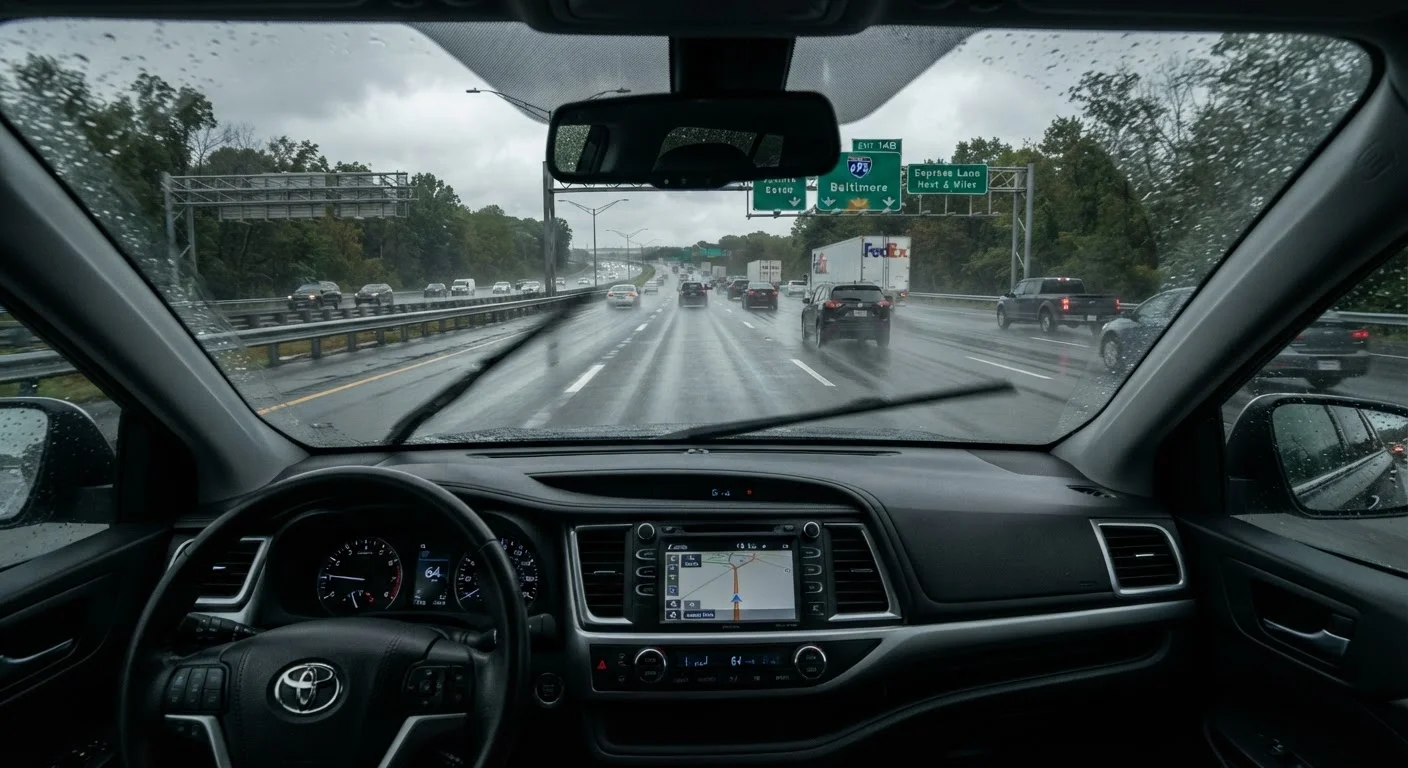
But conditions are rarely ideal. Rain increases stopping distances by roughly 50 percent. Ice can multiply them by eight or more. A vehicle carrying extra passengers or cargo has more momentum to overcome. In any of these situations, two seconds is an insufficient buffer. Three to four seconds - or even more on snow and ice - is a more honest safety margin for family driving in variable conditions. Our article on adjusting driving for weather and road conditions explains how to adapt your approach season by season.
Apply the Two-Second Rule While Driving
Pick any fixed roadside object ahead. When the car in front passes it, begin counting: "one-one-thousand, two-one-thousand." If you pass the object before finishing the count, you're too close. In rain or with a full vehicle, extend your count to four seconds.
Load, Tyres, and the Variables Families Control
One underappreciated factor is what's in the car. A family vehicle loaded with children, luggage, and sports gear weighs meaningfully more than the same vehicle empty. More mass means more momentum, which demands more braking force and more distance. Vehicle manufacturers account for this in their brake design, but physics still apply: heavier loads extend stopping distance.
Tyre condition is equally important and more directly in a family's control. Tread depth affects how well a tyre displaces water from the road surface. Tyres worn close to or below the legal minimum can behave very differently on a wet road compared to tyres with full tread. Regular checks - including tyre pressure, which affects contact area - are among the most cost-effective safety habits a household can maintain. For context on managing vehicle-related costs, including maintenance decisions, see why families often spend more on cars than intended.
Tyre Checks Take Less Than Five Minutes
A quick monthly check of tread depth and tyre pressure takes only a few minutes and costs nothing beyond a basic gauge. Tread depth below 2/32 of an inch (the legal minimum in most U.S. states) significantly compromises wet-road grip. Many tyre professionals and auto centres offer free pressure checks as well.
Frequently Asked Questions
The two-second rule means keeping at least two seconds of travel time between your car and the vehicle ahead. Pick a fixed point on the road; when the car in front passes it, at least two seconds should pass before you reach the same point. In rain, fog, or with a loaded vehicle, extend this to three or four seconds.
Braking distance increases with the square of your speed. Going from 30 mph to 60 mph doesn't double your braking distance - it roughly quadruples it. This is one of the most underestimated physics principles in everyday driving.
Yes. A heavier vehicle carries more momentum, which requires more braking force and distance to overcome. A minivan or SUV loaded with passengers and luggage will need more stopping room than the same vehicle lightly loaded, even with identical brakes and tyres.
Worn tyres have reduced grip, especially on wet roads. Tread depth directly affects how quickly water is displaced from the contact patch. Tyres near or below the legal minimum tread depth can dramatically increase stopping distance in rain.
No. On wet roads, braking distances can increase by 50 percent or more compared to dry conditions. Safety guidance generally recommends doubling the gap - using a four-second rule - in rain, and increasing further on snow or ice.
Thinking distance is how far your car travels during the time it takes you to recognise a hazard and physically press the brake. At 60 mph, that reaction time - typically around 1.5 seconds for an alert driver - translates to roughly 90 feet of distance before braking even begins.
The content provided on our blog site traverses numerous categories, offering readers valuable and practical information. Readers can use the editorial team’s research and data to gain more insights into their topics of interest. However, they are requested not to treat the articles as conclusive. The website team cannot be held responsible for differences in data or inaccuracies found across other platforms. Please also note that the site might also miss out on various schemes and offers available that the readers may find more beneficial than the ones we cover.