

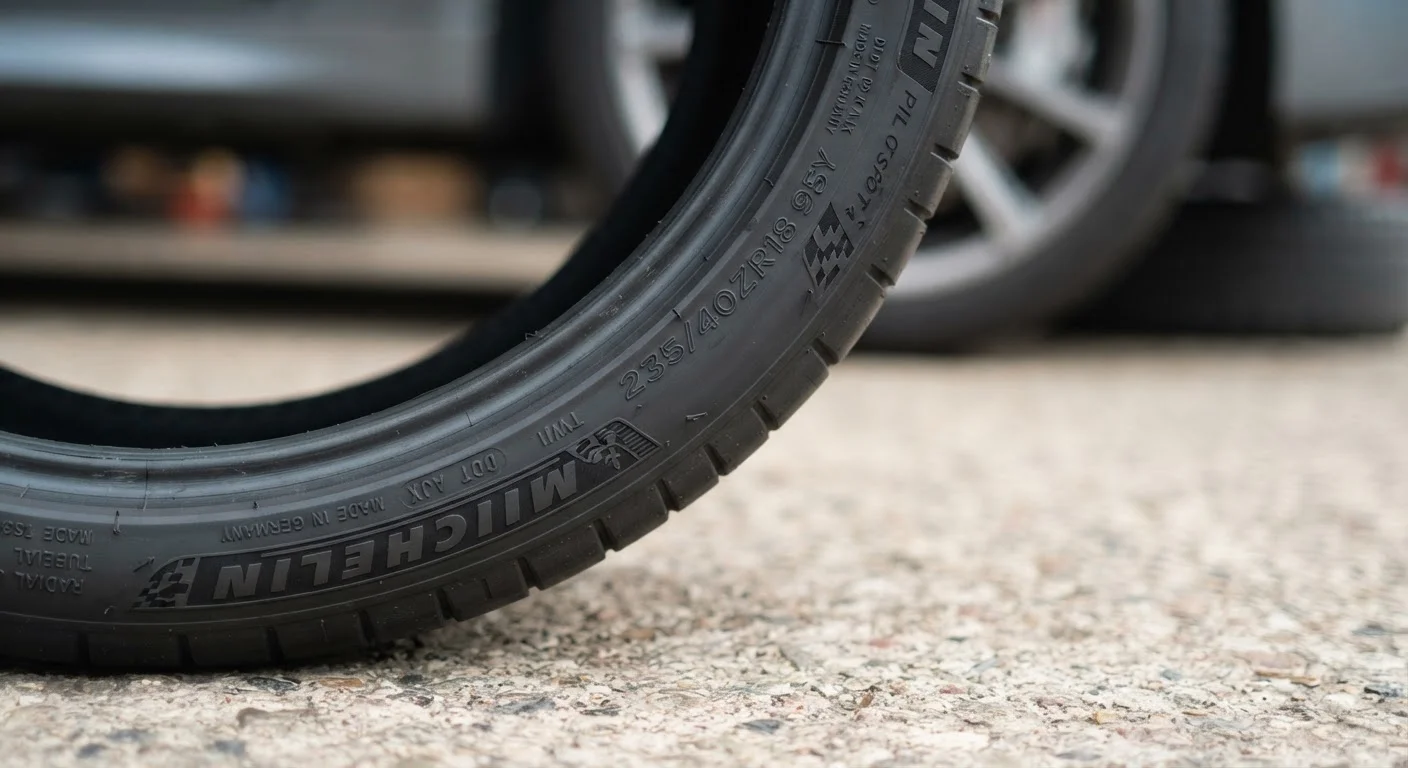
Decoding the Numbers on Your Tyre Sidewall
That string of numbers and letters stamped into your tyre's sidewall - something like 225/55R17 97V - isn't random. Each segment carries specific information your vehicle depends on.
| Legal tread minimum (most U.S. states) | 2/32 inch (State motor vehicle codes; verify for your state) |
| Recommended tread-replacement threshold (safety) | 4/32 inch (General industry and safety guidance) |
| Typical new tyre tread depth | 10/32-11/32 inch (Standard passenger tyre manufacturing specs) |
| TPMS warning threshold | 25% below recommended PSI (U.S. NHTSA TPMS federal standard) |
| Maximum recommended tyre age | 10 years from manufacture date (Most major tyre manufacturers' published guidance) |
- 225
- Section width in millimeters - how wide the tyre is from sidewall to sidewall.
- 55
- Aspect ratio - the sidewall height expressed as a percentage of the section width. A lower number means a shorter, stiffer sidewall.
- R
- Radial construction - the internal ply cords run perpendicular to the direction of travel. Virtually all passenger tyres sold today are radial.
- 17
- Rim diameter in inches - the wheel size the tyre is designed to fit.
- 97
- Load index - a code indicating the maximum weight each tyre can safely carry. A 97 rating corresponds to roughly 1,609 lbs (730 kg) per tyre.
- V
- Speed rating - the maximum sustained speed the tyre is designed for. V indicates up to 149 mph (240 km/h). Never fit a tyre with a lower speed rating than your vehicle manufacturer specifies.
You'll also find a DOT code on the sidewall. The last four digits show the week and year of manufacture - for example, 2322 means the 23rd week of 2022. Tyres older than six years generally warrant professional inspection regardless of visible condition; most manufacturers recommend replacement by ten years from the manufacture date.
Tyre Pressure: Finding and Maintaining the Right PSI
The single most common - and consequential - tyre mistake families make is running on incorrect pressure. Underinflated tyres wear faster on the outer edges, reduce fuel economy, and can overheat at highway speeds. Overinflated tyres wear faster in the center and reduce the contact patch, compromising grip.
PSI
Pounds per square inch - the standard unit used in the U.S. to measure tyre air pressure. Your vehicle's recommended PSI is set by the manufacturer, not the tyre maker.
TPMS
Tyre Pressure Monitoring System. A sensor-based system required on U.S. passenger vehicles since 2008 that alerts the driver when one or more tyres drops significantly below the recommended pressure.
Aspect ratio
The sidewall height expressed as a percentage of the tyre's section width. A tyre marked 225/55R17 has a sidewall height equal to 55% of 225 mm.
Load index
A numerical code on the tyre sidewall that corresponds to the maximum weight the tyre can safely carry at the speed indicated by its speed rating. Fitting a tyre with a lower load index than required is unsafe.
DOT code
A Department of Transportation identification code on every tyre. The last four digits indicate the week and year the tyre was manufactured, helping you track age.
Tread wear indicator
Small raised bars molded into the tread grooves at 2/32" height. When the surrounding tread wears flush with these bars, the tyre has reached the legal minimum and must be replaced.
Where to Find Your Vehicle's Correct Pressure
The number you need is not the maximum PSI printed on the tyre itself - that's the tyre's structural limit, not your car's recommendation. Your vehicle's specified pressure is found on a sticker inside the driver's door jamb, in the owner's manual, or occasionally on the fuel-filler flap. Front and rear tyres sometimes require different pressures, so check both.
When and How to Check
- Always check pressure when tyres are cold - meaning the car has been parked for at least three hours or driven fewer than one mile. Driving heats the air inside, raising the reading by 4-8 PSI and giving a misleading result.
- Use a quality gauge (dial or digital) rather than relying on the visual appearance of the tyre, which can look fine well below the safe threshold.
- Check monthly and before any long road trip. Many vehicles manufactured after 2008 have a TPMS (tyre pressure monitoring system) that triggers a dashboard warning - but TPMS typically alerts only when pressure is already 25% or more below the recommended level. See our guide to dashboard warning lights to understand what that indicator actually means.
1 in 4
Passenger vehicles with at least one significantly underinflated tyre
According to NHTSA survey data, approximately one in four passenger vehicles on U.S. roads has at least one tyre underinflated by 8 PSI or more.
~0.3% MPG loss per 1 PSI drop
Fuel economy lost per PSI below recommended pressure
The U.S. Department of Energy estimates fuel economy drops roughly 0.2-0.3% for every 1 PSI below the recommended level across all four tyres.
Tread Depth: The Legal Minimum and the Safer Benchmark
Tread depth is measured in 32nds of an inch in the U.S. New passenger tyres typically start at 10/32" to 11/32". The legal minimum in most U.S. states is 2/32" - at which point tyres must be replaced. However, independent safety research consistently shows that wet-road stopping distances increase significantly before you reach the legal minimum.
Practical Depth Thresholds to Know
| Depth | Condition | Action |
|---|---|---|
| 6/32" or more | Good | Continue regular monitoring |
| 4/32" | Marginal | Budget for replacement; avoid heavy rain driving if possible |
| 2/32" | Legal minimum (most states) | Replace immediately |
The Quarter Test
Insert a quarter into the tread groove with Washington's head pointing down. If you can see the top of his head, you're at approximately 4/32" - start planning a replacement. The penny test (Lincoln's head visible = 2/32") only confirms you've hit the legal minimum, not that you're safe.
Tread wear is also a diagnostic tool. Wear only in the center points to chronic overinflation; wear on both outer edges suggests chronic underinflation; one-sided wear often signals an alignment or suspension problem. Keeping an eye on wear patterns connects directly to other routine checks that are easy to overlook, like tyre rotation, which should typically happen every 5,000-8,000 miles.
This article is for general informational purposes. Always follow your vehicle manufacturer's specifications and consult a qualified tyre professional if you have concerns about your specific tyres or driving conditions.
The content provided on our blog site traverses numerous categories, offering readers valuable and practical information. Readers can use the editorial team’s research and data to gain more insights into their topics of interest. However, they are requested not to treat the articles as conclusive. The website team cannot be held responsible for differences in data or inaccuracies found across other platforms. Please also note that the site might also miss out on various schemes and offers available that the readers may find more beneficial than the ones we cover.