

Our Verdict
No single drivetrain wins for every family. Electric vehicles offer the lowest long-term fuel costs but require charging infrastructure and a higher upfront investment. Hybrids close much of that gap for drivers who aren't ready to go fully electric. Petrol remains the most flexible and accessible option, while diesel's advantages are most evident for consistent high-mileage highway drivers. The right choice depends on how you drive, where you live, and how long you plan to keep the vehicle.
| Best for | Recommended |
|---|---|
| Families with home charging access and longer ownership horizons | Electric |
| Mixed city and highway drivers without reliable charging access | Hybrid |
| High-mileage highway commuters comfortable with the drivetrain's complexity | Diesel |
| Families prioritizing flexibility, lower upfront cost, and simplicity | Petrol |
Why Lifetime Fuel Costs Matter More Than the Weekly Fill-Up
Most families notice fuel costs at the pump, but few track what they actually spend over the life of a vehicle. Over a 10-year ownership period at 15,000 miles per year, you'll drive roughly 150,000 miles. At even modest fuel prices, that's a five-figure sum - and the difference between drivetrain choices can reach $10,000 or more over that span.
Fuel is only one piece of the puzzle. For a complete picture of what each vehicle actually costs your household, see The True Cost of Owning a Car, which covers depreciation, insurance, and maintenance alongside energy costs. This article focuses specifically on the fuel and energy dimension across four common drivetrain types.
$0.03-$0.05
Electric vehicle energy cost per mile
Based on average US residential electricity rates, compared to roughly $0.10-$0.14 per mile for a typical petrol vehicle at $3.50/gallon.
~$6,500
Estimated 10-year fuel saving: hybrid vs. petrol
Illustrative estimate based on 15,000 miles/year, 30 MPG petrol vs. 48 MPG hybrid, at $3.50/gallon - actual results vary.
150,000
Miles driven over a typical 10-year ownership
At the US average of roughly 15,000 miles per year, small per-mile cost differences compound into thousands of dollars over ownership.
How Each Drivetrain Stacks Up on Fuel Economy
The EPA rates vehicles in miles per gallon (MPG) for petrol and diesel vehicles, and in MPGe (miles per gallon equivalent) for electrics and plug-in hybrids. These figures give a useful starting point, though real-world results vary based on driving style, climate, and terrain.
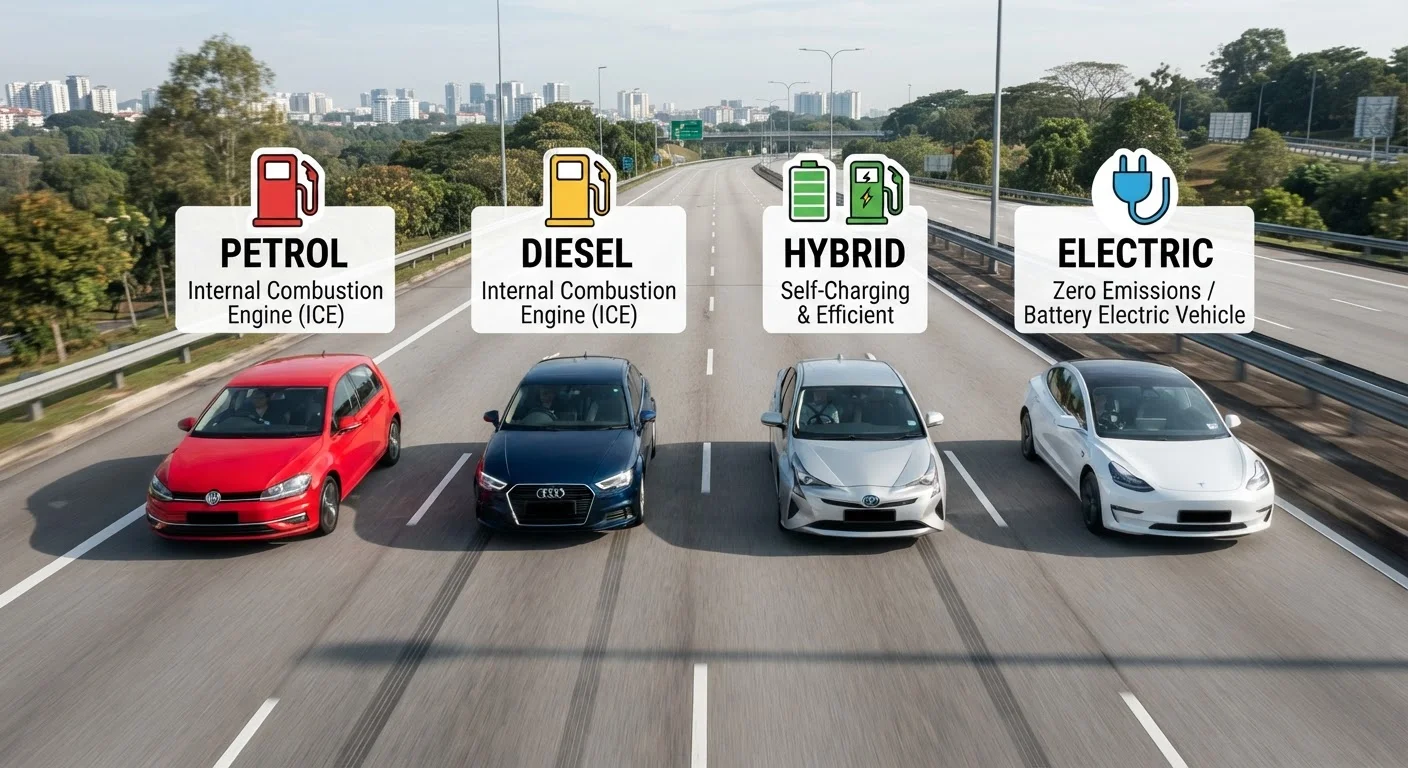
- Petrol: Typical family vehicles return 25-35 MPG combined. Larger SUVs and trucks often fall below 25 MPG.
- Diesel: Diesel engines generally return 30-40 MPG combined in comparable vehicle classes, with the strongest advantage on steady highway driving.
- Conventional hybrid: Most hybrids achieve 40-55 MPG combined, with the biggest gains in stop-and-go city driving where regenerative braking recovers energy.
- Electric (BEV): Battery-electric vehicles typically cost the equivalent of 90-130 MPGe, translating to roughly $0.03-$0.05 per mile at average US electricity rates - compared to $0.10-$0.15 per mile for petrol at $3.50/gallon.
| Petrol | Diesel | Hybrid | Electric | |
|---|---|---|---|---|
| Typical combined MPG / MPGe | 25-35 MPG | 30-40 MPG | 40-55 MPG | 90-130 MPGe |
| Approx. fuel cost per mile (US avg.) | $0.10-$0.14 | $0.09-$0.13 | $0.07-$0.09 | $0.03-$0.05 |
| Est. 10-year fuel cost (15k mi/yr) | $15,000-$21,000 | $13,500-$19,500 | $10,500-$13,500 | $4,500-$7,500 |
| Maintenance complexity | Low-moderate | Moderate-high | Moderate | Low |
| Best driving scenario | All-purpose | High-mileage highway | Mixed city/highway | Regular home charging |
| Upfront purchase premium vs. petrol | Baseline | Moderate premium | Moderate premium | Significant premium |
| Fuel/energy availability | Very wide | Wide | Wide (no plug needed) | Requires charging access |
Projecting Costs Over 5, 10, and 15 Years
Assuming 15,000 miles driven annually and using broadly representative US fuel and electricity prices as a reference, lifetime fuel cost differences become substantial. A petrol vehicle averaging 30 MPG at $3.50/gallon costs approximately $1,750 per year in fuel - or $17,500 over 10 years. A comparable hybrid at 48 MPG reduces that to around $1,094 per year, saving roughly $6,500 over the same period. An electric vehicle at $0.04 per mile costs approximately $600 per year in electricity - a saving of over $11,000 versus petrol over a decade.
Diesel's position is more nuanced. At 38 MPG and diesel prices near petrol, the annual saving over petrol is modest - often $200-$400. But diesel vehicles also carry higher purchase prices, stricter emissions requirements in some states, and potentially higher scheduled maintenance costs depending on the model. Families doing the math should factor in every budget line item, not just the fuel figure.
It's worth noting that fuel prices fluctuate, electricity rates vary by region and time-of-use tariff, and EPA estimates don't always match real-world driving. Use these projections as directional guidance, not guaranteed savings.
What Else Affects the True Running Cost
Fuel economy is only part of the equation. Maintenance costs differ meaningfully across drivetrains. Electric vehicles eliminate oil changes, have fewer moving parts in the drivetrain, and typically require less brake maintenance due to regenerative braking. However, battery replacement - if needed outside of warranty - can be a significant expense. For a detailed breakdown of what changes (and what doesn't) when you switch to electric, see Electric Vehicle Ownership Costs.
Diesel vehicles require diesel exhaust fluid (DEF) in most modern models, and some states have stricter emissions inspection requirements. Hybrids have dual-system complexity - both an internal combustion engine and an electric motor - meaning maintenance intervals and costs can vary. Petrol vehicles are generally the most straightforward and widely serviceable, with the broadest network of mechanics familiar with the technology.
For families evaluating how to finance the vehicle itself, leasing vs. financing trade-offs are worth understanding separately - the monthly payment structure can affect how you assess the fuel savings payback period.
Making the Right Call for Your Family
The drivetrain that makes most financial sense depends on four factors: how many miles you drive annually, the mix of city and highway driving, whether you have access to home or workplace charging, and how long you plan to keep the vehicle. High-mileage drivers realize fuel savings faster. City-heavy drivers get more value from hybrid and electric regenerative systems. Longer ownership periods allow more time to recoup higher upfront costs.
Families who keep vehicles for eight years or more and drive frequently are generally the best candidates for electric or hybrid drivetrains from a pure cost standpoint. Those with shorter ownership cycles, lower annual mileage, or no charging access may find that a modern, efficient petrol vehicle offers a better overall value equation once purchase price is factored in.
For a full framework covering purchase, running costs, and resale, the complete financial guide for families is a practical next step. And for routine maintenance decisions that affect long-term costs regardless of drivetrain, the Car Maintenance hub offers guidance on keeping any vehicle running efficiently.
This article provides general financial information for educational purposes and does not constitute personalized financial or purchasing advice. Fuel prices, electricity rates, and vehicle costs vary by region and change over time. Consult current local data and a qualified adviser for decisions specific to your situation.
The content provided on our blog site traverses numerous categories, offering readers valuable and practical information. Readers can use the editorial team’s research and data to gain more insights into their topics of interest. However, they are requested not to treat the articles as conclusive. The website team cannot be held responsible for differences in data or inaccuracies found across other platforms. Please also note that the site might also miss out on various schemes and offers available that the readers may find more beneficial than the ones we cover.