

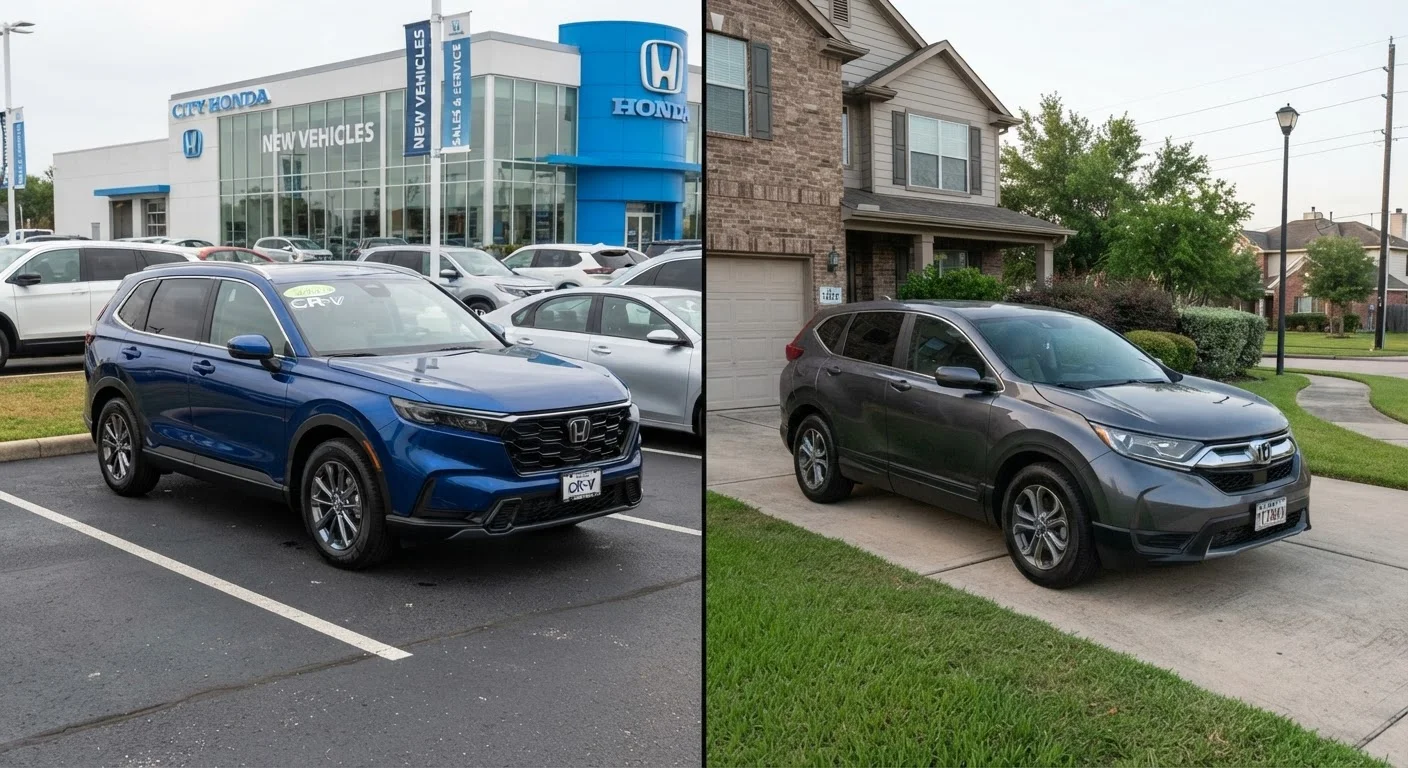
Option A
New Car
Full warranty coverage and the latest features - at a significant premium.
Best for: Families who prioritize predictable maintenance costs, modern safety technology, and plan to keep the vehicle long-term.
Option B
Used Car
Lower entry price, but with financial variables worth scrutinizing.
Best for: Families seeking lower monthly costs and willing to do upfront research to manage reliability risk.
The Depreciation Gap: Where the Real Money Goes
Depreciation is the cost most car buyers underestimate, and it falls hardest on new vehicle owners. According to data compiled by automotive research organizations, a new car typically loses around 20% of its value within the first 12 months of ownership. By the end of year five, that figure commonly reaches 50-60% of the original purchase price.
For a family purchasing a $38,000 vehicle, that first-year drop can represent roughly $7,000-$8,000 in lost value - a cost that does not appear on any monthly statement but is very real when you sell or trade in. Understanding how depreciation works is foundational to any honest comparison between new and used.
A used car purchased at the two- to three-year mark has already absorbed the sharpest part of that curve. The buyer effectively pays a price closer to the vehicle's stabilized market value, rather than the inflated new-car premium.
| Criterion | New Car | Used Car |
|---|---|---|
| First-year depreciation | ~15-20% of purchase price | Steepest drop already absorbed |
| Typical purchase price | Full market value | Significantly lower for same model |
| Warranty coverage | Full manufacturer warranty | Limited or none (CPO extends it) |
| Financing interest rate | Often lower rates available | Generally higher rates |
| Insurance premiums | Higher (higher replacement value) | Lower (lower replacement value) |
| Repair cost exposure | Low during warranty period | Moderate to high depending on age |
| Safety technology | Latest driver-assist features standard | Varies by model year |
| 5-year total cost estimate | Higher overall | Lower overall (condition-dependent) |
Running Costs: Insurance, Financing, and Maintenance
Purchase price is only the beginning. Three recurring cost categories separate new and used ownership in meaningful ways.
Insurance: New vehicles generally carry higher comprehensive and collision premiums because the replacement value is greater. A used vehicle with a lower market value may qualify for lower premiums, though exact figures depend on the driver's record, location, and coverage choices.
Financing: Lenders typically offer lower interest rates on new vehicles, partly because the collateral is considered less risky. However, a lower rate applied to a higher loan balance can still result in more total interest paid than a modestly higher rate on a smaller used-car loan. Families should calculate total interest cost - not just the monthly payment - when comparing scenarios.
Maintenance and repairs: New cars carry manufacturer warranties (commonly three years bumper-to-bumper, five years powertrain) that absorb most repair costs during the early ownership period. Used vehicles outside warranty age are exposed to out-of-pocket repair bills. A certified pre-owned (CPO) program can partially bridge this gap by extending coverage, though CPO vehicles carry a price premium of their own.
~20%
New car value lost in year one
Automotive research organizations consistently estimate new vehicles depreciate around 20% within the first 12 months of ownership.
50-60%
Value lost by end of year five
Industry data suggests most new vehicles retain only 40-50% of their original purchase price after five years on average.
20-35%
Potential annual cost reduction, used vs. new
Total cost of ownership studies indicate comparable used vehicles can cost meaningfully less per year, primarily driven by lower depreciation and loan amounts.
For a fuller picture of every cost category involved, see the true cost of owning a car.
Five-Year Totals: Putting the Numbers Side by Side
The most useful comparison is total cost of ownership over a defined period - typically five years. This combines depreciation, financing costs, insurance, fuel, and maintenance into a single figure that reflects what the vehicle actually costs your household.
Automotive research consistently shows that compact and mid-size new vehicles often cost families $8,000-$12,000 per year in total ownership costs depending on mileage and location. A comparable used vehicle in good condition from a few model years prior can reduce that figure by 20-35%, primarily through lower depreciation and a smaller loan balance. These are general ranges, not guarantees - vehicle condition, financing terms, and local insurance markets all shift the math.
CPO Vehicles: A Middle Ground Worth Considering
Certified pre-owned programs offered by manufacturers apply multi-point inspections and extended warranties to qualifying used vehicles. This reduces some of the reliability uncertainty associated with private used-car purchases. CPO vehicles carry a price premium over standard used cars, so families should verify whether the warranty extension justifies the additional cost in their specific situation.
Families who find themselves spending significantly more than planned should read why families often spend more on cars than they intended - the behavioral patterns described there are common and correctable.
If the used route appeals, completing a thorough financial due-diligence checklist before buying can surface hidden costs before you commit. All of these decisions fit into a broader ownership strategy covered in the complete financial guide for families.
The content provided on our blog site traverses numerous categories, offering readers valuable and practical information. Readers can use the editorial team’s research and data to gain more insights into their topics of interest. However, they are requested not to treat the articles as conclusive. The website team cannot be held responsible for differences in data or inaccuracies found across other platforms. Please also note that the site might also miss out on various schemes and offers available that the readers may find more beneficial than the ones we cover.