

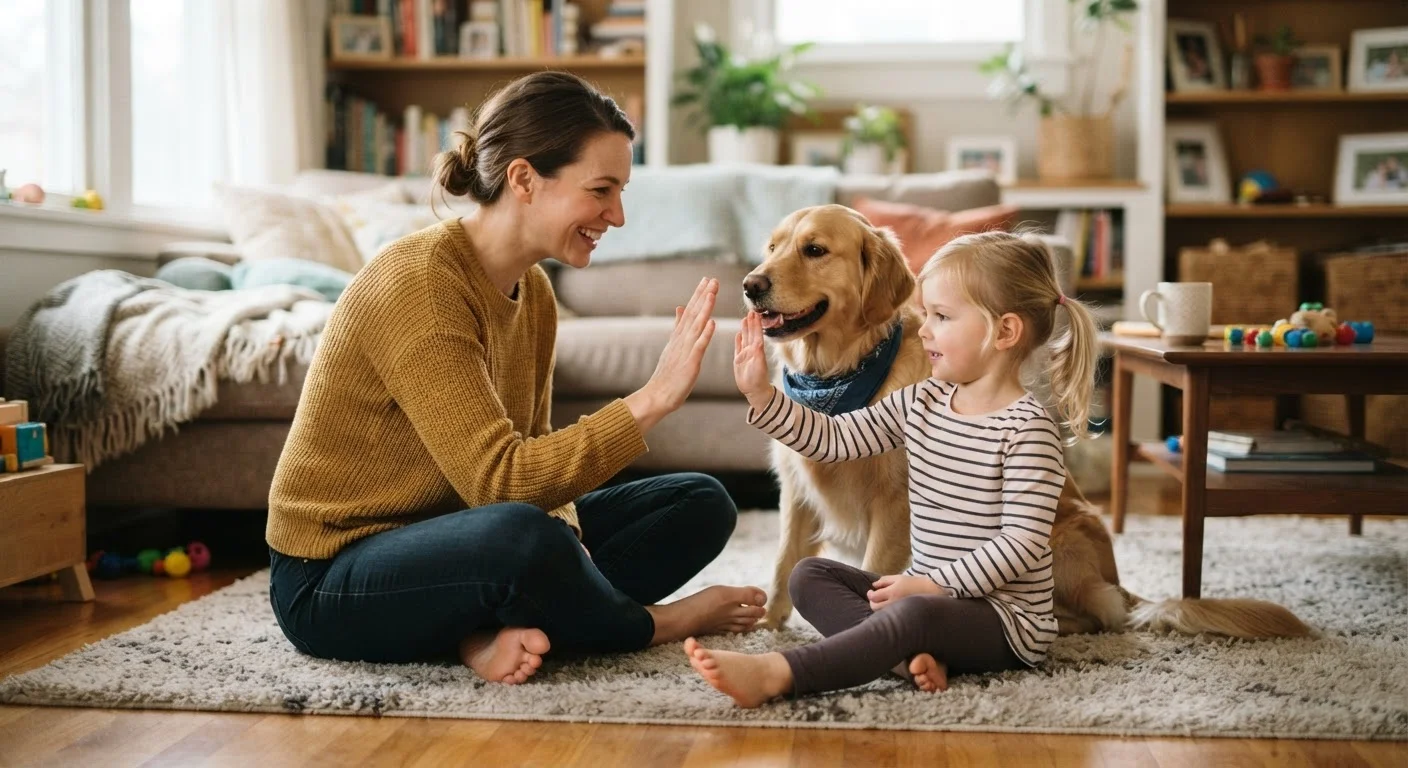
Why Short Sessions Work Better for Busy Households
Most families don't struggle with wanting to train their pets - they struggle with finding time to do it. The good news is that shorter sessions aren't a compromise; they are genuinely more effective for the way pets learn. Animals process and consolidate new behaviors best through frequent, low-pressure repetitions rather than marathon sit-down sessions.
Five minutes, done consistently every day, produces better results than a thirty-minute session squeezed in on weekends. That pattern fits naturally into a family schedule - before school, during a commercial break, or right after dinner. The key is treating training less like a task to complete and more like a brief, daily ritual.
Reward-Based Training: A Quick Definition
Reward-based training - often called positive reinforcement - means adding something the pet enjoys (a treat, praise, or play) immediately after a desired behavior occurs. This increases the likelihood the pet will repeat that behavior. It does not mean ignoring unwanted behavior; it means focusing energy on what you want the pet to do, rather than punishing what you don't. For a deeper look at the science behind this approach, see why positive reinforcement outperforms punishment.
If your household includes more than one pet, timing and sequencing sessions matters even more. The guide to training multiple pets walks through practical strategies for keeping each animal's sessions clear and productive.
Best Practices for Effective Reward-Based Training
Reward-based training is not simply about handing out treats - it's about timing, consistency, and understanding what motivates your individual pet. The practices below are grounded in established animal learning principles and adapted for the realities of a busy household.
Keep each training session to five minutes or less
Short sessions match a pet's natural attention span and prevent frustration for both animal and handler. Research in animal learning consistently shows that frequent, brief repetitions build stronger behavioral patterns than infrequent long sessions. Families are also far more likely to follow through daily when the time commitment is small.
Anchor training to routines you already have
Searching for extra time in a packed schedule is a losing battle. Attaching training to existing anchors - mealtimes, morning walks, the moment you arrive home - removes the need to carve out separate time and builds habit automatically.
End every session on a success
Finishing with a behavior the pet knows well leaves both the animal and the trainer on a positive note. It reinforces the pet's confidence and keeps the experience motivating rather than frustrating - which matters for sustaining effort across a long schedule.
Agree on consistent cues across the whole family
Pets learn words and hand signals as distinct cues. When one family member says 'lie down' and another says 'down,' the pet receives conflicting information, which slows learning significantly. A short household agreement on vocabulary prevents confusion and speeds progress.
Vary the reward to maintain motivation
Pets can become desensitized to the same reward delivered repeatedly, reducing its motivating power. Mixing treat types, adding verbal praise, or occasionally substituting a short play session keeps the pet engaged and responsive across many weeks of training.
Involve children with clear, age-appropriate roles
Kids who participate in training build responsibility and a stronger bond with the family pet, but their involvement needs structure. Younger children can hand over treats on cue from a parent; older children can learn to give the cue and deliver the reward themselves.
If you're weighing whether to use a clicker alongside these techniques, see the comparison of clicker training and verbal cues to find what fits your routine.
Getting Started Today: Quick Wins and Long-Term Habits
Building a training habit doesn't require a perfect plan. Starting small and adding structure gradually is both more sustainable and more realistic for most families. The quick actions below can be put in place today, before you've read another article or purchased any equipment.
Once these micro-habits feel natural, you can expand - adding a new behavior, bringing older kids into the session, or exploring group classes. For a broader look at whether to hire a trainer or self-teach, that resource will help you decide when professional support makes sense.
“The most important variable in training is not the technique - it's consistency. An imperfect cue applied reliably every day will outperform a perfect cue used only when convenient.”
— Karen Pryor, Pioneer of clicker training and author of 'Don't Shoot the Dog'
Consistency is the skill worth practicing here - not technique, not equipment. A family that trains together for five minutes a day will have a noticeably better-behaved pet within weeks, and a much stronger bond with that pet over a lifetime.
The content provided on our blog site traverses numerous categories, offering readers valuable and practical information. Readers can use the editorial team’s research and data to gain more insights into their topics of interest. However, they are requested not to treat the articles as conclusive. The website team cannot be held responsible for differences in data or inaccuracies found across other platforms. Please also note that the site might also miss out on various schemes and offers available that the readers may find more beneficial than the ones we cover.