

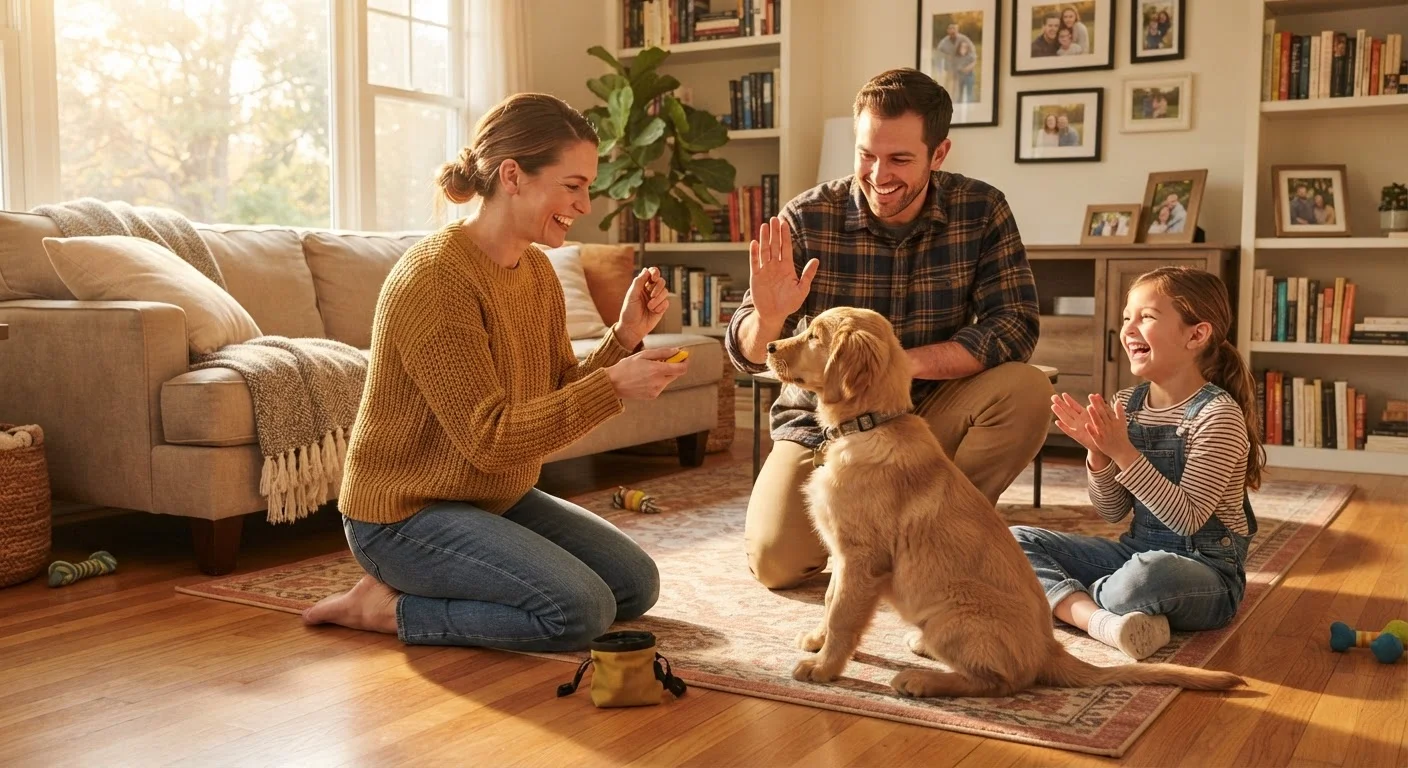
Option A
Clicker Training
The precise, consistent marker method.
Best for: Families who want a clear, unambiguous signal their pet can count on regardless of who is doing the training.
Option B
Verbal Cues
The hands-free, always-available approach.
Best for: Families looking for a low-equipment method that works across different settings and requires no extra tools.
What Each Method Actually Means
Before deciding which approach suits your family, it helps to understand what each one really involves. Clicker training uses a small handheld device that makes a short, sharp clicking sound. That click acts as a marker - a precise signal that tells your pet, "Yes, that exact behavior is what earned your reward." You click the instant the desired behavior happens, then follow immediately with a treat or praise. The timing is everything.
Verbal cues, on the other hand, use a spoken word or short phrase - "sit," "stay," "come" - to signal what you want your pet to do. The word itself becomes the marker or the prompt, depending on how it is used. Some trainers pair a consistent word like "yes!" as a verbal marker in the same role a clicker would play. For a deeper look at the terminology behind these methods, see our guide to common training terms.
Both approaches fall under the umbrella of positive reinforcement - rewarding the behavior you want rather than punishing what you don't. Research consistently supports reward-based training as the most effective and humane way to build reliable behaviors in family pets.
Head-to-Head: How They Compare
Looking at the two methods side by side makes it easier to spot where each one shines - and where it might create friction for a busy household.
| Criterion | Clicker Training | Verbal Cues |
|---|---|---|
| Equipment needed | Small clicker device | None - just your voice |
| Signal consistency | Identical every time | Varies by speaker and tone |
| Timing precision | Very high - click is instant | Moderate - words take longer |
| Ease for kids | Easy once they learn to click | May confuse pet with varied voices |
| Hands-free use | No - requires one hand | Yes - always available |
| Works in noisy environments | Generally well | Can get lost in background noise |
| Learning curve | Brief - pet learns click quickly | Gradual - words need repetition |
| Cost | Minimal one-time purchase | Free |
One factor families often underestimate is household consistency. A clicker always sounds identical, so it doesn't matter if Mom says "sit" firmly and a seven-year-old says it in a high-pitched question. The click remains neutral and uniform. Verbal cues, however, depend on everyone in the household using the same word in a similar way - a genuine challenge with multiple kids or grandparents who visit regularly.
Practical Fit for Family Life
The best training method is the one your family will actually stick with. Clicker training does require keeping the device handy, which can feel like one more thing to remember during a busy morning. Treating the clicker like a kitchen tool - stored in a consistent spot - helps make it second nature.
Verbal cues, by contrast, require zero prep. If your dog does something great mid-walk, you can reinforce it on the spot without reaching into a pocket. That spontaneity is genuinely useful for families with packed schedules. Short, frequent sessions work well with either method - even three to five minutes a day produces meaningful progress over time.
If you have more than one pet at home, coordinating signals becomes more complex. Managing training across multiple animals often benefits from the clarity a clicker provides, since each pet can be taught that only their click means their reward.
3-5 min
Effective daily training session length
Animal behaviorists generally recommend short, focused sessions rather than long ones to maintain a pet's attention and motivation.
< 1 second
Ideal marker-to-behavior gap
Studies in operant conditioning suggest that marking a behavior within about one second produces the clearest association between action and reward in animals.
Before committing to either approach, it's worth pausing to assess your home setup. Our training readiness checklist can help you identify whether your environment and expectations are in place first.
This article is for general informational and educational purposes. For guidance specific to your pet's health or behavioral needs, consult a qualified veterinary or certified animal behavior professional.
The content provided on our blog site traverses numerous categories, offering readers valuable and practical information. Readers can use the editorial team’s research and data to gain more insights into their topics of interest. However, they are requested not to treat the articles as conclusive. The website team cannot be held responsible for differences in data or inaccuracies found across other platforms. Please also note that the site might also miss out on various schemes and offers available that the readers may find more beneficial than the ones we cover.