

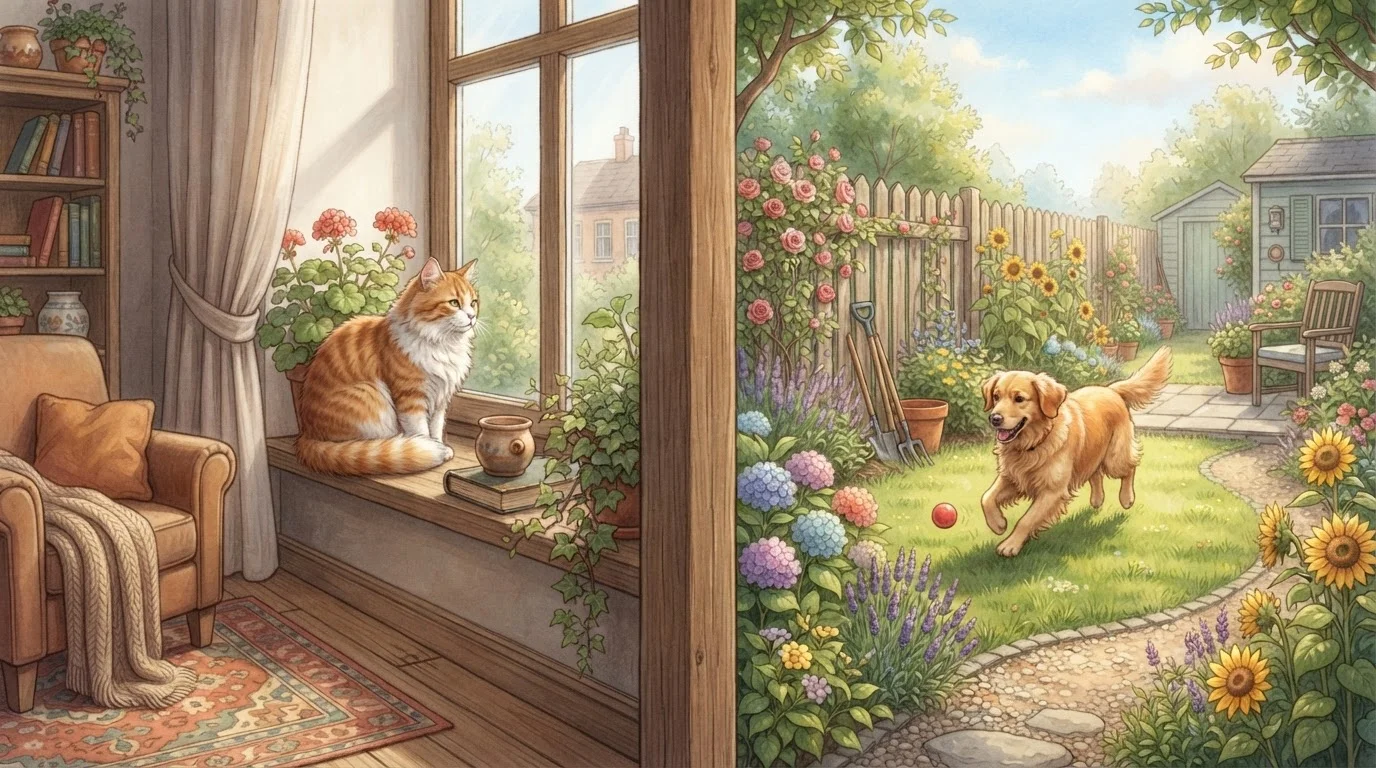
Option A
Indoor Pets
The apartment-friendly, controlled-environment companion.
Best for: Families in smaller homes, apartments, or urban settings who want a pet whose world fits within four walls.
Option B
Outdoor Pets
The space-loving, fresh-air companion.
Best for: Families with yards, rural properties, or active lifestyles who can provide supervised outdoor access and enrichment.
Why Your Home Environment Comes First
Most families start their pet search by asking, "What kind of animal do we want?" But a more useful first question is: "What kind of environment can we honestly provide?" A high-energy dog in a studio apartment, or a delicate indoor bird left exposed to drafts and neighborhood cats on a porch, are mismatches that cause stress for both pet and family - regardless of how much love is in the household.
Your home's square footage, access to outdoor space, climate, and even your lease agreement all factor into which animals can genuinely thrive with you. Before exploring individual species, work through the key lifestyle questions that help narrow down a realistic shortlist. And if you rent, understanding your tenancy rules before adopting is essential - not optional.
What Indoor Pets Actually Need
"Indoor pet" doesn't mean low-maintenance. Animals kept entirely inside depend on their owners to provide every form of stimulation, exercise, and environmental variety they'd otherwise find outdoors. That responsibility is manageable - but it needs to be intentional.
Cats are perhaps the most naturally suited to indoor life, particularly when raised indoors from kittenhood. They're independent, litter-trained, and don't require daily walks. However, they still need vertical space (shelves, cat trees), windows to observe the world, and regular play. A bored indoor cat can develop behavioral problems over time.
Small animals - rabbits, guinea pigs, hamsters - are often assumed to be easy indoor pets because of their size. In reality, each species has distinct daily care demands. What daily care actually looks like for these animals often surprises families expecting minimal effort.
Birds and fish occupy quieter niches but have their own environmental requirements - stable temperatures, appropriate air quality, and consistent routines. Families with allergy concerns should also note that pet dander and fur aren't limited to dogs and cats; understanding pet allergies before adopting any species is a smart step.
| Criterion | Indoor Pets | Outdoor Pets |
|---|---|---|
| Space requirement | Adaptable to smaller homes | Needs yard or large outdoor area |
| Exercise provision | Owner must create enrichment | Outdoor access provides natural activity |
| Safety risks | Lower (controlled environment) | Higher (traffic, predators, weather) |
| Bonding & supervision | Easy - pet is always nearby | Requires deliberate outdoor interaction |
| Suitable for renters | More commonly permitted | Often restricted by tenancy rules |
| Weather dependency | None - climate-controlled | High - shelter and seasonal care needed |
| Best matched species examples | Cats, fish, birds, small rodents | High-energy dogs, chickens, outdoor rabbits |
What Outdoor Pets Actually Need
Outdoor access expands the possibilities - but it also multiplies the responsibilities. Dogs who spend meaningful time outdoors need secure fencing, supervision, and shelter from extreme weather. Leaving a dog unsupervised in a yard isn't the same as providing outdoor enrichment; it can lead to escape attempts, nuisance barking, or anxiety.
Some families consider animals like backyard chickens, ducks, or outdoor rabbits in hutches. These can work well in appropriate settings, but local ordinances vary widely - check zoning rules in your municipality before committing. Weather protection, predator-proofing, and daily hands-on care are non-negotiable for any animal kept primarily outside.
Energy and age matching matters enormously here. Aligning your family's pace with a pet's energy needs prevents the common scenario where an enthusiastic puppy becomes a neglected adult dog because the novelty wore off before the energy did.
Outdoor Access Doesn't Replace Interaction
A yard is an asset, not a substitute for your time and attention. Animals left outdoors without regular human interaction can develop anxiety, behavioral issues, or health problems that go unnoticed longer than they would indoors. Outdoor space works best as a supplement to - not a replacement for - daily engagement with your pet.
For a quick-reference overview of space needs and care demands across species, the species comparison guide is a useful starting point before making any final decision.
Finding the Right Fit for Your Household
The indoor vs. outdoor framing is a starting point, not a rigid rule. Many dogs live primarily indoors but thrive with daily outdoor exercise. Some cats enjoy supervised backyard time in a secure enclosure. The question isn't really "inside or outside" - it's "what does this animal genuinely need, and can our home provide that consistently?"
Families juggling busy schedules should be honest about time. There are practical factors most families overlook when making this decision, and environment is one of the biggest. For an end-to-end framework, the complete family pet guide walks through every stage from lifestyle assessment to ongoing responsibilities - a worthwhile read before visiting any shelter or breeder.
~90%
US cats kept primarily indoors
The American Veterinary Medical Association has noted that the majority of owned cats in the US are kept exclusively or primarily indoors, reflecting a broad shift in owner preference toward controlled environments.
2-3x
Longer lifespan for indoor-only cats
Veterinary guidance generally suggests indoor-only cats tend to live significantly longer than outdoor or free-roaming cats, largely due to reduced exposure to traffic, disease, and predators.
This article is for general informational purposes only. Individual animal needs vary; consult a veterinarian or animal behaviorist for guidance specific to a species or individual pet you are considering.
The content provided on our blog site traverses numerous categories, offering readers valuable and practical information. Readers can use the editorial team’s research and data to gain more insights into their topics of interest. However, they are requested not to treat the articles as conclusive. The website team cannot be held responsible for differences in data or inaccuracies found across other platforms. Please also note that the site might also miss out on various schemes and offers available that the readers may find more beneficial than the ones we cover.