

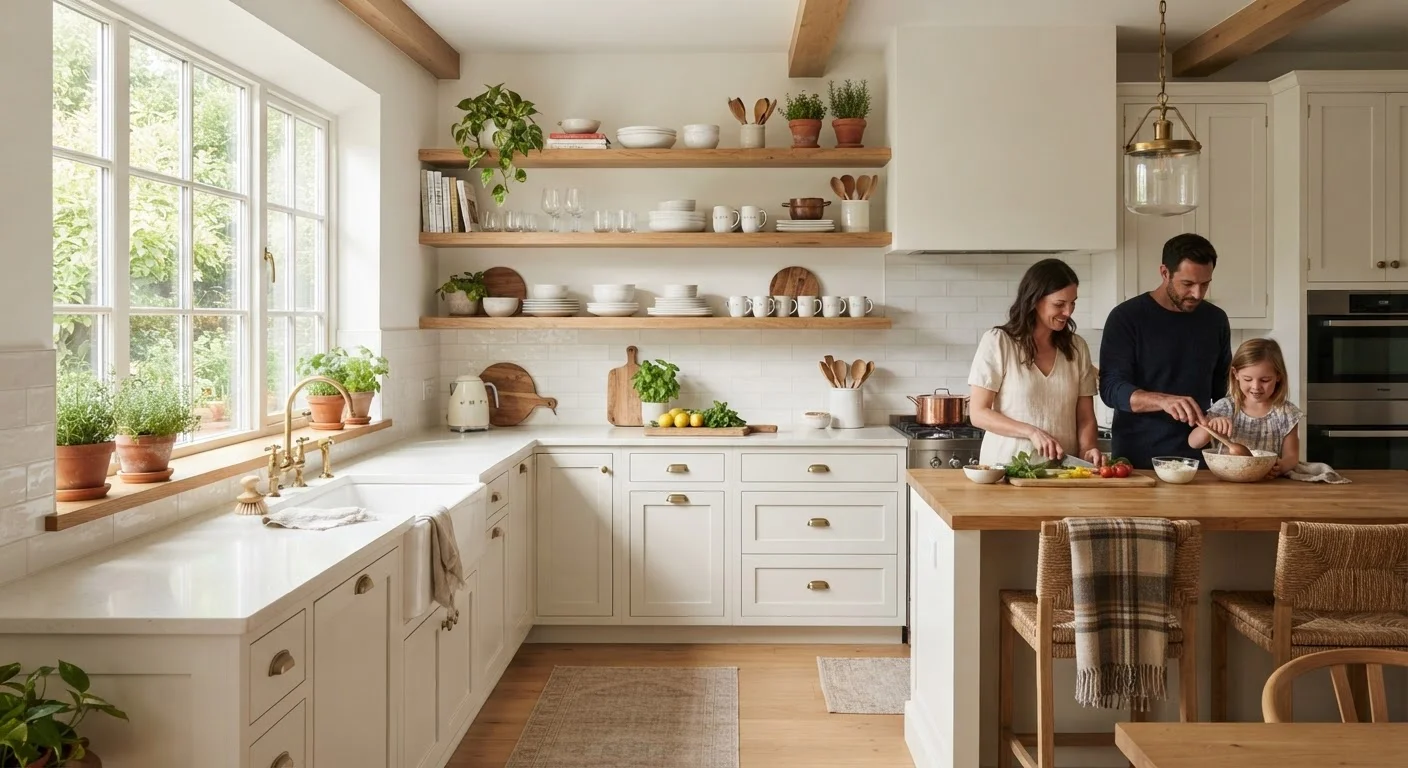
Option A
Open Shelving
The airy, display-forward choice for curated kitchens.
Best for: Families who keep counters tidy and enjoy showcasing dishware as part of their kitchen's personality.
Option B
Closed Cabinets
The practical, hide-it-away workhorse of busy households.
Best for: Families who prioritize low-maintenance storage and need to corral a high volume of mismatched items out of sight.
What You're Actually Choosing Between
Open shelving and closed cabinets aren't just a style decision - they're a statement about how your household actually operates. Open shelves mount directly to the wall without doors, putting everything on display. Closed cabinets use hinged or sliding doors to tuck items away. Both work in virtually any kitchen layout, but each comes with trade-offs that become very visible once the school bags are dropped and dinner prep begins.
The choice also isn't permanent. Many families end up removing upper cabinet doors in one section - near a coffee station, for example - while keeping full cabinetry elsewhere. Understanding the real-world pros and cons of each approach helps you design storage around your routines rather than retrofitting routines around your storage. For broader strategies on dividing a kitchen or living area into functional zones, see how families define space in open-plan homes.
| Criterion | Open Shelving | Closed Cabinets |
|---|---|---|
| Visual weight | Light, airy, spacious feel | Solid, enclosed, defined |
| Accessibility | Everything visible at a glance | Items hidden; requires searching |
| Dust & grease buildup | High - items exposed to air | Low - doors provide protection |
| Tidiness required | High - clutter is always visible | Low - doors hide mess easily |
| Typical installation cost | Lower for basic floating shelves | Higher for full cabinet units |
| Customization flexibility | Easy to restyle anytime | Changes require more effort |
| Child accessibility | Better for lower shelves | Limited for upper cabinets |
The Case for Open Shelving
Open shelves shine in kitchens where visibility and quick access matter. When mugs, plates, and spices sit in plain sight, family members - including children old enough to help - can find and return items without opening every door. That accessibility can meaningfully speed up morning routines.
Aesthetically, open shelves create a lighter, less enclosed feeling, which is especially useful in smaller kitchens where upper cabinets can feel like walls closing in. They also invite personalization: a few well-chosen items displayed on a shelf can make a kitchen feel genuinely lived-in rather than purely functional.
The honest downside is upkeep. Cooking produces steam, grease particles, and odors that settle on open shelves and everything on them. In an active family kitchen, shelves may need wiping down weekly. Items also accumulate dust faster than in closed cabinets. If your household tends toward what interior designers call "organized chaos," open shelving will make that visible to everyone who walks in.
~30%
Of homeowners removing upper cabinet doors post-renovation
Interior design surveys consistently show a growing share of remodelers opt to remove at least some upper cabinet doors to open up the space visually.
2-3×
More frequent cleaning needed for open shelves
Home organization experts generally estimate open kitchen shelves need wiping down two to three times more often than closed cabinet interiors in active cooking households.
The Case for Closed Cabinets
Closed cabinets remain the default in most family kitchens for straightforward reasons: they hide things, they protect things, and they forgive a lot. A chaotic pile of plastic containers, mismatched lids, and kids' cups becomes invisible the moment a door closes. For households juggling packed schedules, that grace is worth a great deal.
Cabinets also protect stored items from cooking byproducts. Dishes, glasses, and dry goods stay cleaner longer behind closed doors, which means less time wiping down shelves and fewer items that need rewashing before use. For families where the kitchen doubles as an entertainment space, cabinets keep the visual noise low even when the sink is full.
The downside is that cabinets can become black holes. Items pushed to the back of a deep cabinet are easily forgotten, contributing to the kind of clutter buildup that a room-by-room decluttering audit often uncovers. Accessibility is also lower: young children typically can't reach upper cabinet contents, and retrieving a specific pan from a crowded cabinet can require shuffling through several others first.
Making a Hybrid Layout Work
For most families, the practical answer isn't either-or. A hybrid layout uses open shelving where it makes sense - near the stove for frequently used spices, above a coffee station, or along a short wall - and closed cabinets everywhere else. This approach captures the visual lightness of open storage without committing every dish to public display.
When planning a hybrid layout, consider which items you reach for multiple times a day and which stay buried for weeks. Items in the first category belong on open shelves; items in the second belong behind doors. A simple decluttering pass before deciding can clarify this quickly - if you're not sure where to start, a structured decluttering audit offers a useful framework.
Also factor in installation. Floating shelves are generally straightforward for walls with accessible studs, but weight limits matter - solid shelves holding heavy items need proper anchoring. Cabinet installation, particularly if it involves new units rather than removing doors from existing ones, is typically a job for a professional carpenter or installer. If the project is part of a larger kitchen renovation, verify whether local permits are required before work begins.
Rental Homes and Reversibility
If you're renting, always confirm with your landlord before removing cabinet doors or installing new shelving hardware. Many floating shelf brackets require wall anchors that create holes, which could affect your security deposit. A freestanding shelving unit is a fully reversible alternative that requires no installation at all.
The content provided on our blog site traverses numerous categories, offering readers valuable and practical information. Readers can use the editorial team’s research and data to gain more insights into their topics of interest. However, they are requested not to treat the articles as conclusive. The website team cannot be held responsible for differences in data or inaccuracies found across other platforms. Please also note that the site might also miss out on various schemes and offers available that the readers may find more beneficial than the ones we cover.