

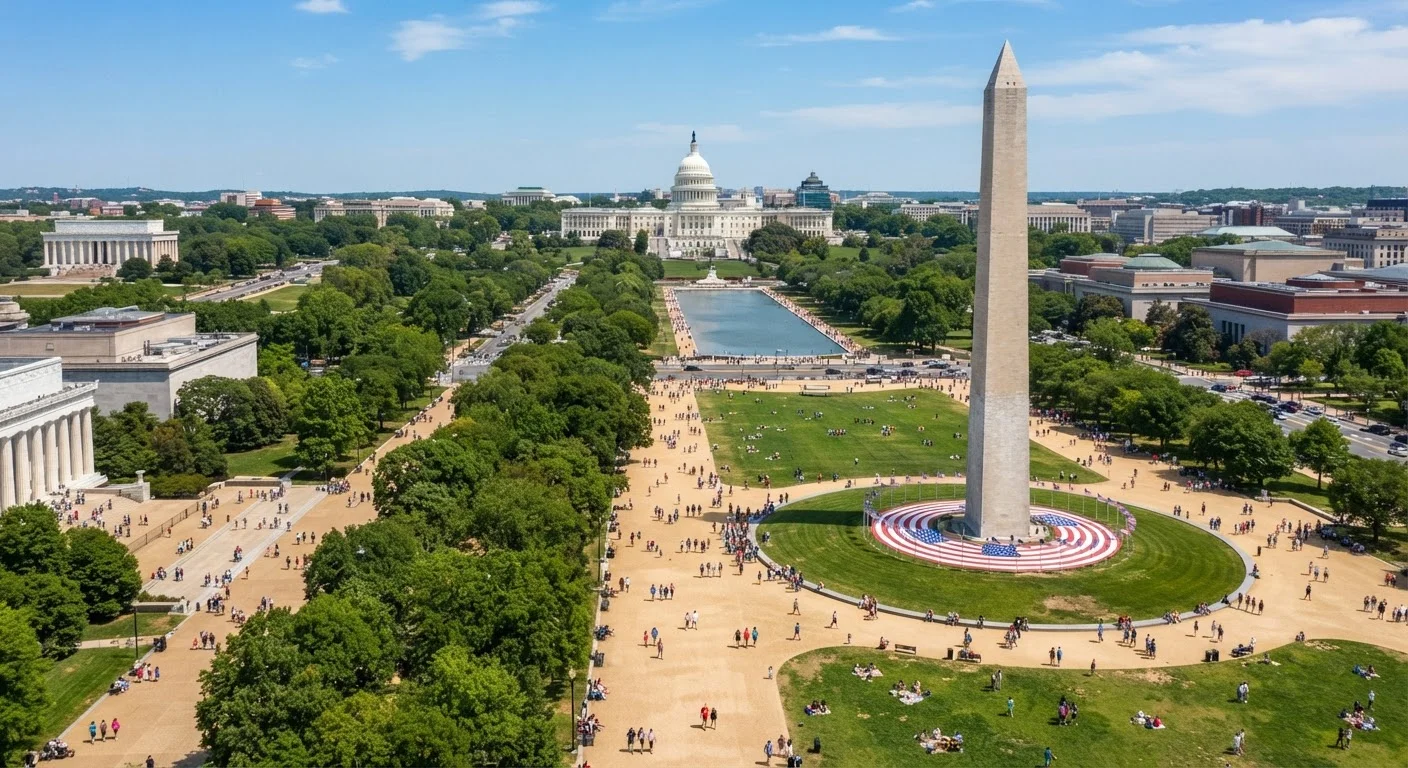
Why D.C. Works Surprisingly Well for Families
Washington D.C. has a reputation for being a school-trip destination - formal, educational, a little stiff. In practice, it's one of the most legitimately family-friendly cities in the United States, and not just because of the history. The combination of free world-class museums, walkable outdoor monuments, and an excellent transit system makes it genuinely accessible for families at a wide range of budgets.
That said, "accessible" doesn't mean «effortless.» D.C. rewards families who arrive with realistic expectations and a strategy. The itineraries you'll find online tend to treat the city like a checklist - Air and Space, Natural History, the Lincoln Memorial, the Capitol, done. Real family travel here looks quite different. For a broader foundation before you dive in, the complete family trip planning guide covers destination research, logistics, and packing in a single walkthrough.
19
Free Smithsonian museums in and around D.C.
The Smithsonian Institution operates 19 museums and galleries, the majority of which are free and located on or near the National Mall.
~40M
Annual visitors to the National Mall area
The National Park Service estimates tens of millions of visits to National Mall and Memorial Parks annually, making crowd planning essential.
3 miles
Length of the National Mall on foot
Walking the full length of the Mall from the Capitol to the Lincoln Memorial covers roughly three miles - significant for families with young children.
The Free Museum System: What to Know Before You Walk In
The 19 Smithsonian Institution museums on and around the National Mall are free to enter - always. That's a genuine, durable fact that makes D.C. extraordinary for budget-conscious families. What the brochures underplay is that several high-demand museums now require free timed-entry passes, and those passes can be fully reserved weeks in advance, especially in summer and during spring break.
The National Museum of African American History and Culture (NMAAHC) has required timed passes for years and is one of the hardest to walk into spontaneously. The National Air and Space Museum, especially its Udvar-Hazy Center annex in Chantilly, Virginia, is more accessible but still gets genuinely crowded. Check the official Smithsonian website for each museum's current entry policy before your trip - policies have shifted over time and vary by location.
A practical tip: anchor your "must-see" museums to mornings when energy is high, and use afternoons for outdoor monuments, which have no entry requirements at all.
Book your timed-entry passes for high-demand Smithsonian museums the moment they open for your travel dates - often 30 days in advance. Set a calendar reminder; popular time slots genuinely disappear.
Families repeatedly report arriving at NMAAHC or similar museums without passes and being turned away, which is demoralizing after traveling cross-country.
Visit the outdoor monuments in the evening rather than midday. The crowds are thinner, the temperature is lower in summer, and the lit memorials - especially the Vietnam Wall and Lincoln Memorial - feel far more powerful.
Monument lighting creates a genuinely different emotional atmosphere, and many families say evening visits are the most memorable part of their D.C. trip.
Navigating the City With Kids
Skip the rental car if your family can manage it. Parking in central D.C. is expensive, garages fill early on busy days, and driving near the Mall involves navigating a maze of closed-off streets and security barriers. The Washington Metro (the city's subway system) is clean, well-mapped, and connects directly to most major attractions. Children under 5 ride free, and the flat-fare structure within the core zone is predictable.
For families with strollers or kids who fatigue quickly, the circulator buses that run along the National Mall offer an inexpensive way to cover distance without adding steps. Rideshare services are widely available but can surge in price during peak tourist hours.
If you're visiting from out of town and driving is unavoidable, consider parking at a Metro station in the suburbs and riding in - it's a common local strategy that saves both money and stress. Verify current parking options and Metro station accessibility on the WMATA (Washington Metropolitan Area Transit Authority) website before your trip.
Pacing the Trip (the Part Most Itineraries Skip)
Here's the honest truth that most D.C. travel guides won't say plainly: two or three museum stops per day is plenty, and for families with younger children, one museum plus outdoor exploration is often the sweet spot. The Smithsonians are large - the Natural History Museum alone can occupy a full morning - and decision fatigue sets in fast when kids are overstimulated.
Overpacking the itinerary is one of the most common family travel mistakes, and D.C.'s abundance makes it especially tempting. Build in buffer time: a slow lunch on the Mall, time to toss a frisbee near the Washington Monument, or an unplanned detour through the National Sculpture Garden. These unscheduled moments often become the ones kids actually remember.
If your trip is short - two or three days - the strategies for short city trips are worth reading before you finalize your plan. Focus beats coverage every time.
Practical Logistics Most Guides Gloss Over
Restrooms: On the outdoor Mall, restrooms are less abundant than you'd expect. The museums themselves are the most reliable option - duck in even if you're not planning to linger. Portable facilities appear near monuments during peak season but aren't guaranteed.
Food: Museum cafeterias are convenient but pricey. Packing a lunch and eating on the Mall grass is completely allowed, saves money, and gives kids a genuine break from indoor stimulation. Several markets and delis operate within a short walk of the Mall if you prefer to buy locally.
Weather: D.C. summers are genuinely hot and humid. If you're traveling June through August, plan outdoor time for morning or late afternoon and build midday museum visits around the heat. Spring, particularly March through early April, is beautiful but coincides with cherry blossom season - when crowds around the Tidal Basin are intense and hotels book far in advance.
For families thinking about how D.C. fits into a larger travel budget, the budget family travel hub has additional strategies worth exploring.
Cherry Blossom Season Means Peak Crowds
The Tidal Basin during peak cherry blossom bloom (typically late March to early April, though timing varies by year) draws enormous crowds - weekend visits can feel genuinely overwhelming with young children. If spring is your window, aim for weekday visits and arrive before 9 a.m. Book accommodation months in advance, as hotels fill early and prices spike significantly during this period.
Making It Meaningful for Kids of Different Ages
D.C. genuinely scales across ages, but it takes intentional framing. For children under 7, the focus should be sensory and visual: the giant whale at Natural History, the rockets at Air and Space, the reflecting pool where they can spot the Washington Monument's mirror image. Don't aim for historical depth - aim for wonder.
Middle schoolers often engage most with the Holocaust Memorial Museum (note: it contains deeply serious content; review the museum's age guidance before visiting), the Bureau of Engraving and Printing (where currency is actually printed), and hands-on exhibits at the American History Museum. High schoolers and teens frequently find the monuments most powerful when visited in the evening, when crowds thin and the lit marble has a different atmosphere entirely.
Whatever age your kids are, let them have input on one activity that's purely their pick - a paddle boat on the Tidal Basin, a stop at the National Zoo (also free), or extra time at whichever exhibit caught their attention unexpectedly. Ownership over part of the itinerary changes how invested they are in the whole trip.
D.C. is a destination that genuinely delivers - just not always in the ways the standard itineraries promise. Come with a loose plan, realistic daily expectations, and a willingness to slow down, and it tends to exceed what families hoped for.
Travel information, museum policies, and entry requirements can change. Always verify current details directly with official sources - including the Smithsonian Institution and WMATA websites - before your trip.
The content provided on our blog site traverses numerous categories, offering readers valuable and practical information. Readers can use the editorial team’s research and data to gain more insights into their topics of interest. However, they are requested not to treat the articles as conclusive. The website team cannot be held responsible for differences in data or inaccuracies found across other platforms. Please also note that the site might also miss out on various schemes and offers available that the readers may find more beneficial than the ones we cover.