

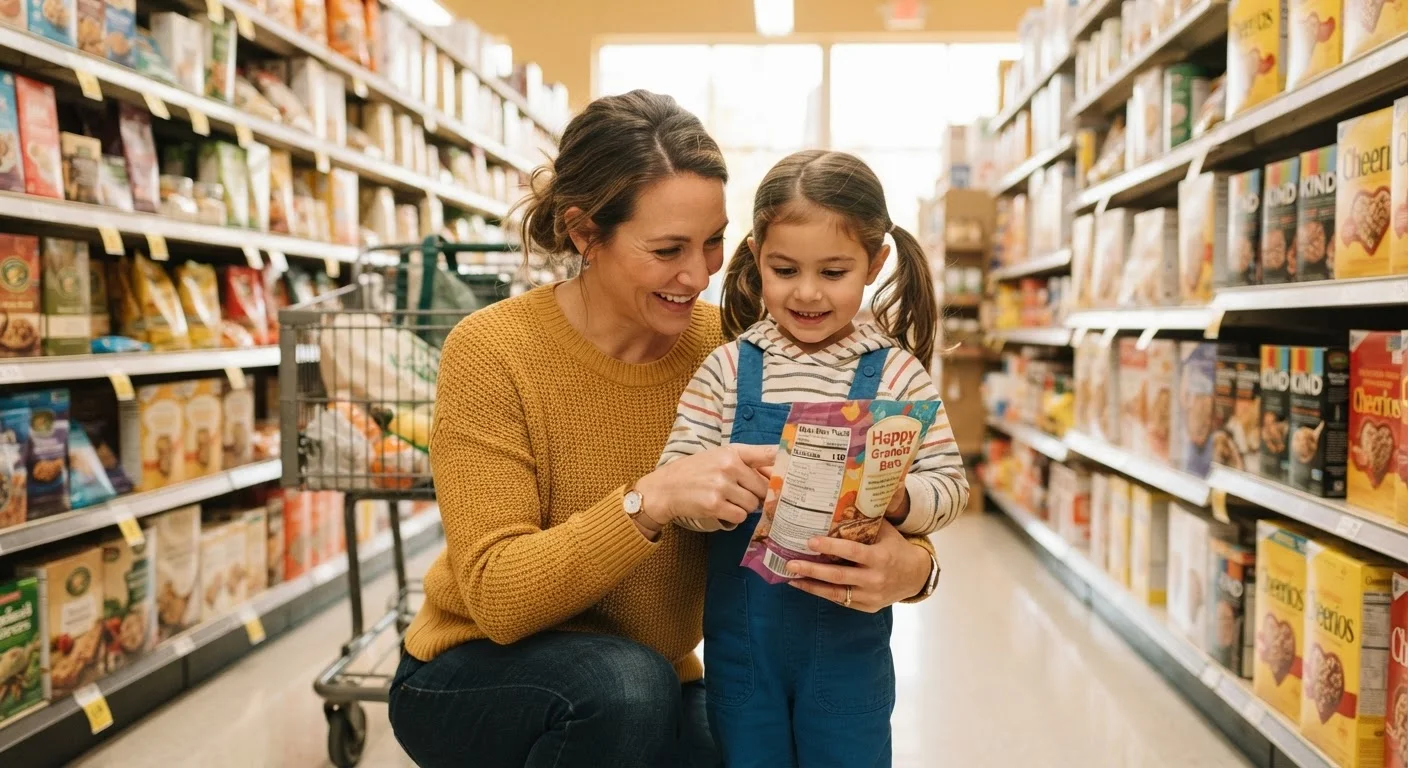
Why Food Labels Feel Confusing - and Why They Don't Have to
Nutrition labels were redesigned by the FDA in 2020 to be more consumer-friendly, yet for most parents they still raise more questions than they answer. The numbers on a box of crackers or a pouch of yogurt were largely designed with adult reference values in mind, which means applying them to a six-year-old requires a little translation. The good news: once you understand the structure of a label, you'll read every one more quickly and confidently.
It's also worth remembering that no single food makes or breaks a child's diet. Labels are tools for building awareness, not scorecards for perfect eating. For a broader look at the nutrients children most commonly fall short on, see The Nutritional Gaps Most Common in Children's Diets.
What you will need
Step-by-Step: Reading a Label With Your Child's Needs in Mind
Work through these steps in order - each one builds on the last. You can practice right now with a package from your pantry.
Start with serving size - always
The serving size sits at the very top of the Nutrition Facts panel and defines every single number that follows. If the label says a serving is 1 cup and your child eats 2 cups, every nutrient value doubles. Serving sizes are set by the FDA based on typical consumption amounts, not recommended amounts - so they describe how much people tend to eat, not how much they should eat.
Check servings per container too. A small bag that looks like a single-serving snack may list two or three servings inside.
Look at calories in context
Calories measure the energy a food provides. Children's calorie needs vary significantly by age, sex, and activity level - a toddler may need around 1,000-1,400 calories per day, while an active ten-year-old may need 1,600-2,000 or more. The FDA's 2,000-calorie reference used on labels is an adult benchmark.
Rather than counting calories precisely, use the calorie number to compare similar foods - for example, two brands of the same snack - and to gauge whether a food is energy-dense relative to its nutritional value.
Find added sugars - and distinguish them from total sugars
The updated FDA label separates total sugars from added sugars. Total sugars include naturally occurring sugars (like those in fruit or milk) plus any sugar added during manufacturing. Added sugars are the ones to watch most closely in children's foods.
The American Heart Association suggests that children ages 2-18 consume no more than 25 grams (about 6 teaspoons) of added sugar per day, and children under 2 should have as little as possible. Many flavored yogurts, cereals, and juice drinks can account for a substantial portion of that in a single serving.
Check sodium
Sodium is the other nutrient most frequently over-consumed in children's diets. Recommended daily limits range from about 1,200 mg for toddlers to 2,300 mg for older children and adolescents. Processed snacks, canned soups, and deli items can contribute significant sodium even when they don't taste particularly salty.
Use the %DV column as a directional guide: 5% DV or less per serving is generally considered low; 20% DV or more is high. Keep in mind that %DV is calibrated for adults, so for younger children the impact of a high-sodium food is proportionally greater.
Look for fiber, calcium, vitamin D, and iron
These are nutrients many children's diets fall short on, and the label makes them easy to spot. For these, a higher %DV is a positive signal. Fiber supports digestive health and steady energy; calcium and vitamin D are essential for bone development; iron supports cognitive function and healthy blood.
A food that delivers meaningful amounts of these nutrients alongside reasonable sugar and sodium levels is generally a strong option.
Read the ingredient list from top to bottom
Ingredients are listed in descending order by weight - the first ingredient is present in the greatest amount. If a refined grain or a form of added sugar appears in the first two or three positions of a food marketed as wholesome, that's meaningful context the nutrition panel alone won't reveal.
A shorter ingredient list isn't automatically better, but ingredients you recognize and can pronounce are generally a sign of less processing. Look for whole grains, fruits, vegetables, or legumes near the top of lists on products you buy regularly.
Common Label Claims and What They Actually Mean
Front-of-package claims are marketing language, not nutrition guidance. Understanding a few common terms helps you look past them.
- "Reduced sugar" means the product contains at least 25% less sugar than the original version - not that it is low in sugar overall.
- "Made with whole grain" tells you whole grain is present somewhere in the ingredient list, but it may not be the primary grain. Check where it ranks in the ingredient order.
- "Natural" has no standardized legal definition in the context of nutrition and carries no meaningful nutritional guarantee.
- "Fortified" or "enriched" means nutrients were added, often to replace those lost during processing. Whole food sources of the same nutrients are generally preferable when available.
A Quick Rule of Thumb for %DV
The Percent Daily Value column gives you a fast way to gauge whether a nutrient is present in a significant amount. In general, 5% DV or less per serving is considered low, and 20% DV or more is considered high. Apply this in both directions: aim low for added sugars and sodium, and aim higher for fiber, calcium, vitamin D, and iron.
If your child has specific growth or weight concerns, pairing your label-reading skills with an understanding of how pediatricians track development is helpful - our guide on Growth Chart Basics Every Parent Should Understand explains what those measurements mean in context.
Putting It All Together at the Store
You don't need to scrutinize every label at every shopping trip. A practical approach is to read carefully when you're buying a food for the first time, then rely on that knowledge for repeat purchases. Over time, a handful of go-to comparisons become second nature.
When comparing two similar products, focus on the three or four nutrients most relevant to your child - typically added sugars, sodium, fiber, and any nutrients your pediatrician has flagged. Avoid getting drawn into an exhaustive point-by-point comparison; that path leads to decision fatigue rather than better choices.
Label literacy is also a natural foundation for teaching kids about food as they grow. Involving older children in the process - asking them to find the serving size or spot where sugar appears in the ingredient list - builds lifelong skills without turning meals into a lesson. Building Healthy Eating Habits in Children Without Making Food a Battleground offers evidence-informed strategies for keeping food conversations positive at any age.
This article is for general informational purposes only and is not a substitute for personalized advice from a qualified healthcare provider or registered dietitian. Nutritional needs vary by age, size, and individual health status. Please consult your child's pediatrician for guidance specific to your family.
The content provided on our blog site traverses numerous categories, offering readers valuable and practical information. Readers can use the editorial team’s research and data to gain more insights into their topics of interest. However, they are requested not to treat the articles as conclusive. The website team cannot be held responsible for differences in data or inaccuracies found across other platforms. Please also note that the site might also miss out on various schemes and offers available that the readers may find more beneficial than the ones we cover.