

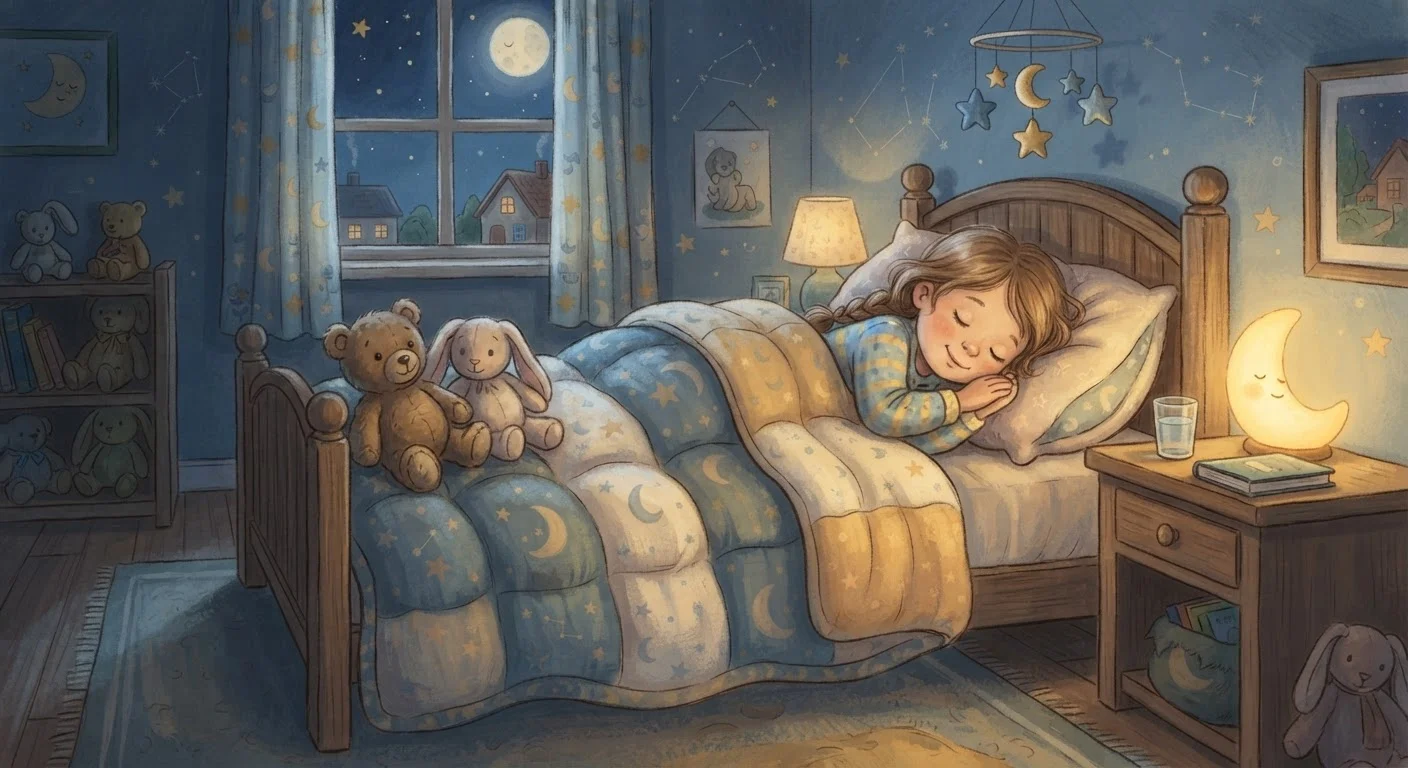
The Basic Architecture of a Child's Night
Every night, your child's brain doesn't simply switch off - it moves through a carefully choreographed sequence of sleep stages, each with a specific biological job. Understanding that sequence can help you make sense of night wakings, early rising, and why some mornings your child seems refreshed while others they wake grumpy despite a full night in bed.
Sleep scientists organize sleep into two broad categories: non-REM sleep (NREM) and REM sleep. NREM is itself divided into three stages, moving from light sleep through progressively deeper, harder-to-rouse states. After reaching the deepest stage, the brain gradually shifts back toward lighter sleep and enters REM - then the whole cycle begins again.
Children move through this loop multiple times per night. Because their cycles are shorter than an adult's, they complete more of them, spending a greater overall proportion of the night in deep and REM sleep combined. This isn't inefficiency - it reflects how much developmental work a child's brain and body are doing around the clock.
50%
Newborn sleep time spent in REM
According to the National Sleep Foundation, newborns spend roughly half their sleep in active (REM-like) sleep, reflecting intensive early brain development.
9-12 hrs
Recommended nightly sleep for ages 6-12
The American Academy of Sleep Medicine recommends 9-12 hours of sleep per night for school-age children for optimal health and development.
50-60 min
Typical infant sleep cycle length
Infant sleep cycles are considerably shorter than the adult average of roughly 90 minutes, contributing to more frequent overnight wake-ups.
What Happens in Each Sleep Stage
Stage 1 NREM - Light Sleep
This is the drowsy transition between wakefulness and sleep. Muscle activity slows, eye movements become slow and rolling, and the brain begins to produce theta waves - slower electrical patterns than those of an alert mind. Stage 1 is brief, typically lasting just a few minutes, and children are easy to rouse here. This is why a child who has just fallen asleep in the car often wakes when lifted out.
Stage 2 NREM - Consolidated Sleep
The brain now produces distinctive bursts of activity called sleep spindles and occasional K-complexes - both thought to play a role in memory consolidation and protecting sleep from external disturbances. Body temperature drops, heart rate slows, and the child becomes harder to wake. A significant portion of the night is spent in Stage 2.
Stage 3 NREM - Deep (Slow-Wave) Sleep
This is the most restorative stage physically. The brain shifts to large, slow delta waves, and the body releases the majority of its nightly growth hormone. Tissue repair, immune system strengthening, and energy restoration all happen here. Children in deep sleep are very difficult to rouse - this is also when sleepwalking and night terrors typically occur, as the brain partially activates without fully waking.
REM Sleep - The Active Brain
Despite the body being still (most voluntary muscles are temporarily paralyzed), the brain in REM sleep is almost as active as it is when awake. This is when dreaming occurs, and when the brain consolidates emotional memories and sorts the day's learning. Infants spend up to 50% of their sleep time in REM - a figure that reflects the extraordinary pace of early brain development. By school age, REM proportions begin to resemble adult patterns more closely.
“Sleep is the power source that keeps your mind alert and calm. Every aspect of your mental and physical health is tied to the quality of your sleep.”
— Matthew Walker, Professor of Neuroscience and Psychology, University of California, Berkeley, and author on sleep science
How Sleep Cycles Change as Children Grow
A newborn's sleep looks almost nothing like a toddler's, and a toddler's looks very different from a ten-year-old's. Age-related changes in cycle structure are normal and expected.
- Newborns (0-3 months): Cycles last roughly 50-60 minutes and consist primarily of active sleep (an early form of REM) and quiet sleep. They have not yet developed the full NREM stage architecture of older children.
- Infants (4-12 months): Distinct sleep stages begin to emerge and consolidate. Cycles lengthen slightly, and night sleep begins to anchor into longer stretches - though multiple wake-ups remain common and normal.
- Toddlers and preschoolers (1-5 years): Deep sleep is abundant, supporting rapid physical growth. Naps decline as daytime alertness increases. Night terrors, if they occur, are most common in this window because of the depth of slow-wave sleep.
- School-age children (6-12 years): Sleep architecture resembles adult patterns more closely, though total sleep need remains higher. This is a critical period for memory consolidation tied to academic learning. Even modest nightly shortfalls can accumulate into measurable effects on attention and mood.
Why Consistent Sleep Routines Support the Whole Cycle
Knowing that children cycle through sleep stages multiple times per night helps explain why when a child goes to bed matters as much as how long they sleep. Cutting sleep short - whether by a late bedtime or early alarm - disproportionately trims the later cycles of the night, which tend to be richest in REM sleep. That means less time for emotional processing and memory consolidation, even if total hours look acceptable on paper.
A calm, predictable wind-down routine signals to the brain that sleep is approaching, helping the transition into Stage 1 happen more smoothly. If your child seems to hold everything together at school but unravels in the evening, there's a neurological explanation for that pattern worth understanding.
Screens before bed are worth considering carefully too. The research on screens and children's sleep points to both light exposure and content engagement as factors that can delay the onset of sleep - shortening the window available for all stages to complete.
Build a Sleep-Friendly Wind-Down Routine
Aim for a consistent 20-30 minute pre-bed routine that involves calm, low-stimulation activities - such as a bath, quiet reading, or gentle conversation about the day. Keeping the same routine every night, including weekends, helps reinforce the brain's internal clock and makes transitioning into Stage 1 sleep easier and faster for children of all ages.
This article is for general informational purposes only and is not a substitute for personalized medical advice. If you have concerns about your child's sleep patterns, consult your child's pediatrician or a qualified healthcare professional.
Frequently Asked Questions
It depends on age and total sleep duration. An infant sleeping 14 hours may complete many short cycles, while a school-age child sleeping 10 hours completes roughly 6-8 longer cycles. Each cycle includes light sleep, deep sleep, and REM sleep.
Young children have shorter sleep cycles - sometimes just 50 minutes - and naturally rouse briefly between cycles. Infants haven't yet learned to self-settle, so these normal partial awakenings become full wake-ups. This is developmentally expected and not a sign that something is wrong.
REM sleep is when the brain processes and consolidates memories, sorts emotional experiences, and supports neural development. It is especially abundant in infants, reflecting the intense brain-building happening during early childhood.
Both are essential and serve different purposes. Deep (slow-wave) sleep drives physical growth and immune function, while REM sleep supports cognition and emotional health. Children need adequate time in both stages every night.
The American Academy of Sleep Medicine recommends that children ages 6-12 get 9-12 hours of sleep per night for optimal health. Teenagers need 8-10 hours. Consistent sleep schedules - not just total hours - also matter.
Yes - research consistently shows that predictable pre-sleep routines help children's bodies and brains prepare for sleep by signaling a shift toward lower alertness. A calm, consistent 20-30 minute wind-down routine is one of the most effective tools available to parents.
The content provided on our blog site traverses numerous categories, offering readers valuable and practical information. Readers can use the editorial team’s research and data to gain more insights into their topics of interest. However, they are requested not to treat the articles as conclusive. The website team cannot be held responsible for differences in data or inaccuracies found across other platforms. Please also note that the site might also miss out on various schemes and offers available that the readers may find more beneficial than the ones we cover.