

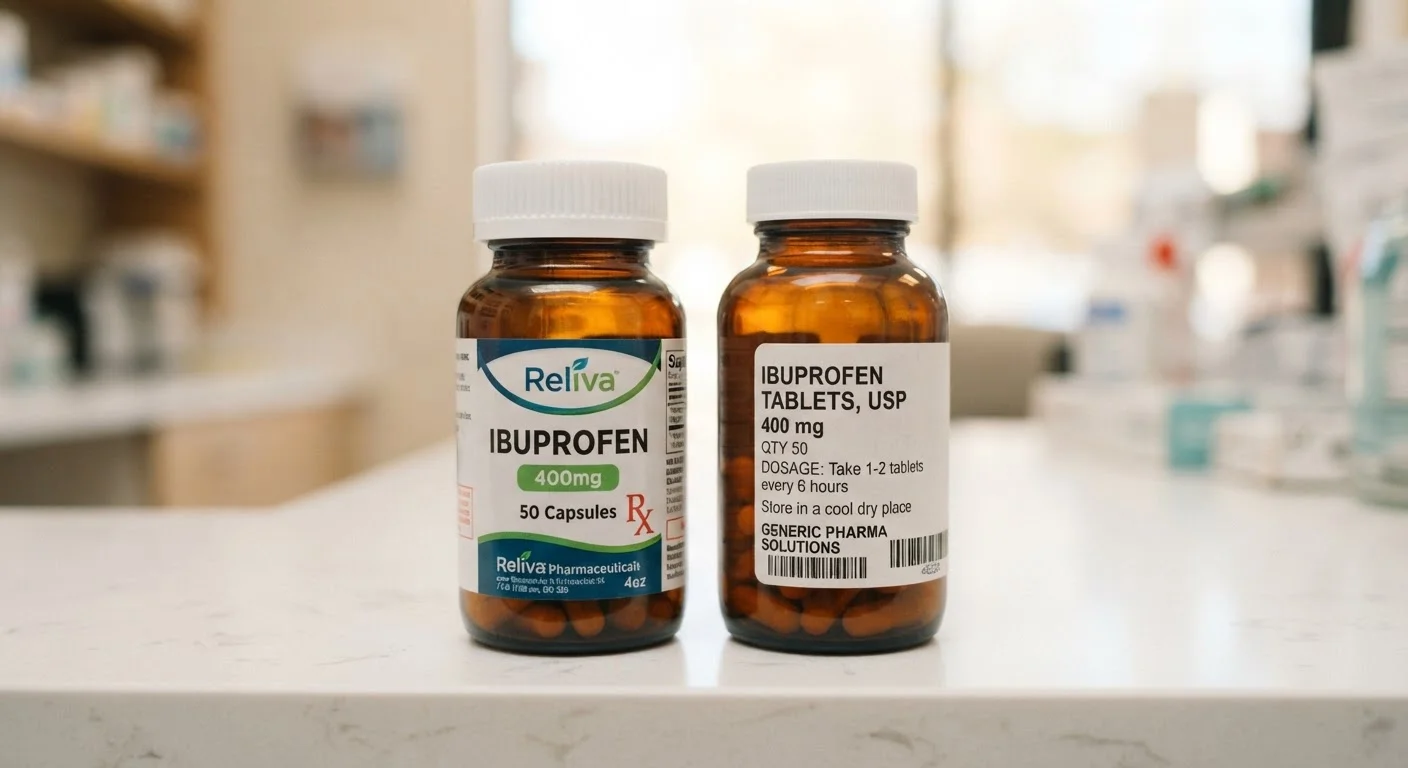
Option A
Brand-Name Medications
The original, patent-protected formulation.
Best for: Patients whose doctors have identified a clinical reason to use the specific branded formulation, or whose insurance covers it without significant cost difference.
Option B
Generic Medications
The rigorously regulated, lower-cost equivalent.
Best for: Most patients seeking the same therapeutic effect as the brand-name drug at a substantially lower out-of-pocket cost.
How the FDA Defines Equivalence
When a pharmaceutical company develops a new drug, it receives patent protection - typically up to 20 years - giving it exclusive rights to sell the medication under a brand name. Once that patent expires, other manufacturers can apply to the FDA to produce a generic version.
To gain approval, generic manufacturers must demonstrate bioequivalence: the generic must deliver the same active ingredient into the bloodstream at a comparable rate and extent as the original drug. The FDA's Abbreviated New Drug Application (ANDA) process sets strict standards for this. Generics must match the brand-name drug in active ingredient, strength, dosage form (tablet, capsule, liquid), and route of administration.
What this means practically: when you pick up a generic version of a common blood pressure medication, for example, the FDA has already confirmed it works in your body the same way the brand-name version does.
| Criterion | Brand-Name Medications | Generic Medications |
|---|---|---|
| Active ingredient | Original formulation | Identical by FDA requirement |
| Inactive ingredients | Proprietary formula | May differ (fillers, dyes) |
| FDA approval standard | Full New Drug Application (NDA) | Abbreviated NDA with bioequivalence data |
| Typical cost | Higher out-of-pocket | Substantially lower |
| Market availability | Available from patent filing | Available after patent expiry |
| Manufacturing standards | FDA-regulated facilities | Same FDA-regulated standards |
| Narrow therapeutic index drugs | May be preferred for consistency | Discuss switching with your doctor |
Where Generics Actually Differ - and When It Matters
Generics are not required to be identical in every way. Inactive ingredients - binders, fillers, colorings, and coatings - may vary. For the vast majority of people, this is not clinically meaningful. However, for individuals with documented allergies to specific dyes or fillers, it's worth checking the ingredient list with a pharmacist.
A more nuanced consideration involves narrow therapeutic index (NTI) drugs - medications like levothyroxine (thyroid hormone), warfarin (a blood thinner), and certain anti-seizure drugs. These are drugs where a small difference in blood concentration can affect how well they work or their safety profile. For patients stabilized on one version of these medications, some doctors recommend staying with a consistent formulation - brand or generic - rather than switching back and forth. This is a conversation worth having with your prescribing physician or pharmacist.
For the overwhelming majority of common medications - antibiotics, statins, antihistamines, antidepressants - generics perform equivalently and are the standard of care.
A Note on Switching Formulations
If you've been stable on a specific medication for a long time - whether brand or generic - and your pharmacy switches you to a different manufacturer's generic, it's reasonable to mention any changes you notice to your doctor or pharmacist. Generic manufacturers producing the same drug may use slightly different inactive ingredients. This doesn't mean the medication is less effective, but your care team can help you evaluate any concerns.
Making a Confident Decision for Your Family
For most families, generics represent a straightforward, well-regulated choice that doesn't compromise care. Your pharmacist is one of your most accessible resources: they can review your specific medications, flag any inactive ingredient concerns, and explain whether a particular drug falls into a narrow therapeutic index category.
It's also worth understanding that the manufacturing standards generics must meet are the same as those for brand-name drugs - both are subject to FDA facility inspections and quality controls. If you're curious about how to evaluate health product claims more broadly, our article on third-party testing vs. manufacturer claims explores how independent verification works across consumer products.
Similarly, the logic of generic equivalence has some parallels to the store-brand debate in other categories - though medications operate under a uniquely rigorous regulatory framework. For a look at how that plays out elsewhere, see what research shows about store brands vs. name brands.
This article is for general informational purposes only and is not a substitute for professional medical advice. Always consult a qualified healthcare provider or licensed pharmacist before making decisions about your medications.
The content provided on our blog site traverses numerous categories, offering readers valuable and practical information. Readers can use the editorial team’s research and data to gain more insights into their topics of interest. However, they are requested not to treat the articles as conclusive. The website team cannot be held responsible for differences in data or inaccuracies found across other platforms. Please also note that the site might also miss out on various schemes and offers available that the readers may find more beneficial than the ones we cover.