

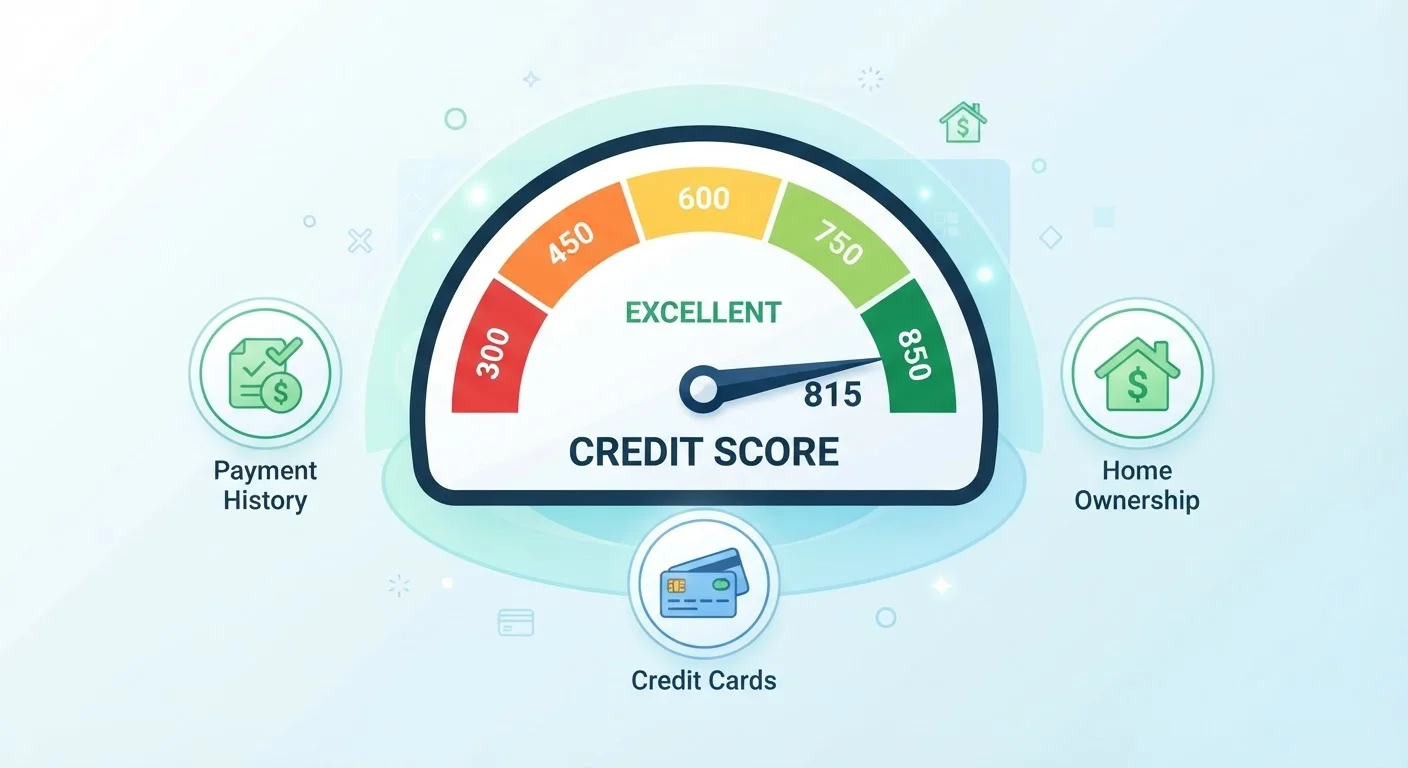
The Five Factors That Build Your Score
Credit scores don't emerge from a black box. The FICO model - the most widely used in the U.S. - draws on five specific categories of information from your credit report, each weighted differently.
- Payment history (approx. 35%): Whether you've paid accounts on time. A single missed payment can have a noticeable negative impact, particularly on an otherwise clean record. See what a missed payment actually does to your score for a detailed breakdown.
- Amounts owed / credit utilization (approx. 30%): The share of your available revolving credit you're currently using. Keeping this ratio low - typically below 30% is a commonly cited guideline - is generally favorable. Credit utilization deserves its own deep dive because it's one of the fastest-moving variables in your score.
- Length of credit history (approx. 15%): How long your accounts have been open, including the age of your oldest account, newest account, and average age across all accounts.
- Credit mix (approx. 10%): Whether you manage different types of credit - installment loans (like a car loan or mortgage) alongside revolving credit (like a credit card).
- New credit / recent inquiries (approx. 10%): How many new accounts you've opened or applied for recently. Multiple applications in a short window can signal financial stress to lenders.
35%
Weight of payment history in FICO score
According to FICO's published scoring criteria, payment history is the single heaviest factor in a standard FICO Score calculation.
716
Average U.S. FICO Score
FICO has reported that the average U.S. FICO Score has generally hovered in the 'good' range in recent years, based on its national consumer data.
3
Major credit bureaus that generate reports
Equifax, Experian, and TransUnion each maintain separate consumer credit files, which is why scores can differ slightly depending on which bureau a lender queries.
What the Number Range Actually Means
A three-digit number only makes sense in context. Under the standard FICO range:
| Score Range | General Classification | Typical Implication |
|---|---|---|
| 800-850 | Exceptional | Likely to qualify for most credit products at favorable rates |
| 740-799 | Very Good | Strong borrowing position with competitive pricing |
| 670-739 | Good | Near or above average; most lenders see low risk |
| 580-669 | Fair | May face higher rates or stricter terms |
| 300-579 | Poor | Limited credit options; rebuilding period often needed |
These classifications are general reference points. Individual lenders set their own approval criteria and interest-rate tiers, so the same score can yield different outcomes depending on where you apply and what you're applying for.
VantageScore vs. FICO: Know the Difference
When you check your score through a bank app or free credit monitoring service, you may be seeing a VantageScore rather than a FICO Score. Both use the 300-850 range and similar inputs, but the weighting differs, so the numbers won't always match. Most mortgage lenders specifically use FICO Scores when making underwriting decisions, so it's worth knowing which model you're looking at.
Why Your Score Matters Beyond Getting a Loan
Most families associate credit scores with borrowing - mortgages, car loans, credit cards. But the number reaches further into everyday life than many people realize.
Renting a home: Most landlords run a credit check before approving a lease. A lower score may require a larger security deposit or result in an outright denial.
Insurance premiums: In many states, auto and homeowners insurance companies use credit-based insurance scores - a related but distinct metric - when calculating premiums. A lower score can mean higher premiums, though this practice varies by state.
Employment: Some employers, particularly in financial services, request a credit check (with your written consent) as part of background screening. They see a modified report, not your actual score, but negative items can still factor into hiring decisions.
Understanding your score is a foundational step - but the score alone tells an incomplete story. Reading your full credit report gives you the underlying detail behind the number and reveals any errors worth disputing.
“Your credit score is essentially a summary of your financial reliability as seen through the lens of past borrowing behavior. It's a backward-looking measure - which means it can always be influenced by the choices you make going forward.”
— Consumer Financial Protection Bureau, U.S. government agency responsible for consumer financial protection and education
Common Misconceptions That Can Cost You
A few widely held beliefs about credit scores are simply wrong - and acting on them can quietly damage your financial standing.
Myth: Carrying a small balance on a credit card helps your score. Paying your balance in full each month does not hurt your score. Interest charges accrue regardless, so carrying a balance costs money without providing a scoring benefit.
Myth: Closing old credit cards improves your score. Closing an account reduces your total available credit, which can increase your utilization ratio. It also shortens your average account age over time. Both effects can lower your score.
Myth: Income is part of your credit score. Scoring models don't consider your salary, assets, employment status, or net worth. These may come up during a lender's broader underwriting process, but they have no direct bearing on the score itself.
For a fuller list of misconceptions, see credit myths that cost American families real money.
This article is for general informational and educational purposes only and does not constitute personalized financial advice. Consult a licensed financial professional for guidance specific to your situation.
Frequently Asked Questions
Under the FICO scoring model, scores of 670 to 739 are generally considered 'good,' while 740 to 799 is 'very good,' and 800 or above is 'exceptional.' Scores below 580 are typically classified as 'poor.' Different lenders set their own thresholds for approval and pricing.
Your credit score recalculates whenever a lender or credit bureau processes new information - typically monthly when creditors submit updated account data. This means a score you check today may differ from one checked in 30 days, especially if you've made payments or reduced balances.
No. Checking your own score is called a 'soft inquiry' and has no impact on your score. Only 'hard inquiries' - triggered when a lender checks your credit as part of an application - can cause a small, temporary dip.
Yes. Lenders use credit scores to price loans; borrowers with higher scores typically qualify for lower interest rates. Even a modest difference in rate can mean thousands of dollars more or less paid over the life of a mortgage.
Multiple scoring models exist, and each of the three major credit bureaus - Equifax, Experian, and TransUnion - may hold slightly different information. As a result, the score a lender pulls can differ from one you see through a consumer app.
The content provided on our blog site traverses numerous categories, offering readers valuable and practical information. Readers can use the editorial team’s research and data to gain more insights into their topics of interest. However, they are requested not to treat the articles as conclusive. The website team cannot be held responsible for differences in data or inaccuracies found across other platforms. Please also note that the site might also miss out on various schemes and offers available that the readers may find more beneficial than the ones we cover.