

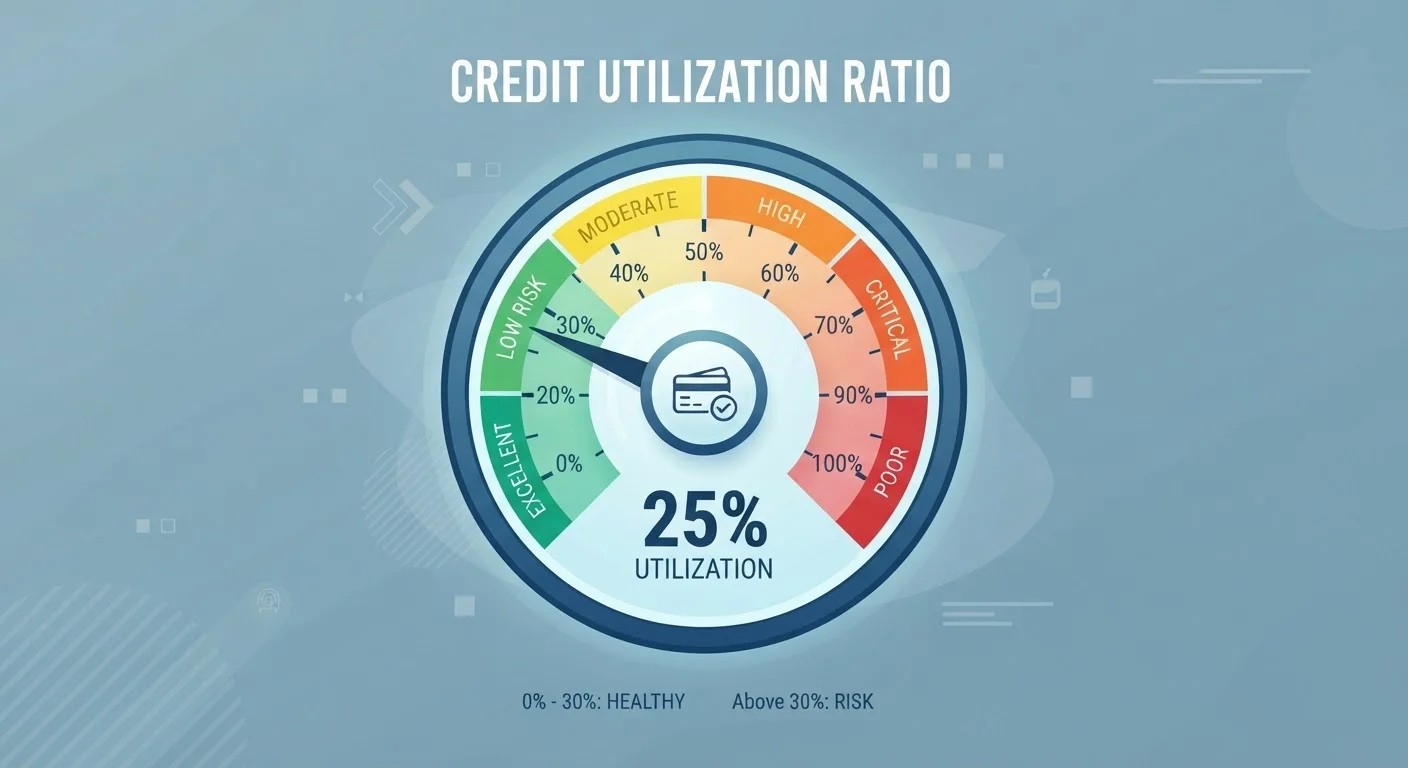
How Credit Utilization Is Calculated
The math behind credit utilization is straightforward. Add up all the balances currently reported on your revolving accounts - primarily credit cards and personal lines of credit - then divide that total by the sum of all your credit limits. Multiply by 100, and you have your overall utilization rate.
Example: Two credit cards - one with a $500 balance and a $2,500 limit, another with a $700 balance and a $5,000 limit. Your combined balance is $1,200, your combined limit is $7,500, and your overall utilization is 16%.
But the overall number isn't the only figure that matters. Scoring models also evaluate each card individually. A single card maxed out at 90% can drag down your score even if your overall utilization looks fine. This is why spreading a balance across multiple cards doesn't always help as much as people expect - the per-card ratio still registers.
For a broader look at how utilization fits into the language of credit, see our household debt glossary, which covers this and more than 20 other terms you'll encounter in statements and loan agreements.
Why Lenders and Scoring Models Watch This Number
Credit utilization is widely cited as comprising roughly 30% of a FICO score - second only to payment history. The underlying logic is behavioral: someone using a large share of their available credit may be under financial stress, overextended, or more likely to miss future payments. Lenders use this as a proxy for risk.
~30%
Share of FICO score tied to credit utilization
According to FICO's published scoring factor breakdown, amounts owed - primarily utilization - is the second-largest factor in the widely used FICO scoring model.
<10%
Utilization typical of highest-scoring consumers
FICO has reported that consumers who score above 800 tend to use a very small fraction of their available revolving credit, often in the single digits.
1-2 cycles
Time for score to reflect lower utilization
Because utilization is recalculated each time balances are reported, score changes from paying down balances can appear within one to two billing cycles.
This doesn't mean a temporary spike in utilization defines you as a borrower. But when you apply for a mortgage, auto loan, or new credit card, the utilization rate at that moment is what gets evaluated. A 45% utilization on the day you apply is what lenders see, regardless of what it was three months prior.
It's also worth distinguishing utilization from missed payments in terms of their credit impact. A missed payment leaves a mark that can linger for years. High utilization, by contrast, has no memory - it resets as soon as lower balances are reported.
Practical Ways to Manage Your Utilization
Managing utilization doesn't require eliminating all credit card use - it requires being thoughtful about timing and limits. Here are the primary levers available:
- Pay before the statement closes. Your issuer generally reports your balance to the credit bureaus on your statement closing date. Paying down the balance before that date lowers what gets reported, even if you technically carry a balance during the month.
- Request a credit limit increase. If your spending stays the same but your limit goes up, your utilization ratio drops automatically. Be aware that some issuers run a hard inquiry to approve a limit increase, which can cause a small, temporary score dip.
- Avoid closing old accounts unnecessarily. Closing a card removes its limit from your total available credit, which raises utilization on remaining balances. If a card has no annual fee and you're not tempted to overspend, keeping it open generally helps your ratio.
- Distribute charges strategically. If you have multiple cards, spreading purchases so no single card climbs above 30% can protect your per-card utilization, even if your overall rate is low.
Time Big Purchases Strategically
If you're planning to apply for a mortgage, auto loan, or other major credit product within the next few months, be mindful of when large credit card purchases appear on your statement. Consider paying down the balance before your statement closing date - not just the due date - so the lower balance is what gets reported to the bureaus and reflected in your score at application time.
If you're working to build credit as a family - including setting up younger members for success - our guide on credit-building habits worth starting early covers utilization management in the context of long-term credit health.
Common Misconceptions Worth Correcting
A number of widely circulated beliefs about credit utilization can lead families to make decisions that backfire. One persistent myth is that carrying a small balance each month - rather than paying in full - somehow helps your score by showing lenders you're actively using credit. This is not accurate. Carrying a balance means paying interest with no credit benefit. Scoring models reward low utilization, not sustained balances.
Another misconception is that utilization only matters for people with low credit scores. In fact, even consumers with strong scores can see meaningful fluctuations when utilization spikes - for instance, after a large purchase on a single card before the statement closes. Understanding this can help you time major credit card purchases more strategically before a loan application.
For a fuller breakdown of these and other credit beliefs that affect real household finances, credit myths that cost families real money is a useful companion read. And if you're newer to how credit works overall, the starter framework for families provides the foundational context that makes concepts like utilization easier to apply.
This article is for general informational and educational purposes only and does not constitute personalized financial or credit advice. For guidance tailored to your specific situation, consult a qualified financial professional.
Frequently Asked Questions
Most credit scoring guidance points to staying below 30% as a reasonable benchmark, but research suggests that consumers with the highest scores tend to use a much smaller share - often in the single digits. Lower utilization generally signals less reliance on credit, which scoring models tend to reward. There's no single magic number, but keeping each individual card and your overall ratio as low as comfortably possible is a sound goal.
It depends on timing. Your issuer typically reports your balance to credit bureaus on or near your statement closing date - not necessarily when you pay. If you pay in full after the statement closes, the reported balance may still show a balance. To lower the reported utilization, pay down or pay off your balance before the statement closing date.
Yes, closing a card removes that card's credit limit from your total available credit, which can raise your overall utilization ratio if you still carry balances on other cards. For example, eliminating a $5,000 limit from your total shrinks your available credit, making the same balances represent a higher percentage. This is one reason financial educators generally caution against closing old cards impulsively.
No - these are distinct measures. Credit utilization compares your balances to your credit limits and appears directly on your credit report. Debt-to-income (DTI) ratio compares your monthly debt payments to your gross monthly income, and lenders calculate it manually during loan underwriting. DTI does not appear in your credit score, but lenders often review both when evaluating an application.
Utilization has no memory in credit scoring models - once a lower balance is reported to the bureaus, your score can reflect the improvement within one to two billing cycles. This is meaningfully different from a missed payment or derogatory mark, which stays on your report for years. Paying down balances is one of the fastest ways to see score movement.
Very low utilization is generally favorable, but some scoring models may treat 0% utilization slightly differently than, say, 1-5%, because it can signal that accounts aren't being actively used. The practical difference is small for most people. Using cards occasionally and paying them off tends to keep utilization low while demonstrating active, responsible account management.
The content provided on our blog site traverses numerous categories, offering readers valuable and practical information. Readers can use the editorial team’s research and data to gain more insights into their topics of interest. However, they are requested not to treat the articles as conclusive. The website team cannot be held responsible for differences in data or inaccuracies found across other platforms. Please also note that the site might also miss out on various schemes and offers available that the readers may find more beneficial than the ones we cover.