

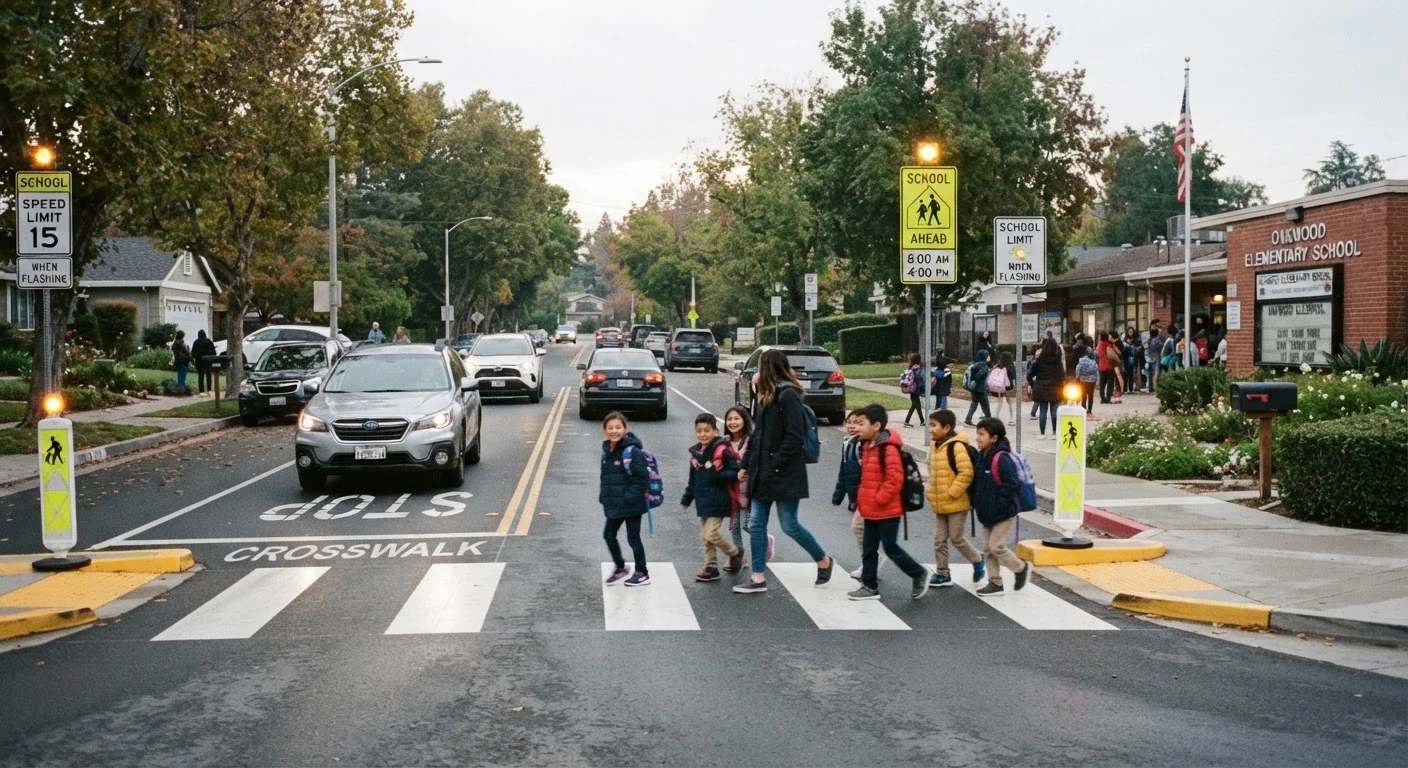
Why the Familiar Route Is the Dangerous One
Most families drive the same school route five days a week, often at the same time each morning. That repetition feels like competence - but it quietly erodes alertness. Cognitive science has a name for it: habituation. When your brain predicts what comes next, it allocates less attention to actually looking. A child stepping out from between parked cars, a cyclist cutting across the junction, or a driver reversing out of a driveway can all happen in spaces your eyes technically scanned but your brain never fully processed.
This is the central paradox of the school run: the route you know best is the one where your guard drops furthest. Combine that with morning time pressure, a car full of children, and the need to manage school bags and drop-off logistics, and the risk profile is substantially higher than most parents realise. See habits that quietly make family driving more dangerous for a broader look at how everyday routines erode safety margins.
Habituation Is Not a Character Flaw
The tendency to become less alert on familiar routes is a normal feature of how human attention works, not a sign that you are a careless driver. Recognising it is the first step to managing it. Even experienced, safety-conscious drivers are susceptible - which is exactly why structural habits matter more than good intentions alone.
The Specific Hazards Around Schools
School zones concentrate several hazards simultaneously that you would rarely encounter together elsewhere:
- Unpredictable pedestrian behaviour: Children aged 5-10 have limited ability to judge vehicle speed and gap size. They move impulsively - running, crouching to pick something up, or turning back suddenly. Unlike adult pedestrians, they rarely scan traffic before stepping off the kerb.
- Double-parked and stationary vehicles: Drop-off zones create walls of stopped cars that obscure children from view and force them to walk between vehicles and into the road. Slow speeds do not eliminate the danger - a child at bumper height is invisible in most rear-view mirrors.
- Cyclists and scooters: Older children often cycle or scooter to school and may enter junctions from unexpected directions, travelling faster than their apparent age suggests.
- Other distracted parents: Drop-off zones are full of drivers who are also managing children, checking school bags, or looking at phones. You cannot assume other drivers are attending to the road.
Good vehicle maintenance also matters here: properly adjusted mirrors, working brake lights, and tyres in good condition reduce stopping distances and improve visibility in exactly these tight, slow-speed situations.
Arrive two minutes early to eliminate time pressure at the drop-off.
Time pressure is one of the most consistent contributors to poor driving decisions. When you are running late, you accept smaller gaps, speed slightly, and attend to logistics rather than the road. Building in a buffer removes the incentive to rush.
Perform a deliberate 'scan reset' at every school-zone entry.
A brief, conscious act of attention - such as reducing speed early and doing a slow sweep of both kerbs - interrupts the autopilot pattern that habituation creates. It signals to your brain that this environment demands active processing.
Keep children settled and secure before you move the car.
Conversations with or about children in the back seat are among the most common in-car distractions on short trips. Addressing a dispute, passing a bag, or answering a question splits attention precisely when it needs to be fully allocated to a complex environment.
Walk the route on foot once a term to see it from a child's perspective.
Driving a route and walking it reveal entirely different hazard profiles. Blind spots from a vehicle's bumper height, sightlines blocked by hedges, and the narrowness of the footpath become obvious on foot - and sharpen your awareness when you are back behind the wheel.
Treat every stationary vehicle as a potential source of a hidden child.
Children frequently emerge between parked cars with no warning. Treating each gap between vehicles as a possible entry point - reducing speed to walking pace past them - gives you the reaction time to stop safely.
Building Habits That Fight Complacency
Countering habituation requires deliberate, repeatable strategies - not just reminding yourself to be careful.
Beyond these immediate steps, the most effective long-term strategy is to treat the school run as a distinct driving context that requires its own mental preparation, not an extension of autopilot. The Family Road Safety Playbook outlines how to build consistent, household-wide driving habits that go beyond any single trip - a useful companion to the school-specific practices covered here.
This article provides general driver safety information for educational purposes. Always follow local traffic laws and school-zone regulations in your area.
The content provided on our blog site traverses numerous categories, offering readers valuable and practical information. Readers can use the editorial team’s research and data to gain more insights into their topics of interest. However, they are requested not to treat the articles as conclusive. The website team cannot be held responsible for differences in data or inaccuracies found across other platforms. Please also note that the site might also miss out on various schemes and offers available that the readers may find more beneficial than the ones we cover.