

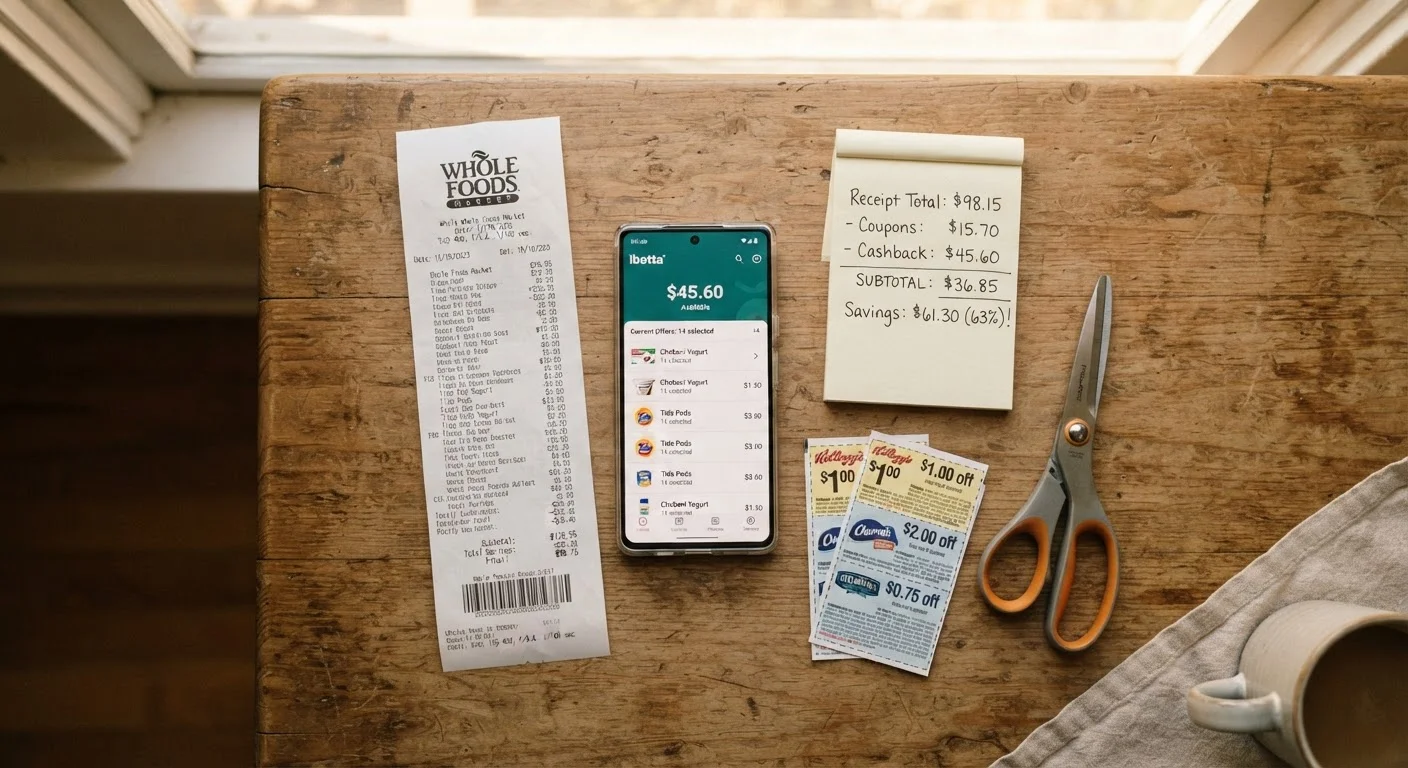
What Stacking Savings Actually Means
Savings stacking is the practice of applying multiple discount methods to a single purchase simultaneously - for example, buying a product that's already on sale, scanning a digital coupon at checkout, and then submitting the receipt to a cashback app afterward. Each layer trims the price a little further, and together they can reduce a regular grocery or household item's cost by 30-50% or more on a good run.
The concept sounds straightforward, but the rules governing what can be combined vary by store and by the terms attached to each offer. Understanding the core terminology around coupons, rebates, and cashback offers is the essential first step before attempting any stacking strategy. Without that foundation, it's easy to violate store policies, have coupons rejected at the register, or submit a receipt that doesn't qualify.
This guide walks through the process in a practical sequence - from reading the fine print to executing a stacked transaction without holding up the checkout line.
What you will need
The Three Layers and How They Interact
Think of stacking as three independent discount channels that can - under the right conditions - apply to the same item at the same time:
- Sales and promotions: The store temporarily lowers the shelf price. This is the baseline. Everything else stacks on top of the already-reduced price.
- Coupons (manufacturer and store): Most retailers allow one manufacturer coupon and one store coupon per item. Digital store coupons clipped to a loyalty account count as store coupons. Paper manufacturer coupons issued by the brand itself are separate. Combining both on a sale item is the classic triple stack.
- Cashback apps and rebate portals: These operate independently of the transaction itself - you scan a receipt or link a loyalty card after the fact. Because they're post-purchase, they rarely conflict with coupon policies. This makes them the most universally stackable layer.
The interactions to watch: two manufacturer coupons on one item are almost never permitted. Two store coupons on one item are usually blocked by the register automatically. One of each, however, is widely accepted at major grocery chains. Always read the coupon's fine print for exclusions - sale items are sometimes explicitly carved out.
Watch for Coupon Exclusion Language
Many coupons carry fine print that excludes trial sizes, certain package counts, or items already on sale. Read the terms on every coupon before building your stack. If a coupon is rejected at the register due to an exclusion you missed, the cashier is not able to override the system - the coupon simply won't apply.
Step-by-Step: Building a Stacked Transaction
The steps below apply to grocery and household goods shopping, the most common context for stacking. The same logic applies to clothing or home goods retailers, though coupon structures may differ. For larger purchases, stacking principles also feature in a broader family savings roadmap.
Review the store's coupon stacking policy
Before building any stacking strategy at a specific retailer, look up their coupon policy - most major grocery chains publish it on their website. Confirm whether they accept one manufacturer coupon plus one store coupon per item, and whether digital coupons count as store coupons. Note any exclusions for sale or clearance items.
Start with the store's weekly sale items
Open the current weekly ad and identify items on your planned shopping list that are marked down. These sale prices form the base price your coupons and cashback will apply against. Items with the steepest percentage discounts offer the most amplification when additional layers are added.
Clip matching digital store coupons
Log into your store loyalty account or app and search for digital coupons that match your sale items. Clip every relevant coupon to your account before you shop - most digital coupons apply automatically at checkout when your loyalty card or phone number is entered. Check the expiration date and any quantity limits on each coupon.
Source a manufacturer coupon for the same items
Search for manufacturer coupons through coupon aggregator websites, the brand's own app or website, or Sunday newspaper inserts. Confirm that the coupon's terms allow use on the specific size or variety you're buying, and that it doesn't explicitly exclude sale items. Add paper coupons to your wallet or save digital manufacturer coupons to a compatible platform.
Load cashback offers before you shop
Open your cashback or rebate app and activate any offers matching your planned purchases. Many apps require you to activate the offer before the purchase, not just before submitting the receipt. If you use a linked-card cashback program, confirm the offer is active on the card you plan to use at checkout.
Complete the transaction and submit your receipt
At checkout, enter your loyalty card number or phone number first, then present or scan any paper coupons. Verify that digital coupons deducted correctly on the screen before paying. After the transaction, photograph your receipt immediately and submit it through each cashback app you loaded offers on. Most apps require submission within 24-72 hours.
Stacking works best when paired with buying items at the right quantity. See our guide to bulk buying for families to understand when stocking up amplifies your savings versus when it creates waste.
When Stacking Isn't Worth the Effort
Not every purchase rewards a stacking effort. Small-dollar items where the total discount amounts to a few cents rarely justify the time investment of searching multiple platforms. Similarly, if applying a coupon means buying a size or variety your household won't use, the "savings" are fictitious - you're spending more than you would have otherwise.
The other common trap: buying something purely because it can be stacked. This is one of the deal-hunting habits that quietly cost families more. A 40% discount on an item you didn't need is still 60% wasted. Stacking should always follow the shopping list, not drive it.
Finally, some product categories - fresh produce, store-brand staples, clearance items - may carry restrictions that limit coupon use. Checking the family buying guides hub can help you identify which categories tend to be most stackable and where to focus your energy.
Build a Simple Per-Trip Checklist
Before each shopping trip, run through four questions: Is this item on sale this week? Do I have a store coupon clipped? Do I have a manufacturer coupon? Is there an active cashback offer loaded? A quick mental or written checklist takes under two minutes and ensures you don't leave a layer of savings unclaimed. Over a month of regular grocery runs, skipped steps add up to real money.
The content provided on our blog site traverses numerous categories, offering readers valuable and practical information. Readers can use the editorial team’s research and data to gain more insights into their topics of interest. However, they are requested not to treat the articles as conclusive. The website team cannot be held responsible for differences in data or inaccuracies found across other platforms. Please also note that the site might also miss out on various schemes and offers available that the readers may find more beneficial than the ones we cover.