

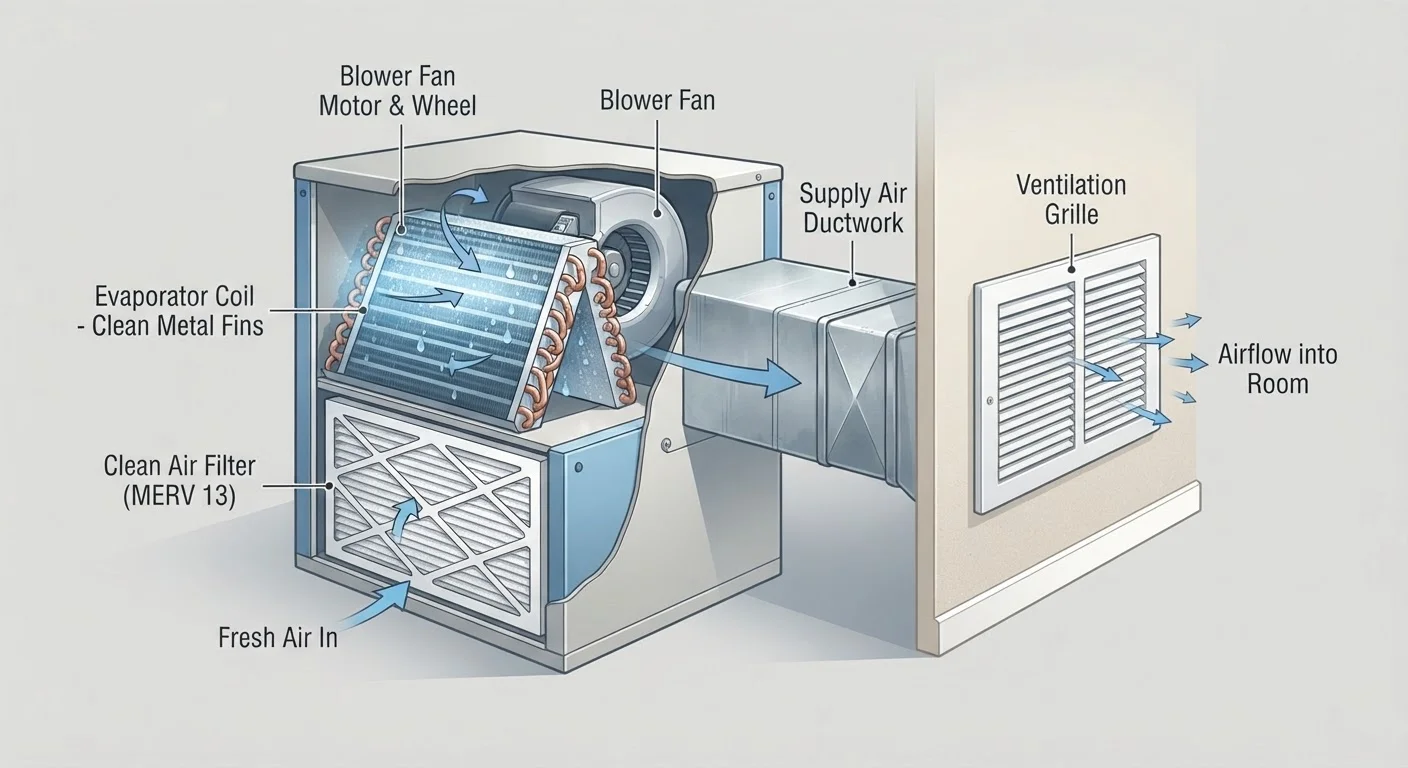
The Three Components That Do the Heavy Lifting
Your home's heating, ventilation, and air conditioning (HVAC) system has many moving parts, but three components affect your indoor air quality and energy bills more than any others: the air filter, the coils, and the supply and return vents. Understanding what each one does - and what happens when it's neglected - makes routine upkeep far less intimidating.
Think of these three as a team. The filter catches airborne particles before they enter the system. The coils transfer heat to warm or cool the air. The vents deliver conditioned air to each room and pull stale air back for reconditioning. When one falls behind, the whole system works harder.
Air Filters: Your First Line of Defense
The air filter sits in the return-air path, typically in a slot near the air handler or in a wall/ceiling grille. Its job is to trap dust, pollen, pet dander, mold spores, and other airborne particles before they reach the system's internal components.
Filters are rated on the MERV scale (Minimum Efficiency Reporting Value), which runs from 1 to 16 for residential use. A higher MERV rating means finer filtration - but also more airflow resistance. Most homes do well with MERV 8-11: effective enough to improve air quality without straining the blower motor.
A clogged filter restricts airflow, forcing your system to work harder, raising energy consumption, and accelerating wear on the blower. In humid climates, a blocked filter can also cause the evaporator coil to ice over. Most manufacturers recommend checking the filter every 30 days and replacing it every 60-90 days, though homes with pets or allergy sufferers may need more frequent changes. See our monthly maintenance checklist for a simple way to build this habit.
Filter Type Matters as Much as Frequency
Fiberglass panel filters are inexpensive but capture only larger particles. Pleated filters with a MERV 8-11 rating offer meaningfully better filtration for most families. Electrostatic and true HEPA filters can be highly effective, but verify your HVAC system can handle the increased airflow resistance before upgrading - your system's manual or an HVAC technician can advise.
Coils: Where the Real Heating and Cooling Happens
Your HVAC system has two coils that work together to move heat energy:
- Evaporator coil - Located inside the air handler, this coil absorbs heat from indoor air, effectively cooling the air that flows back into your home. In heating mode, a heat pump's evaporator coil reverses this process.
- Condenser coil - Housed in the outdoor unit, this coil releases the absorbed heat to the outside air. Fins on the coil maximize surface area for efficient heat transfer.
Both coils accumulate dirt over time. A dirty evaporator coil insulates itself, reducing its ability to absorb heat and causing the system to run longer cycles. A blocked condenser coil - often clogged with grass clippings, cottonwood seeds, or leaves - can overheat the compressor, one of the most expensive components to replace.
Coil cleaning is generally a job for a licensed HVAC technician during an annual tune-up. However, homeowners can keep the condenser coil healthier by clearing a 2-foot perimeter around the outdoor unit and gently rinsing the fins with a garden hose (water only, directed downward) when visibly dirty. For a broader look at seasonal upkeep, see our season-by-season home maintenance calendar.
Vents and Registers: Delivering and Collecting Conditioned Air
Supply vents push conditioned air into each room; return vents pull room air back to the air handler to be filtered and reconditioned. Together they form the duct loop that keeps air circulating throughout your home.
Blocked or closed supply vents create pressure imbalances that force conditioned air into unintended spaces - including wall cavities and attics - wasting energy and potentially causing moisture problems. Contrary to common practice, closing vents in unused rooms generally does not save energy in a central HVAC system; it creates back-pressure that can stress the ductwork and equipment.
Dust buildup on vent grilles is normal and easy to address: remove the grille, vacuum the inside of the duct boot, and wipe the grille with a damp cloth. If you notice persistent musty odors, uneven temperatures between rooms, or visible mold near a vent, those are signs to call an HVAC professional for a duct inspection. Better air delivery also connects directly to overall indoor air quality, so clean vents are worth the small effort.
MERV Rating
Minimum Efficiency Reporting Value - a standard scale from 1 to 20 that rates how effectively an air filter captures airborne particles. Higher numbers mean finer filtration.
Evaporator Coil
The indoor coil that absorbs heat from room air, cooling it before it's distributed through supply vents. It works by evaporating refrigerant flowing through it.
Condenser Coil
The outdoor coil that releases heat absorbed from inside the home to the outside air. Fins on the coil increase surface area for more efficient heat transfer.
Supply Vent
A register in the wall, floor, or ceiling that delivers conditioned (heated or cooled) air from the HVAC system into a room.
Return Vent
A grille that draws room air back into the HVAC system to be filtered and reconditioned. Return vents should never be blocked by furniture.
Airflow Restriction
A reduction in the volume of air moving through the HVAC system, typically caused by a clogged filter or blocked vent, which forces the equipment to work harder and use more energy.
The content provided on our blog site traverses numerous categories, offering readers valuable and practical information. Readers can use the editorial team’s research and data to gain more insights into their topics of interest. However, they are requested not to treat the articles as conclusive. The website team cannot be held responsible for differences in data or inaccuracies found across other platforms. Please also note that the site might also miss out on various schemes and offers available that the readers may find more beneficial than the ones we cover.