

Why Most Families Pack Too Much (And How to Break the Cycle)
Overpacking is almost a rite of passage for first-time family travelers. The instinct to prepare for every possible scenario - weather changes, outfit disasters, a bored toddler at 30,000 feet - is completely understandable. But lugging heavy bags through airports, train stations, and hotel lobbies quickly turns anticipation into exhaustion.
The families who travel most smoothly tend to have one thing in common: a repeatable system they trust. Rather than repacking from scratch before every trip, they refine the same approach each time. The good news is that building that system doesn't take long - and the payoff starts on your very first trip.
If you're also thinking about the bigger picture of trip planning, our guide on why overpacking the itinerary is a common family travel trap is worth a read alongside this one.
Build and maintain a single master packing list for your family - then reuse and refine it every trip.
Starting from scratch each time leads to forgotten essentials and last-minute panic buying at airport shops. A living document you update after each trip gets smarter over time and dramatically reduces decision fatigue in the days before departure.
Give every family member - including young children - their own bag to manage.
When one parent carries everything, overpacking is almost guaranteed. Distributing bags by person naturally limits how much goes in each one, and kids who carry their own gear tend to make more deliberate choices about what they actually want.
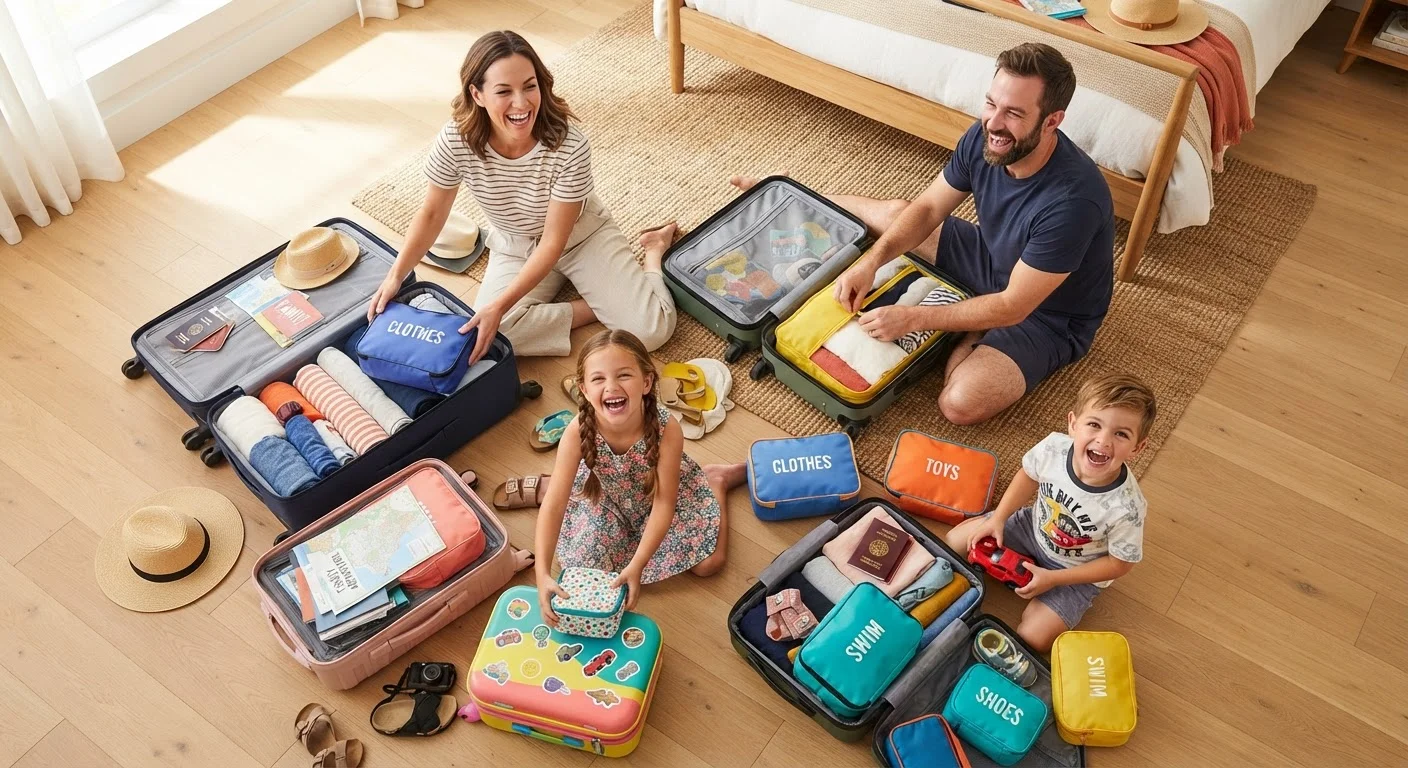
Use packing cubes to organize by person or category, and pack a single shared 'family essentials' pouch.
Rummaging through a shared suitcase for one child's medication or a snack at the gate wastes precious time and raises stress levels. Cubes compress clothes and keep each person's belongings self-contained; a dedicated essentials pouch keeps documents, medications, and snacks immediately grabbable.
Roll clothes instead of folding, and pack outfits as complete sets rather than separates.
Rolling reliably fits more into the same space than flat folding, and pairing complete outfits - top, bottom, and any layers - means you can instantly see how many days of clothing you have without doing mental math in a hotel room.
Pack intentionally light on the outbound trip to leave room for souvenirs and purchases on the way home.
Families almost always acquire things on vacation - gifts, local goods, kids' treasures. Arriving at your departure airport with a bag that's already at its limit means either paying fees or making stressful decisions about what to leave behind.
Do a 'test pack' 48 hours before departure, not the night before.
Packing the night before a flight almost guarantees both overpacking (everything gets thrown in) and forgotten items (you're too tired to think clearly). A 48-hour window gives you time to realize you need to do laundry, that a shoe is missing, or that your child's swimsuit is still at a friend's house.
The Core Habits Experienced Family Travelers Use Every Time
These aren't abstract principles - they're the specific, repeatable habits that translate into lighter bags, calmer departures, and more enjoyable arrivals. Start with one or two that feel most immediately useful, and add others as they become second nature.
For families watching travel costs closely, smarter packing pairs naturally with a smarter budget approach. See how to pack a family trip without paying baggage fees for a practical checklist that keeps you within carry-on limits as a group.
Building a System That Grows With Your Family
The most powerful thing about a packing system is that it compounds. Each trip, you note what you never touched and remove it. You notice what you wished you'd brought and add it. Within two or three trips, your master list starts to feel almost effortless - because it's genuinely calibrated to how your family actually travels.
“The goal of packing is not to bring everything you might need - it's to bring only what you'll actually use and trust yourself to handle the rest.”
— Rick Steves, Travel author and longtime advocate for light, practical packing
As kids get older, hand off more packing responsibility to them. A seven-year-old can absolutely manage their own clothes and a small backpack of entertainment. This isn't just convenient - it builds real-world organizational skills and makes kids feel genuinely invested in the trip.
Once your packing is dialed in, the next layer of smart travel planning is the trip itself. Our guide to shared itinerary tools vs. paper planning helps you figure out which organizational style fits your household best. And if budget is a consideration, family travel on a budget breaks down the planning mindset that makes it genuinely work.
The content provided on our blog site traverses numerous categories, offering readers valuable and practical information. Readers can use the editorial team’s research and data to gain more insights into their topics of interest. However, they are requested not to treat the articles as conclusive. The website team cannot be held responsible for differences in data or inaccuracies found across other platforms. Please also note that the site might also miss out on various schemes and offers available that the readers may find more beneficial than the ones we cover.