

Our Verdict
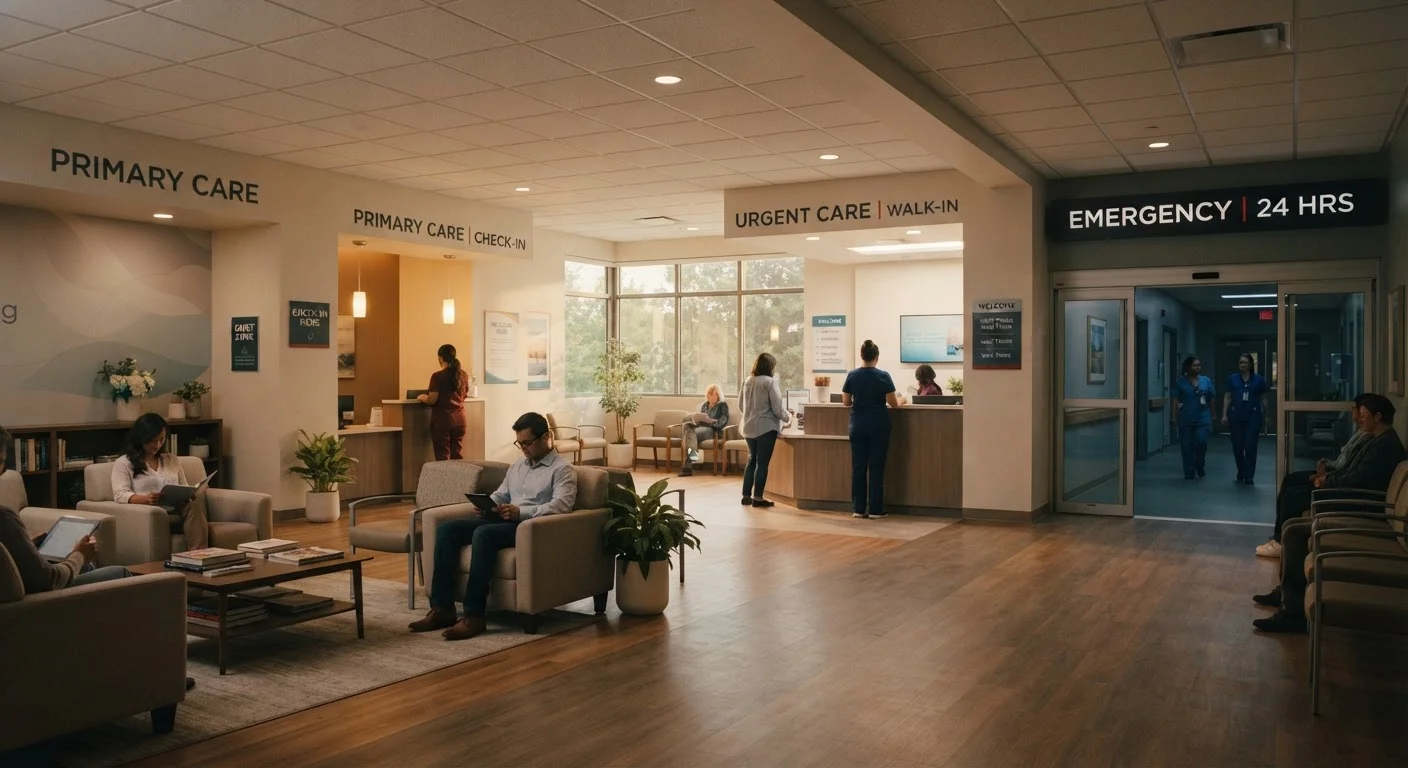
Each care setting exists for a distinct purpose, and matching your situation to the right one leads to better care and fewer unnecessary costs. Primary care handles the foundation of your family's health; urgent care fills the same-day gap; the ER is reserved for true emergencies. When symptoms are unclear, a quick call to your doctor's office or a nurse helpline can guide the decision.
| Best for | Recommended |
|---|---|
| Routine checkups, chronic condition management, and preventive care | Primary Care |
| Same-day illnesses or injuries that aren't life-threatening | Urgent Care |
| Potentially life-threatening symptoms or serious trauma | Emergency Room |
| Uncertain situations where severity is unclear | Call your primary care provider or nurse line first |
Why the Right Setting Matters
When a family member feels unwell or gets hurt, the instinct is often to head straight to the nearest emergency room. In reality, choosing a care setting that doesn't match the situation can mean longer waits, higher bills, and occasionally - if the ER is bypassed when it shouldn't be - delayed critical treatment. Understanding the purpose of each setting helps families make confident, calm decisions rather than reactive ones.
This is general health education to help you navigate common situations. For personal medical concerns, always consult a qualified healthcare provider.
| Primary Care | Urgent Care | Emergency Room | |
|---|---|---|---|
| Best for | Ongoing & preventive care | Same-day non-emergencies | Life-threatening situations |
| Typical wait time | By appointment | Minutes to 1-2 hours | 1-6+ hours (varies) |
| Hours | Business hours + some after-hours | Extended hours, weekends | 24/7 |
| Relative cost | Lowest | Moderate | Highest |
| Advanced imaging/labs | Limited (referral needed) | Basic X-ray and labs | Full diagnostic capability |
| Handles emergencies | No - refer or call 911 | No - stabilize and transfer | Yes |
Primary Care: Your Health Home Base
Your primary care provider (PCP) - whether a family medicine physician, internist, or pediatrician - is the right first call for the vast majority of health needs. PCPs manage ongoing conditions such as asthma, diabetes, or high blood pressure; provide annual physicals and immunizations; and coordinate referrals to specialists when needed.
Primary care is also the appropriate setting for symptoms that have developed gradually, mental health screenings, prescription refills, and follow-up care after a hospital stay. Building a relationship with a PCP over time means they know your history, which often leads to more thorough, personalized care. If you have children, the annual well-child visit preparation guide offers a helpful checklist for making those appointments as productive as possible.
When to choose primary care: non-urgent symptoms, routine screenings, chronic disease management, mental health support, and preventive care.
Urgent Care: The Same-Day Gap Filler
Urgent care clinics exist for situations that feel time-sensitive but are not life-threatening - a sprained ankle on a Saturday afternoon, a child's ear pain late in the evening, a suspected UTI, or a mild fever that needs evaluation today rather than next week. Most urgent care centers offer walk-in appointments, extended hours, on-site X-rays, and basic lab work.
Check Before You Go
Many urgent care centers allow you to check current wait times online or join a virtual queue before arriving. If your primary care office offers same-day sick appointments, calling them first is worth a quick two-minute phone call - you may get seen just as quickly with a provider who already knows your history.
Urgent care is generally faster and more affordable than the ER for eligible conditions. However, these clinics are not equipped for cardiac events, strokes, severe breathing problems, or major trauma. If you arrive with those symptoms, staff will stabilize you and transfer you to an ER.
When to choose urgent care: minor cuts needing stitches, mild to moderate respiratory illness, sprains and strains, minor burns, pink eye, or when your PCP is unavailable and the issue can't safely wait.
The Emergency Room: For True Emergencies
Emergency departments are staffed and equipped around the clock to handle life- or limb-threatening conditions. They carry advanced imaging, surgical teams, and specialists that no other outpatient setting can match. That capability comes with trade-offs: longer wait times when the department is busy, and significantly higher costs - both billed and out-of-pocket.
The ER is the right choice when symptoms could signal a serious, rapidly worsening, or irreversible problem. Common examples include chest pain or pressure, difficulty breathing, signs of stroke (sudden face drooping, arm weakness, slurred speech), severe allergic reactions, uncontrolled bleeding, head injuries with loss of consciousness, and high fevers in newborns under three months. If you ever feel uncertain whether a situation qualifies, calling 911 or heading to the ER is always the safer choice.
Don't Wait on These Symptoms
Certain symptoms always warrant a 911 call or immediate ER visit: chest pain or tightness, sudden severe headache, signs of stroke, difficulty breathing, severe allergic reaction, or uncontrolled bleeding. In these situations, minutes genuinely matter. Do not try to drive yourself - call emergency services.
When to choose the ER: any symptom that could indicate a life-threatening emergency, severe pain, major trauma, or when a child under three months has a fever. Do not drive yourself if you are experiencing chest pain or neurological symptoms - call 911.
A Practical Decision Framework for Families
When a health situation arises, a simple three-question check can help:
- Could this be life-threatening right now? If yes - call 911 or go to the ER immediately.
- Is the issue urgent enough that it can't wait a few days, but not an emergency? If yes - urgent care or a same-day appointment with your PCP.
- Is this a chronic, ongoing, or preventive concern? If yes - schedule with your primary care provider.
Many insurance plans also offer nurse advice lines at no extra cost, available by phone around the clock. These nurses can help triage symptoms and confirm which setting makes the most sense - a useful resource when you're unsure. Having your insurance card and PCP's after-hours number accessible saves valuable time in stressful moments.
Understanding these distinctions is one part of broader health preparedness. Just as it helps to know the real facts about emergency savings, knowing your care options in advance reduces anxiety when situations arise unexpectedly.
This article is for general informational and educational purposes only and does not constitute medical advice. Always consult a qualified healthcare professional for concerns about your health or the health of a family member.
The content provided on our blog site traverses numerous categories, offering readers valuable and practical information. Readers can use the editorial team’s research and data to gain more insights into their topics of interest. However, they are requested not to treat the articles as conclusive. The website team cannot be held responsible for differences in data or inaccuracies found across other platforms. Please also note that the site might also miss out on various schemes and offers available that the readers may find more beneficial than the ones we cover.