

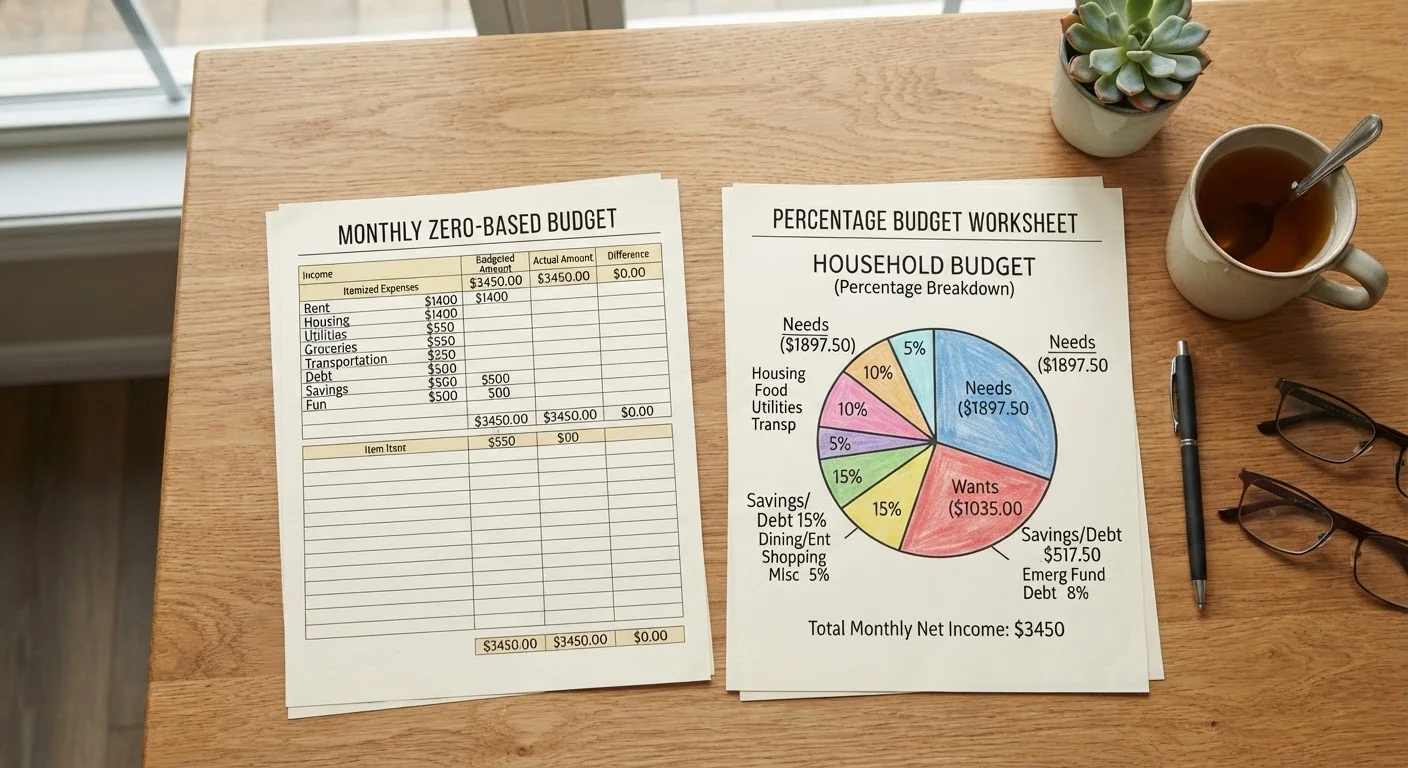
Option A
Zero-Based Budgeting
The meticulous, every-dollar-has-a-job approach.
Best for: Families who want precise control over each spending category and are willing to revisit their plan monthly.
Option B
Percentage-Based Budgeting
The flexible, proportional framework for simpler planning.
Best for: Households seeking a low-maintenance structure that adapts easily to income changes over time.
How Each Method Works
Both frameworks share the same starting point - your total monthly take-home income - but they divide it very differently.
Zero-based budgeting asks you to assign every dollar to a named category until your income minus all allocations equals zero. That zero doesn't mean you're broke; it means every dollar has a deliberate destination, whether that's rent, groceries, a car-repair fund, or retirement savings. At the end of each month, you rebuild the budget from scratch for the next one. For a practical walkthrough of setting spending categories from the ground up, see Your First Family Budget in Seven Steps.
Percentage-based budgeting groups spending into a small number of broad buckets defined by a fixed share of income. The widely cited 50/30/20 rule - 50% to needs, 30% to wants, 20% to savings and debt repayment - is one common version. Rather than itemizing every expense, you track whether each category stays within its percentage target. For a deeper look at how this specific rule holds up in real household situations, see The 50/30/20 Rule and Whether It Works for Families.
| Criterion | Zero-Based Budgeting | Percentage-Based Budgeting |
|---|---|---|
| Core principle | Every dollar assigned to a category | Income split by proportional targets |
| Monthly time commitment | Higher - rebuilt each month | Lower - targets stay fixed |
| Works with variable income | Requires manual adjustment | Scales automatically with income |
| Spending visibility | High - line-by-line detail | Moderate - broad category view |
| Best for debt payoff | Yes - redirects dollars precisely | Possible, but less targeted |
| Learning curve | Steeper for beginners | Gentler entry point |
| Handles irregular expenses | With sinking funds built in | Absorbed into broad categories |
Practical Trade-Offs for Family Households
The gap between these methods becomes most visible when real life gets complicated - an unexpected car repair, a school expense, or a month with three paychecks instead of two.
With zero-based budgeting, a mid-month surprise requires you to find the dollars somewhere in the existing plan: you reduce one category to fund another. That flexibility is built in, but it demands attention. Families with one primary budgeter often find the monthly rebuild takes 30-60 minutes, which is a real time commitment. The payoff is granular visibility: it's difficult for spending to drift quietly when every category has a ceiling.
Percentage-based budgeting is more forgiving of income swings. If take-home pay drops by $400 one month, every bucket simply receives 400 fewer dollars in proportion - no line-by-line recalculation required. The trade-off is less precision. A family spending 52% on needs instead of 50% may not notice the drift until it compounds. This is why many financial educators recommend pairing percentage targets with a monthly budget reset checklist to catch category creep before it becomes a habit.
A Note on Percentage Targets
Common percentage frameworks like 50/30/20 are general guidelines, not universal rules. A family in a high cost-of-living city may find that housing alone consumes 40% of take-home pay, making a strict 50% needs target unrealistic. Treat published ratios as starting benchmarks, then adjust them to reflect your actual fixed obligations. The Family Budgeting Complete Household Reference includes standard expense categories and ratios to help calibrate your targets.
Whichever method you use, the foundational skill is the same: knowing your actual monthly income and your fixed versus variable expenses. If those concepts are still unfamiliar, Family Budgeting from the Ground Up is a useful starting point.
Choosing, Combining, or Switching Methods
These two frameworks aren't mutually exclusive. Some families use percentage targets to set the big-picture structure - say, capping total spending at 80% of income - and then apply zero-based allocation within each bucket for granular control. This hybrid approach can work well once you're comfortable with the basics.
If you're uncertain which to try first, consider your income type and your available time. Stable-income households with time to plan monthly often benefit from the discipline of zero-based budgeting. Variable-income or time-pressed families frequently find percentage budgeting more sustainable. For a side-by-side look at a wider range of household budgeting systems, Budgeting Methods Every Family Should Know covers the broader landscape.
Switching methods mid-year is also reasonable. If you start with percentages and find your discretionary spending vague, moving to zero-based for a few months can sharpen awareness. The goal is a system your household will actually use consistently - because a well-executed simple plan outperforms a theoretically perfect one that gets abandoned by February.
~40%
U.S. adults without a monthly budget
Surveys conducted by the National Foundation for Credit Counseling have consistently found that a significant share of American adults do not follow a formal household budget.
30-60 min
Typical monthly setup time for zero-based budgeting
Personal finance educators commonly estimate this time range for households rebuilding a zero-based plan each month, depending on the number of spending categories tracked.
This article is for general informational and educational purposes only and does not constitute personalized financial advice. Consult a qualified financial professional for guidance specific to your household's circumstances.
The content provided on our blog site traverses numerous categories, offering readers valuable and practical information. Readers can use the editorial team’s research and data to gain more insights into their topics of interest. However, they are requested not to treat the articles as conclusive. The website team cannot be held responsible for differences in data or inaccuracies found across other platforms. Please also note that the site might also miss out on various schemes and offers available that the readers may find more beneficial than the ones we cover.