

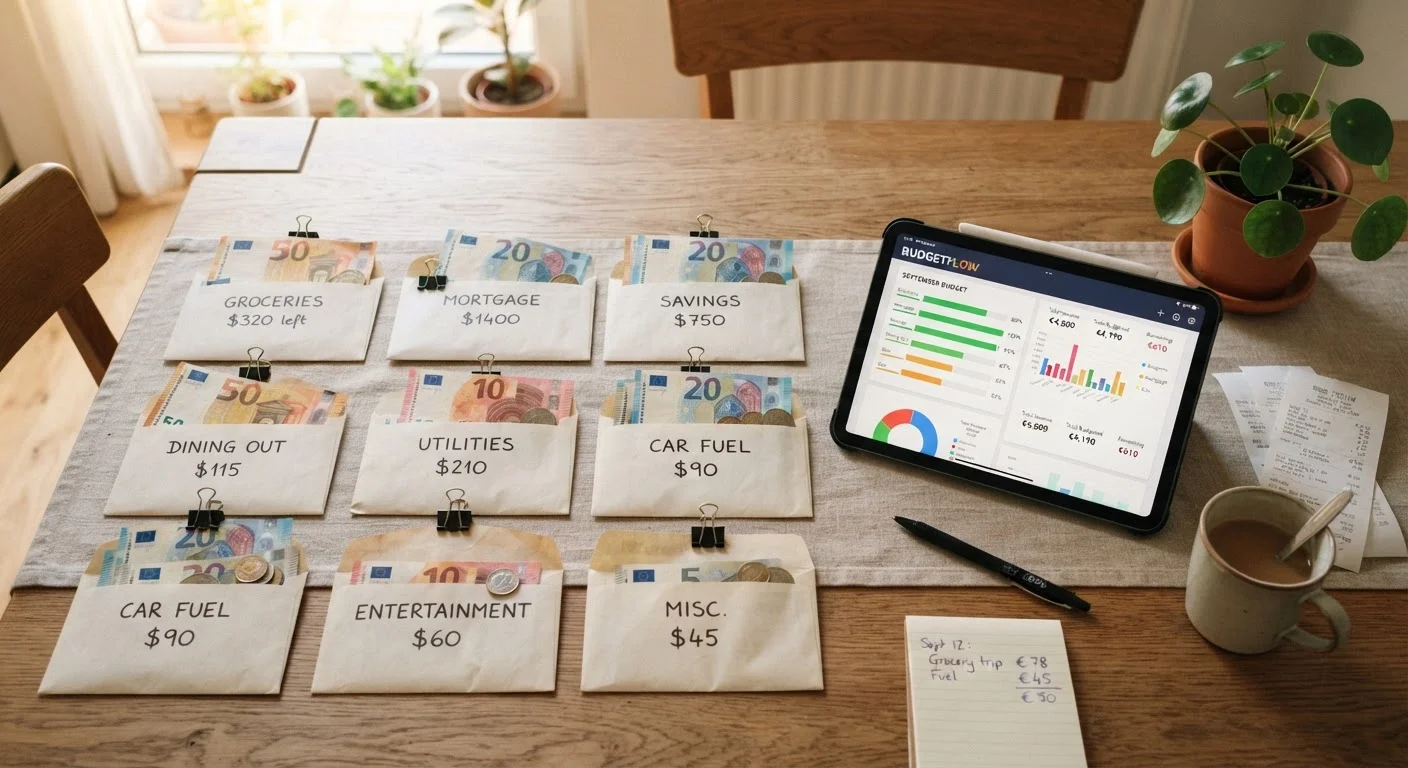
Option A
Paper Envelope Budgeting
The tactile, zero-friction cash discipline system.
Best for: Families who overspend on discretionary categories and need a physical boundary to curb impulse purchases.
Option B
Digital Budgeting Tools
The data-rich, always-available household finance companion.
Best for: Busy households juggling multiple income sources, bank accounts, or shared spending that benefits from automatic tracking.
How Each Method Works
The paper envelope system - popularized by financial educators over decades - is straightforward: each payday, you withdraw cash and distribute it into labeled envelopes (Groceries, Gas, Dining Out, Kids' Activities, and so on). When an envelope is empty, spending in that category stops until the next pay period. No math app required. For a deeper grounding in how category-based budgets work, see our guide on what a family budget actually tracks.
Digital budgeting tools are software applications - desktop or mobile - that connect to your bank accounts and credit cards to automatically import and categorize transactions. You set spending limits per category and the tool alerts you as you approach or exceed them. Some families use spreadsheets as a low-cost digital alternative, which requires manual entry but offers similar structural benefits.
| Criterion | Paper Envelopes | Digital Budgeting Tools |
|---|---|---|
| Setup effort | Low - cash, envelopes, labels | Moderate - account linking, configuration |
| Works for online spending | No - cash only | Yes - tracks all channels |
| Real-time visibility | Manual - check envelope balance | Automatic - syncs transactions |
| Behavioral spending friction | High - cash feels more real | Low - card spending feels abstract |
| Shared partner access | Physical only - whoever holds the envelope | Shared login or app access |
| Cost | Free (possible ATM fees) | Free to paid subscription tiers |
| Historical reporting | None unless tracked manually | Months or years of data |
The Real Strengths of Paper Envelopes
Research in behavioral economics consistently finds that people spend more freely with cards than with cash - a phenomenon sometimes called the pain of paying. Physical cash triggers a stronger psychological response at the moment of purchase, which is precisely why envelope budgeting is effective for discretionary categories like groceries or dining.
There's also zero technological dependency. No app subscription, no syncing errors, no forgotten passwords. For households where one partner is skeptical of budgeting software, a tangible, visible system is often an easier starting point. If your family is exploring different frameworks for the first time, budgeting methods every family should know covers how envelopes fit into the broader landscape.
The primary limitations are practical: cash doesn't work for online bills, subscription services, or fuel at the pump. Families also need to make regular ATM withdrawals, which can be inconvenient and occasionally incur fees.
~$300
Extra monthly spending with cards vs. cash
Behavioral studies, including work cited by the Journal of Consumer Research, consistently find consumers spend materially more when using cards compared to cash for equivalent purchases.
74%
U.S. adults who say they budget
According to a Gallup survey, roughly three in four American adults report following a budget, though adherence and method vary widely across households.
Where Digital Tools Pull Ahead
The standout advantage of digital tools is automation. Rather than manually logging every coffee or school supply purchase, transactions flow in from linked accounts and are categorized automatically. For a two-income household juggling a checking account, a joint credit card, and a savings account, this consolidated view is difficult to replicate with paper.
Digital tools also make it far easier to spot patterns over time - are grocery costs creeping up month over month? Is the car fund on track? That historical data is valuable. Families managing vehicle costs, for example, can use budget tracking to flag rising fuel or maintenance spending; our hub on car costs and savings explores how to keep those expenses in check.
The trade-off: digital tools require consistent review. Automation can create a false sense of control - transactions import, but if no one looks at the dashboard, overspending goes unnoticed. There's also a modest privacy consideration, as linking bank accounts to third-party software involves sharing financial data.
Choosing the Right Fit for Your Family
The honest answer is that neither system is inherently superior - the best budgeting method is the one your household will actually maintain. Consider your family's spending patterns, comfort with technology, and whether most of your discretionary spending happens in cash-friendly or digital contexts.
Many families land on a hybrid approach: using digital tools for fixed bills, subscriptions, and tracking overall cash flow, while keeping cash envelopes for one or two high-temptation categories like dining out or kids' activities. This preserves the behavioral guardrail of cash where it matters most while handling the complexity of modern household finances digitally.
Whichever direction you choose, pair it with a clear understanding of your income and fixed obligations. Our article on family budgeting from the ground up is a practical starting point. And before committing to a strict system, it's worth reviewing the honest trade-offs of strict family budgeting so you enter with realistic expectations.
This article provides general financial education and is not personalized financial advice. Consider speaking with a qualified financial professional about decisions specific to your household's situation.
The content provided on our blog site traverses numerous categories, offering readers valuable and practical information. Readers can use the editorial team’s research and data to gain more insights into their topics of interest. However, they are requested not to treat the articles as conclusive. The website team cannot be held responsible for differences in data or inaccuracies found across other platforms. Please also note that the site might also miss out on various schemes and offers available that the readers may find more beneficial than the ones we cover.