

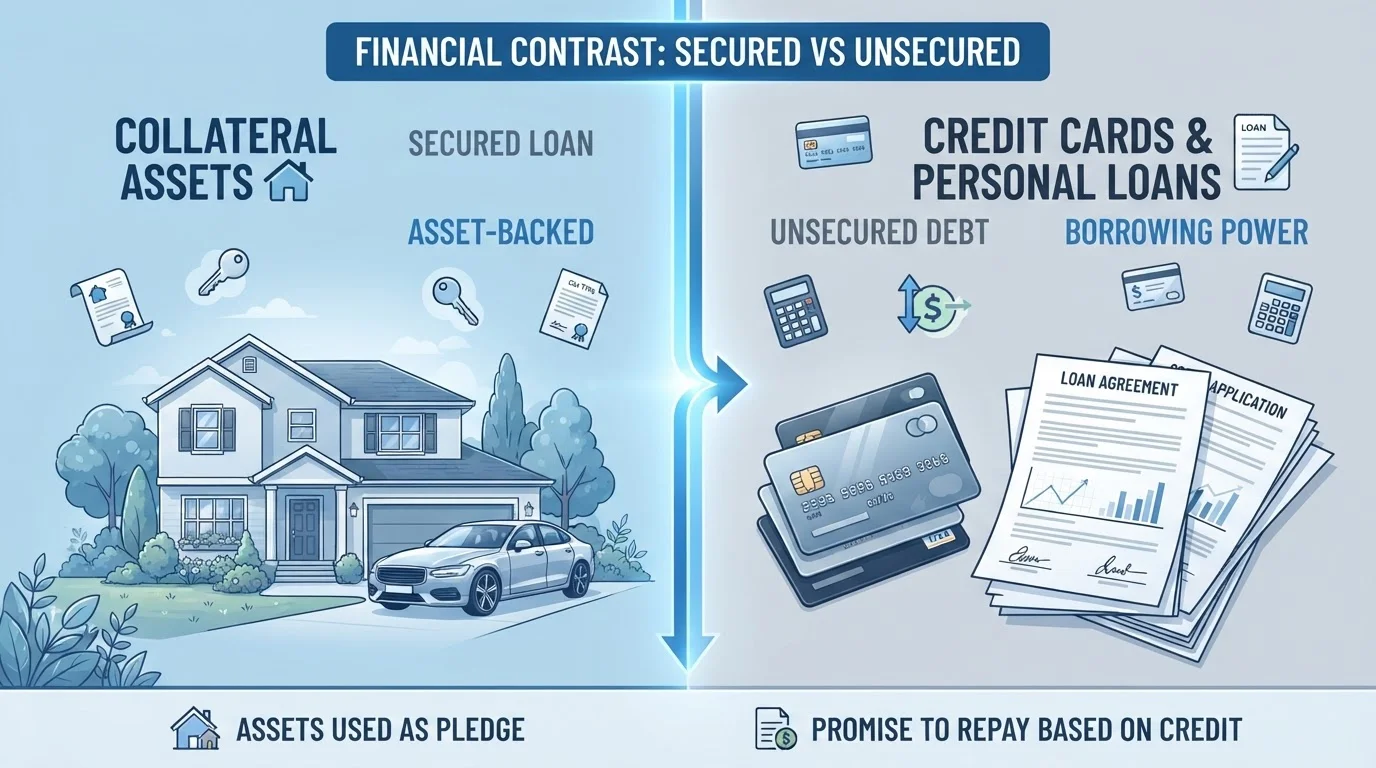
Option A
Secured Debt
The collateral-backed obligation with lower rates and higher stakes.
Best for: Borrowers seeking lower interest rates who can pledge a tangible asset-such as a home or vehicle-as collateral.
Option B
Unsecured Debt
The flexible, collateral-free borrowing with greater accessibility and higher cost.
Best for: Borrowers who need funds without pledging assets, accepting higher interest rates in exchange for that flexibility.
What Makes Debt 'Secured' or 'Unsecured'?
At its core, the distinction comes down to one word: collateral. Collateral is a specific asset you pledge to the lender-your home, your car, a savings account-that they have the legal right to claim if you stop making payments. When collateral backs a loan, that loan is secured. When no asset is pledged, the debt is unsecured.
Common examples of secured debt include mortgages, home equity loans or lines of credit (HELOCs), and auto loans. Common examples of unsecured debt include credit cards, personal loans, medical bills, and student loans. For a plain-language reference to additional terms you may encounter on statements, see the Household Debt Glossary.
This single structural difference-collateral versus no collateral-cascades into meaningful differences in interest rates, borrower risk, and what happens when repayment breaks down.
| Criterion | Secured Debt | Unsecured Debt |
|---|---|---|
| Collateral required | Yes (home, car, savings) | No |
| Typical interest rate | Lower | Higher |
| Common examples | Mortgage, auto loan, HELOC | Credit card, personal loan, medical bill |
| Default consequence | Foreclosure or repossession | Collections, credit damage, possible judgment |
| Lender's recovery method | Seize and sell collateral | Debt collection or court judgment |
| Speed of adverse action | Can be relatively fast | Typically longer timeline |
| Credit score impact on default | Severe and long-lasting | Severe and long-lasting |
The Real Consequences of Default
Understanding default consequences is where the secured-versus-unsecured distinction truly matters for family financial planning.
Secured Debt Defaults
When you fall behind on a mortgage, the lender can begin foreclosure-a legal process that can ultimately result in losing your home. Auto loan defaults typically lead to repossession, often with little warning and little legal recourse for the borrower. These outcomes can happen relatively quickly-sometimes within a few months of missed payments-and the timeline varies by state law and lender policy.
Unsecured Debt Defaults
Because no collateral exists, unsecured lenders rely on other remedies: reporting the delinquency to credit bureaus, selling the debt to a collection agency, or obtaining a court judgment. A judgment can in some circumstances lead to wage garnishment or a bank account levy, depending on your state. These outcomes are serious but generally unfold over a longer timeline than a repossession.
State Laws Shape the Timeline
Foreclosure and repossession timelines, as well as wage garnishment rules, vary significantly by state. Some states require court proceedings before foreclosure; others allow non-judicial processes that move more quickly. Before assuming how much time you have in a hardship situation, verify the rules in your state through a nonprofit credit counselor or legal aid organization.
This difference is why most financial educators advise prioritizing secured debt payments during a cash-flow crisis. Losing your home or car can trigger a cascade of problems-loss of transportation to work, displacement of children from schools-that compound the financial hardship. This is general guidance; consult a certified financial counselor about your specific situation.
Interest Rates and the Cost of Borrowing
Collateral doesn't just protect the lender-it lowers your cost of borrowing. Because the lender can recover losses by seizing an asset, they accept a lower interest rate. Unsecured lenders, facing greater risk of loss, charge more to compensate.
~8-10%
Typical personal loan APR range
Federal Reserve consumer credit data consistently shows personal loan rates well above those of home-secured borrowing products.
~20%+
Average credit card interest rate
The Federal Reserve's quarterly G.19 report tracks average credit card rates, which have exceeded 20% in recent reporting periods.
~6-7%
Typical 30-year fixed mortgage rate range
Freddie Mac's Primary Mortgage Market Survey tracks weekly national averages; rates fluctuate with broader economic conditions.
The gap between secured and unsecured rates can be substantial. A homeowner borrowing against home equity might pay a rate far below what they'd pay on a credit card balance. That spread represents real dollars over time-especially when balances are large or repayment periods are long.
For families financing major household purchases, understanding this cost difference matters. Our article on financing household purchases explores how interest rates and deferred payment terms affect the true cost of big-ticket items.
One important nuance: a lower rate is valuable only if the terms are otherwise sound. Pledging your home as collateral to consolidate credit card debt, for example, converts unsecured risk into secured risk-meaning a default that might have led to collection calls could now lead to foreclosure. That trade-off deserves careful thought, and you should speak with a licensed financial professional before making it.
This article provides general financial education and is not personalized financial or legal advice. Consult a qualified financial advisor, credit counselor, or attorney for guidance tailored to your situation.
The content provided on our blog site traverses numerous categories, offering readers valuable and practical information. Readers can use the editorial team’s research and data to gain more insights into their topics of interest. However, they are requested not to treat the articles as conclusive. The website team cannot be held responsible for differences in data or inaccuracies found across other platforms. Please also note that the site might also miss out on various schemes and offers available that the readers may find more beneficial than the ones we cover.